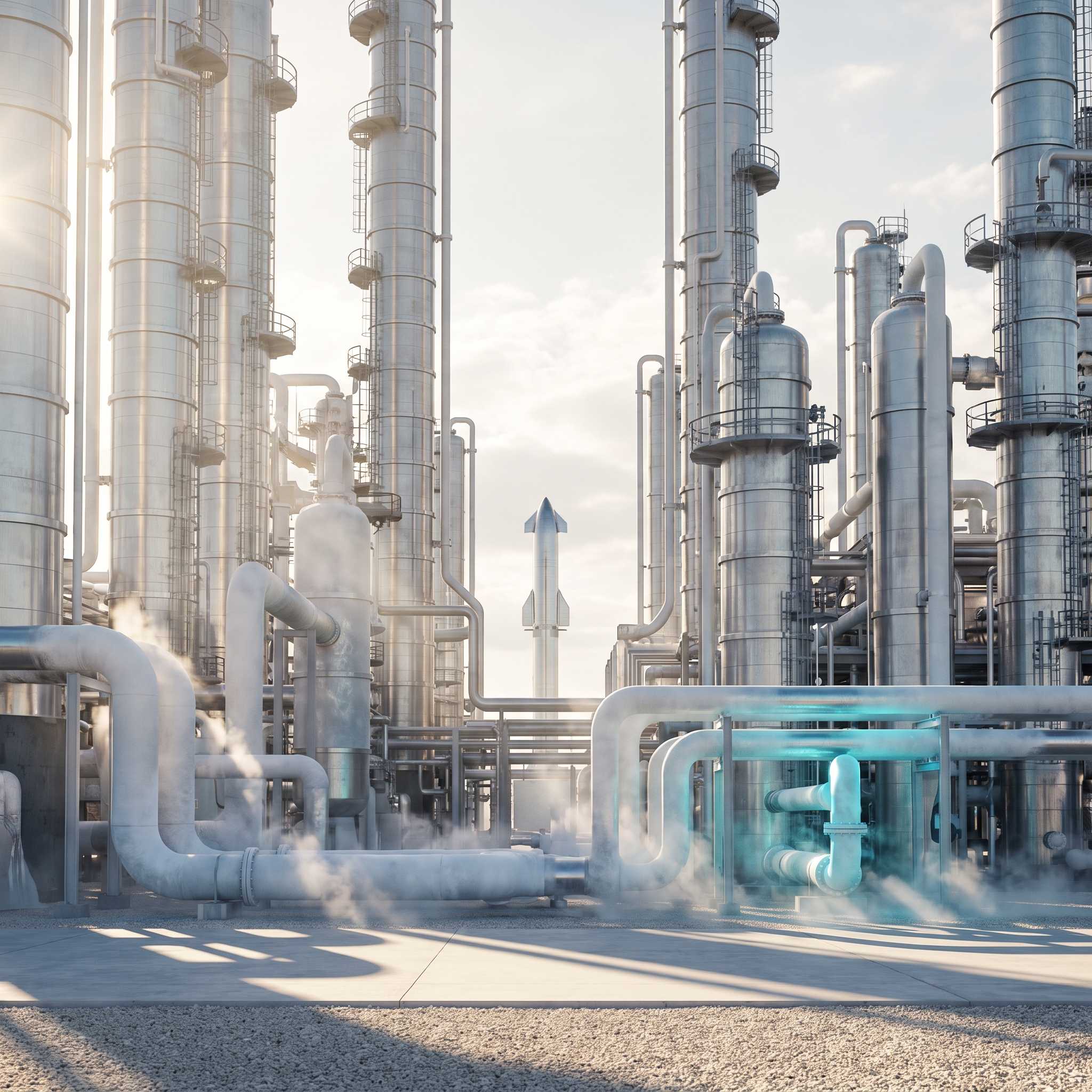
Finn Brooks: Okay, rough week — but then I read about SpaceX's situation at Starbase and it genuinely reset my brain, so I'm choosing to count that as a win.
Clara Bennett: Reset how? What was the thing that landed?
Finn Brooks: Two hundred trucks. More than two hundred tanker trucks of liquid oxygen and nitrogen, rolling down Texas State Highway 4, every single launch. That's the supply chain for Starship right now.
Clara Bennett: Wait — per launch?
Finn Brooks: Per launch! And meanwhile they've built Starfactory — the manufacturing building at Starbase — to crank out one Starship vehicle per day. So the production line is ready. The bottleneck isn't rockets, it's the road.
Clara Bennett: Now that's the part that's interesting to unpack, because SpaceX isn't just complaining about the trucks — they're actually in the middle of solving it. That's what today is really about: the $100 million air separation plant they've contracted Linde to build near Starbase, and whether it actually closes the gap.
Finn Brooks: Right — and the question I can't shake is, if Starbase is this jaw-dropping feat of engineering, how did it launch without on-site cryogenic production in the first place? Like, was that a miscalculation, or did they just move so fast they deliberately left it for later?
Clara Bennett: That's a good place to start — because the answer actually tells you a lot about how Elon Musk and SpaceX build infrastructure.
Finn Brooks: But okay, I keep saying 'air separation plant' like everyone knows what that means — and I genuinely didn't until last week. What is the thing actually doing?
Clara Bennett: Right — so strip the jargon entirely. An air separation plant sucks in regular air, cools it to cryogenic temperatures until it liquefies, then distills out the components. You get liquid oxygen on one end, liquid nitrogen on the other. That's it. You are literally turning the sky into rocket fuel on-site.
Finn Brooks: The sky. The sky is the supply chain.
Clara Bennett: Which is — I mean, the analogy is a brewery next to the restaurant instead of trucking in every keg. The inputs are ambient. You stop being dependent on Highway 4, on tanker scheduling, on whether Linde's fleet is available Thursday morning. Now, the liquid oxygen runs Starship and Super Heavy as the primary oxidizer. The liquid nitrogen is the pressurant. Both consumed in enormous volumes, every single launch. And right now — actually, here's the constraint that matters — SpaceX has one operational launch pad with a second being prepared. Double the pads, you've roughly doubled the propellant demand. The truck model doesn't scale to that. At all.
Finn Brooks: Wait — so the second pad makes the truck problem worse, not just bigger?
Clara Bennett: Exactly worse. Because Highway 4 has finite road capacity. You can't just double the convoy. So without on-site production, the second pad is actually constrained by the same bottleneck as the first — you haven't added throughput, you've added demand against a fixed ceiling.
Finn Brooks: Okay that — no, that reframes the whole thing for me. The Linde plant isn't a nice logistics upgrade. It's the thing that makes the second pad actually functional.
Clara Bennett: That's the foundational fix, yes. The 159-foot tower going up at North Brownsville Industrial Park — the whole point is eliminating a hard scheduling dependency on external suppliers before you even try to talk about eight-day launch cadence. Without it, that cadence claim doesn't survive contact with a road.
Finn Brooks: And that's — okay, that's the partial win I'll take. The trucking bottleneck is real, the Linde plant is the right call. But here's what stings: Linde only broke ground around July 2025. That's, like, two months ago. And the plant doesn't come online until early-to-spring 2026.
Clara Bennett: While Starship flight ten lifted off August 26th. Two days of delays, then it flew — without the plant.
Finn Brooks: Without the plant! So picture a Linde construction crew on a Thursday morning, framing out one of the twenty structures on that 1.66-acre site, and literally across the highway SpaceX just launched the most powerful rocket ever built using a convoy of tanker trucks. That image — I can't get past it.
Clara Bennett: The gap is real. A 159-foot tower isn't built in a quarter. And the eight-day cadence claim is already circulating — Elon Musk has stated it publicly — while the infrastructure that makes it physically possible is still under construction.
Finn Brooks: So the cadence ambition and the infrastructure readiness aren't even on the same timeline.
Clara Bennett: Not yet. And the Cameron County vote — that 3-1 approval for the beachfront construction certificate and the dune protection permit — that wasn't unanimous. Someone said no. Which means the coastal permitting friction is real, it's on the record, and it could resurface.
Finn Brooks: Wait, 3-1? I mean — I assumed that was a formality.
Clara Bennett: One commissioner voted no. That's not a formality, that's a signal. The plant sits 280 feet inland from the dune vegetation line — that's close enough that somebody on the county board decided it wasn't acceptable.
Finn Brooks: And honestly, the air separation plant is just one piece — the Starpipe methane pipeline is also under development, Starfactory is already built. There's a version of this where we're not looking at one project slipping, we're looking at three simultaneous capital bets that only pay off if the launch cadence actually materializes. And that's — we're gonna have to get into that.
Clara Bennett: That's exactly the framing I want to push on — three simultaneous bets — because I think the compounded risk is actually understated. The Linde plant isn't just a standalone fix. Starpipe is also under development. That's SpaceX's planned 8-mile natural gas pipeline running from the Port of Brownsville straight to Starbase, supplying methane for the liquid methane fuel. Target service date: January 2027. They've already filed engineering plans with the U.S. Army Corps of Engineers. So you have the air separation plant, Starpipe, Starfactory at full rate — none of them operational. All three have to work, in sequence, for the eight-day cadence to be real.
Finn Brooks: January 2027? That's — wait, that's after the air separation plant.
Clara Bennett: A full year after, roughly. Which means in practice, even if Linde delivers on time in spring 2026, SpaceX is still trucking in methane — or sourcing it some other way — until Starpipe is live. The oxygen problem gets solved first. The fuel problem trails.
Finn Brooks: Okay I — no, I missed that entirely. I was treating the Linde plant as the whole solution. But it's only half the propellant stack.
Clara Bennett: And here's the part I want to be precise about, because I think the framing gets loose: Linde building this doesn't mean SpaceX is vertically integrating in any real sense. Linde is an external industrial gas company. They're building it, they're presumably operating it. SpaceX is paying a specialist to locate the solution closer to the pad. That is smart contracting — it is not ownership of the supply chain.
Finn Brooks: That's the thing that got me. Dude — SpaceX builds rockets that catch themselves out of the sky, and they outsourced the air plant.
Clara Bennett: Which is actually the right call. Linde is world-class at this — you don't rebuild that expertise from scratch. But it does mean the execution timeline is Linde's, not SpaceX's. And Linde has other clients.
Finn Brooks: So what's the calibrated take? Like, strip the hype — is this a logistics problem being correctly fixed, or is this a structural gap that could actually stop the cadence targets cold?
Clara Bennett: Correctly identified, correctly fixing — but the execution window is tight and the compounded risk is real. The GBIC incentives, the 90 to 100 jobs, Mayor Cowen's welcome — that economic upside is genuine, and it materializes if SpaceX executes. The honest version is: SpaceX has a credible infrastructure plan whose three components are not yet operational and whose payoff depends entirely on a launch cadence that doesn't exist yet either. That's not a reason to dismiss it. It's a reason to track the commissioning dates very carefully.
Finn Brooks: Fine. Fine, I'll say it. 'Just a trucking problem' was maybe a little reductive for a 159-foot cryogenic tower on a beach in Texas.
Clara Bennett: Slightly, yes.
Finn Brooks: But like — we started with two hundred trucks rolling down Highway 4 and somehow ended at, the whole premise of affordable space access depends on whether Linde hits a spring 2026 commissioning date. That's the actual stakes.
Clara Bennett: That's the thing. If Linde delivers on schedule, SpaceX will have quietly solved a logistics constraint that's held aerospace back for decades — not with a rocket, with a factory that separates air. If it slips, that $100 million becomes the symbol for why the eight-day cadence was always a projection and not a plan.
Finn Brooks: The unglamorous sentence that either changes everything or explains everything.