Ben Okonkwo: Good to be back. Hey, I want to lead with something — did you catch the Joey Roulette piece in Reuters yesterday?
Marcus Vale: June 25th. Starpipe. Been thinking about it since six this morning.
Ben Okonkwo: Right, so — interesting thing here — this entire story comes from regulatory filings. The Railroad Commission of Texas, PHMSA. SpaceX filed through an affiliate, Lone Star Mineral Development LLC, and then said absolutely nothing publicly. Reuters asked. They declined.
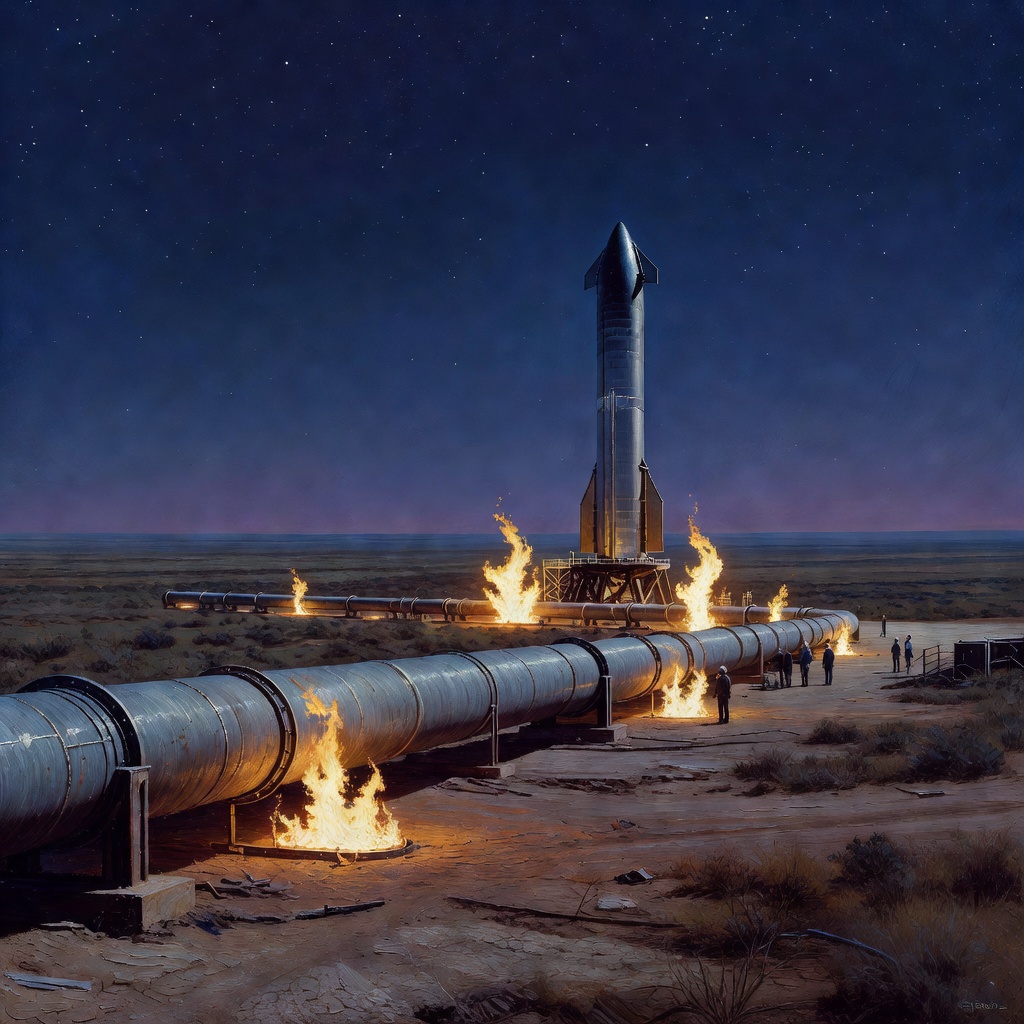
Marcus Vale: Which is itself data. But let's back up — because the why matters before the silence does. Each Starship launch takes 630,000 gallons of liquid methane. Currently delivered by tanker truck. Hundreds of them. Per launch.
Ben Okonkwo: It's — yeah. It's the water-main analogy, right? You don't keep trucking water jugs to a factory once the factory is running at scale. You run a pipe.
Marcus Vale: Exactly. Eight miles, from the Brownsville Ship Channel north shore to Starbase. Construction July 7th, operational January 26, 2027 — that's per the Railroad Commission filings. Elon Musk wants hundreds, eventually thousands of launches per year. The tanker-truck model is physically incompatible with that number.
Ben Okonkwo: Now — do we actually believe January 2027?
Ben Okonkwo: I mean — probably not January 2027, honestly. But that's almost beside the point. The thing that actually surprised me digging into this: Falcon 9 launches roughly 60 times a year. That's two per week. SpaceX never built its own fuel pipeline for that program. Kerosene, third-party suppliers, done. So what makes methane different enough to justify Starpipe at all?
Marcus Vale: Liquefaction. That's the answer. Kerosene ships as a liquid. Methane comes out of the ground as gas — you have to freeze it down to cryogenic temperatures on-site before it touches the rocket.
Ben Okonkwo: Right, and Gwynne Shotwell actually confirmed that — engineering plans for an on-site liquefaction plant at Starbase. So the pipeline alone doesn't close the loop. You need the pipe and the plant.
Marcus Vale: Two-part infrastructure build. Neither works without the other.
Ben Okonkwo: Which is — okay, wait, that's actually what's new here, not the pipeline headline. Everyone ran with Starpipe. But the real story is vertical integration across the whole chain. And meanwhile Starship has completed twelve test launches since 2023. Twelve. The rocket is still the binding constraint, not fuel logistics.
Marcus Vale: Sergio Chapa pulled the route specifics from public filings — sixteen inches in diameter, north shore of the Brownsville Ship Channel straight to Starbase. That detail didn't come from SpaceX. They're still saying nothing. So the headline overstates the certainty and undersells the actual ambition.
Marcus Vale: The bad take that's already circulating — and I've seen it three times this morning — is that Starpipe confirms SpaceX is operating at scale cadence. That the vertical integration play is settled strategy. It's not. Almost everything beyond the pipe diameter and the route comes from Cameron County land records. That's it. Reuters reviewed county filings. SpaceX said nothing.
Ben Okonkwo: Right, and — okay, this is the part that actually matters — Lone Star Mineral Development LLC has no track record operating energy infrastructure. None. Building a natural gas pipeline is a fundamentally different competency than building rockets.
Marcus Vale: That's the load-bearing assumption, yeah.
Ben Okonkwo: And SpaceX's silence isn't confidence — I'd actually flip that. If Musk were certain of January 26th and the full liquefaction plan, there's an announcement. There's a tweet. The radio silence suggests the timeline is — I mean, uncertain internally is the charitable read. The other read is they don't want to be locked into a public commitment they can't control.
Marcus Vale: No, I don't buy the incompetence framing. The Lone Star structure — filing separately with the Railroad Commission and PHMSA — that's deliberate optionality. You build that entity when you're planning to own drilling, liquefaction, maybe eventually trade gas. That's not a company that doesn't know what it's doing. That's a company ring-fencing risk.
Ben Okonkwo: Okay, but — what experiment would have to fail for you to update that? Because right now Starship is twelve test launches in three years. What if Starpipe hits operational in 2027 and SpaceX is still averaging one launch a month? Then you've got stranded infrastructure and a shell affiliate with a pipeline to nowhere.
Ben Okonkwo: That's actually the scenario I keep sitting with. March 2027 — say Starpipe is running, the liquefaction plant is online, Lone Star Mineral Development has delivered the pipe. And Starship is still — I mean, twelve test launches in three years works out to roughly one every three months. What if that number barely moves? You've got eight miles of natural gas infrastructure, an on-site cryogenic plant, and a rocket that still isn't proving weekly cadence. At that point the pipeline isn't a supply chain investment — it's a monument to a problem SpaceX hasn't solved yet.
Marcus Vale: Or it's the right infrastructure at the right moment, laid eighteen months early. AWS wasn't obviously necessary until Amazon needed it.
Ben Okonkwo: Right. So which is it — does Starpipe become the thing that was waiting for Starship to catch up, or does the rocket never actually close the gap that the pipeline was built to solve?