Lila Soto: Long week — but honestly this SpaceX thing has been rattling around my head and I kind of need to say it out loud to figure out if I'm reading it right.
Lila Soto: October 20th — SpaceX launches Bandwagon-5, which turns out to be the 60th Falcon 9 launch of the year from Florida, and then nothing. No more Florida launches scheduled. And the next day, Kiko Dontchev gets up at a fireside chat in Cocoa Village and says, oh yeah, there's a six-week gap coming, it's just infrastructure prep. And I'm like — that's a strange way to describe retiring your most successful rocket.
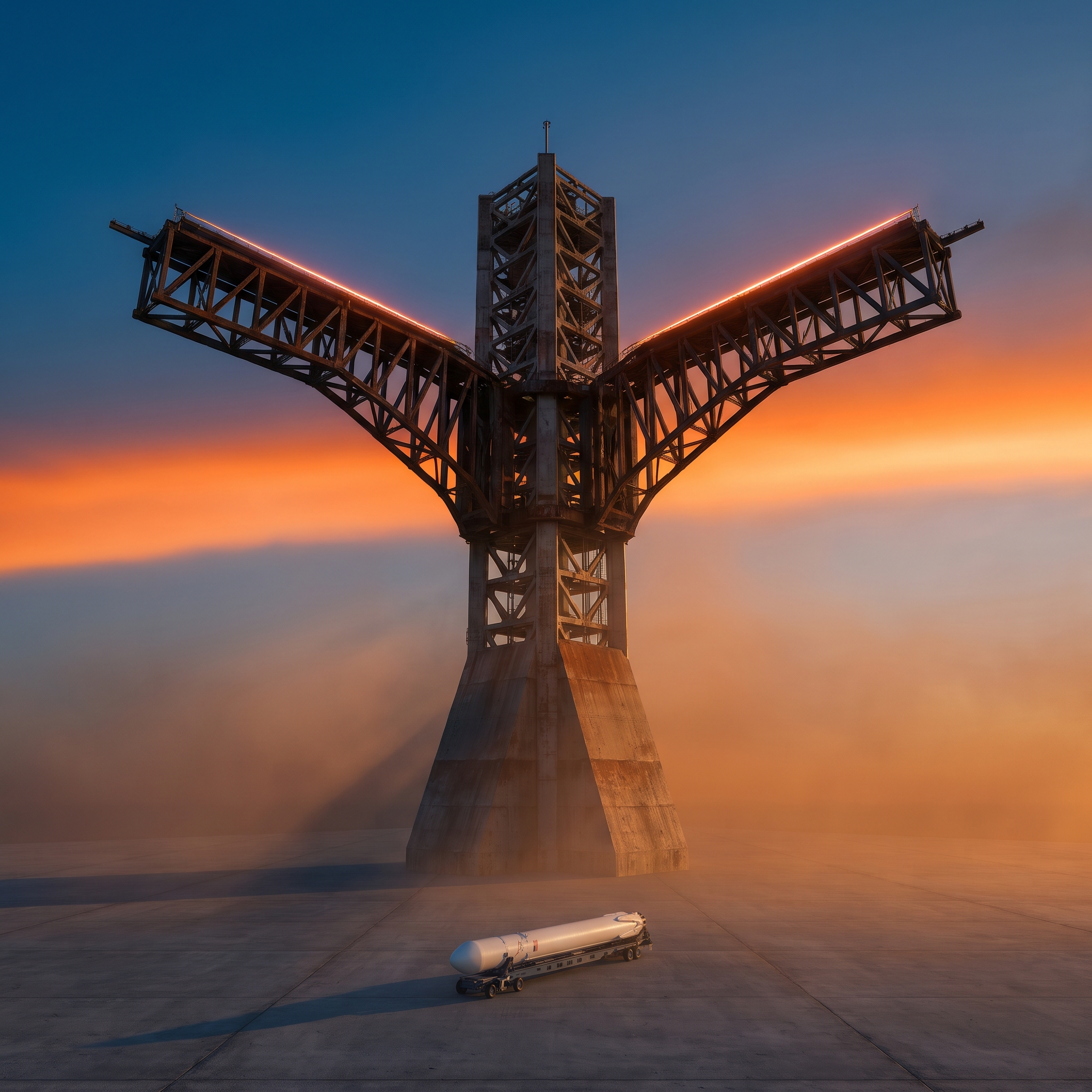
Hugo Vance: The preparation being — converting Pad 39A at Kennedy Space Center for Starship operations.
Lila Soto: They're rebuilding the launchpad for a vehicle that has never launched from Florida. Fourteen Starship flights, all from Boca Chica, Texas. None from here.
Hugo Vance: Well. That's the part I'd want a listener to hold. The stated cause is the pad conversion. But SpaceX has already closed Falcon 9 commercial bookings beyond 2028. So the pause is temporary — the retirement is not.
Lila Soto: It's like your airline stopped selling seats past 2028 and is now saying the runway closure is just maintenance. Those are two different announcements, but they land in the same place.
Hugo Vance: And that gap — between the public framing and the institutional fact — is precisely where this story lives.
Lila Soto: And what makes the framing so strange is — Florida in 2025 was at its highest launch cadence ever. SpaceX alone was 85% of all U.S. launches that year. So the baseline we're dropping from isn't average. It's a record.
Hugo Vance: Which makes the six-week drought not a pause from normal — it's a cliff from a peak.
Lila Soto: Right — but the part that doesn't fit is people keep asking me, couldn't SpaceX just reopen Falcon 9 bookings if Starship isn't ready in time? Like, isn't this reversible?
Hugo Vance: You see, that's the question I'd want to press on. Companies do not close order books for products they intend to keep selling. The booking closure is the tell. Not the pad conversion — the closure.
Lila Soto: So the six weeks is just — the first visible symptom. The actual decision was already made when they stopped taking Falcon 9 bookings beyond 2028.
Hugo Vance: Yes. And the scale of that decision — I mean, when one company holds 85% of U.S. launches, a single internal product-retirement call isn't a corporate scheduling matter. It's carrying geopolitical weight now. Elon Musk's company deciding Falcon 9 is done is effectively reshaping what's available to allied governments.
Lila Soto: Canada. Actual allied nation, booked satellite launches, and now those booking windows are closing with no domestic alternative for years.
Hugo Vance: Which raises the question — and this is where I'd be cautious about treating this as only a logistics story — what does this mean for the customers who needed Falcon 9 right now, not in 2028?
Lila Soto: That's the 'but wait' moment, actually — because everyone's assumption is, okay, SpaceX is constrained, fine, you call ULA. That's what the National Security Space Launch program is built around. Two certified providers. A duopoly with redundancy baked in. Except — Vulcan suffered a solid-rocket booster anomaly in 2026. So ULA's national security launch cadence is already paused.
Hugo Vance: The backup is also down.
Lila Soto: And Audrey Decker at Politico named it directly — October 22nd, 2026 — Space Force tried to book rides for three satellite missions through NSSL. SpaceX said no Falcon rockets. ULA couldn't commit. Blue Origin? No firm Florida launch dates. Three missions. Zero takers.
Hugo Vance: I mean — put a face on that. Someone at the Space Development Agency, satellite is built, it's manifested, the contract is signed. They work down the NSSL certified list. End of the list.
Lila Soto: That satellite is sitting in a clean room somewhere. Not launching.
Hugo Vance: Yes. And the NSSL framework — it was designed assuming you'd always have at least one certified provider available. It has no contingency mechanism for simultaneous constraint on both legs of that duopoly. None.
Lila Soto: So the backup to the backup doesn't exist.
Lila Soto: And the answer you keep hearing is — well, Starship. Which, I mean, that's the part we should get into, because fourteen launches from Boca Chica is real data, but whether that data is the right data for what the Space Force actually needs on that satellite sitting in the clean room — that's a completely different question.
Hugo Vance: And that's exactly the problem — 'Starship will handle it' assumes the thing on the pad can actually carry what needs flying. It can't. Not yet. Starship's payload bay is shaped around flat-stacked Starlink satellites. That's the geometry it was designed for. Military satellites are built on different bus configurations entirely, and those designs are locked in years before the rocket is chosen.
Lila Soto: Can't they just... redesign the satellites to fit?
Hugo Vance: You see, that's the instinct — and it sounds reasonable until you learn what a satellite redesign actually costs. We're talking years. Budget cycles. Congressional appropriations. The satellite sitting in that clean room right now was specced, contracted, and built for a vehicle that existed when the paperwork was signed.
Lila Soto: So Canada is already living that problem. They booked Falcon 9. The booking window closes. There's no domestic alternative — and redesigning around Starship is a multi-year conversation they haven't even started.
Hugo Vance: Yes. And the deeper tension — I mean, this is the part I find genuinely difficult to resolve — SpaceX's model is learn-by-flying. Fourteen Boca Chica launches, iterate fast, tolerate failures in service of speed. That doctrine works. But the Space Force's doctrine is prove-before-flying. Mission assurance. You do not iterate on a national security payload.
Lila Soto: Those are two completely different definitions of 'ready.'
Hugo Vance: And there's no confirmed date for Starship's first Florida launch. Kennedy Space Center, Pad 39A — still mid-conversion. No date. So the question isn't whether Starship is impressive. It is. Fourteen launches is real. The question is whether fourteen test-cadence flights from South Texas is the same as 'certified to fly what the Space Development Agency needs, from Florida, on a schedule the Space Force can plan around.' Those are not the same statement.
Lila Soto: Hm — and the thing underneath all of it is there's no governmental mechanism that can actually slow SpaceX's internal timeline down. Like, who tells them 'hold the Falcon 9 retirement until Starship is certified for NSSL'?
Hugo Vance: Well. Nobody, as far as I can tell. That is the historical break. Saturn V to Shuttle, Shuttle to commercial — in each case a government entity retained the authority to pace the transition. Here, SpaceX's product calendar is the infrastructure calendar. And the gap between those two doctrines — learn-by-flying versus prove-before-flying — that gap has no referee.
Lila Soto: And that's the thing that's been sitting with me since Dontchev said it in Cocoa Village — the unsettling part isn't the six weeks. It's that nobody in government has the authority to say 'keep Falcon 9 available a little longer.' That retirement timeline is entirely SpaceX's. It's a private commercial decision. There's no lever to pull.
Hugo Vance: Yes. And what makes that genuinely new — Saturn V to Shuttle, Shuttle to commercial providers — in each of those handoffs, a government entity held the pacing authority. NASA, the military, someone with a mandate could say: not yet. Here the only calendar that exists is SpaceX's internal product calendar.
Lila Soto: So mid-2027 is the fork, I think. If Starship gets to reliable Florida operations by then — Pad 39A converted, flights actually going up — the Bandwagon-5 launch on October 20th becomes a footnote. The 60th Florida flight of 2025, the last one before the quiet. And if Starship hits delays, that same launch is the moment everyone points back to. 'That's when we found out the system had no reversal mechanism.'
Hugo Vance: And the unsettling part is — we'll only know which one it was in hindsight.
Lila Soto: Yeah. No way to see it from inside the six weeks.
Hugo Vance: Well. I came in thinking this was a logistics story with a national security edge. I don't think that anymore. Good conversation.