Onpode
Cover art for SpaceX is valued at $1.77 trillion but has never turned a profit — can it justify the gap?

SpaceX is valued at $1.77 trillion but has never turned a profit — can it justify the gap?

June 28, 2026 · 6 min

Alex Mercer & Jordan Hale

SpaceX IPO'd at $135/share in June 2026, valuing the company at $1.77 trillion despite a $41.3 billion accumulated deficit and a $4.937 billion net loss in 2025. Starlink is the only profitable division. Morningstar's DCF puts fair value at $63/share — a 59% gap the market has yet to close.

SpaceX completed the largest initial public offering in financial history on June 12, 2026, raising approximately $75 billion at an IPO price of $135 per share, implying a valuation of $1.77 trillion. The company's shares trade on Nasdaq under the ticker SPCX.

0:005:47
Make your own on Onpode

Describe any topic. Hear it in minutes.

More Onpode episodes on SpaceX

About this episode

SpaceX filed its S-1 in late May 2026 — the first public look at the books ever — and what it showed was bracing: a $41.3 billion accumulated deficit stretching back to 2002, and a swing from a $791 million profit in 2024 to a $4.937 billion loss in 2025. The company IPO'd anyway at $135 a share, raised $75 billion, and landed a $1.77 trillion valuation. Morningstar's discounted cash flow analysis puts fair value at $63. That gap is the whole conversation. This episode works through the actual numbers rather than the mythology. Starlink is real — $11.4 billion in 2025 revenue and $4.4 billion in operating profit make it a mature, profitable business. But the market is pricing SpaceX at roughly 150 times that operating profit, which means the valuation is almost entirely a bet on Starship, xAI, and commercial ventures that aren't generating cash yet. The February 2026 xAI merger alone folded $6.4 billion in operating losses into the books, which explains most of the 2025 loss. The episode also traces what happened after IPO: the stock peaked at $2.66 trillion four days in, then pulled back about 30% within two weeks. Analyst targets range from $115 to $401 — a spread that says less about disagreement over assumptions and more about the limits of conventional analysis when a company is priced on story rather than cash flow. Worth a listen if you want to understand what's real, what's speculative, and what the difference costs.

Frequently asked

Why did SpaceX lose money in 2025 if Starlink is profitable?

SpaceX swung to a $4.937 billion net loss in 2025 primarily because Elon Musk absorbed xAI into SpaceX via an all-stock deal in February 2026, folding in $6.355 billion in xAI operating losses and $12.7 billion in capital expenditures. Without that acquisition, SpaceX's financials look fundamentally different.

How much revenue does Starlink generate?

Starlink generated $11.387 billion in 2025 revenue and $4.423 billion in operating profit, making it SpaceX's only profitable division. The market is pricing SpaceX at roughly 150 times that operating profit, meaning the $1.77 trillion valuation depends almost entirely on future Starship and xAI cash flows.

What is SpaceX's accumulated deficit?

SpaceX's S-1 filing, submitted to the SEC in late May 2026, disclosed a $41.3 billion accumulated deficit — meaning the company has never, since its founding in 2002, cumulatively earned enough to offset what it has lost across all years of operation combined.

What is SpaceX's fair value according to analysts?

Morningstar's discounted cash flow analysis values SpaceX at $63 per share, roughly $780 billion total — 59% below the $135 IPO price. Analyst price targets range from $115 to $401, a spread that reflects deep disagreement over whether Starship and xAI will ever generate cash at the scale the valuation requires.

What happened to SpaceX's stock price after its IPO?

SpaceX IPO'd at $135/share on June 12, 2026, peaked at a $2.66 trillion valuation on June 16, and then pulled back roughly 30% within two weeks. The IPO was more than 2x oversubscribed with over $10 billion in institutional orders, and MSCI's inclusion in the Global Standard Index forced additional passive-fund buying.

Grounded in 10 sources
SpaceX (SPCX) IPO: Live updates · cnbc.com
Here’s a Clue About SpaceX’s Actual Revenue-Generating Plans - Gizmodo · gizmodo.com
SpaceX: What Investors Need to Know About Its Enormous ... · morningstar.com
**Motley Fool questions SpaceX $1.77T valuation amid $41.3B losses** · fool.com
Is SpaceX Worth $1.77 Trillion When It Can't Turn a Profit? These 4 Stocks Suggest There's a Better Way to Play Aerospace. | The Motley Fool · fool.com
SpaceX's Week of Extremes: Twin Launches and Index Inclusion Clash with $305 Million Bond Losses · ad-hoc-news.de
SpaceX Targets US$1.77 Trillion Valuation | INN · investingnews.com
Assessing SpaceX Finances, Addressable Market, and the AI Pitch Ahead of IPO - Via Satellite · satellitetoday.com
SpaceX Prices Tomorrow at $135 for the Largest IPO in History — What the S-1 Financials Actually Say · tradingkey.com
**Aswath Damodaran values SpaceX at $1.25-1.35T** · x.ai
Read transcript

Jordan Hale: Okay, I'm going to say something that might sound insane — SpaceX is the most expensive mythology purchase in the history of capital markets. Fight me.

Alex Mercer: Bold opener. Where are you starting from?

Jordan Hale: The S-1. Late May 2026, SpaceX files with the SEC for the first time ever — first-ever public look at their books — and buried in there is a $41.3 billion accumulated deficit. Which means, like, net net, since the very beginning, they've lost more than they've made. Every year, added up. And then June 12th they IPO at $135 a share on Nasdaq, raise $75 billion, and the market goes yeah, $1.77 trillion, sure.

Alex Mercer: And swung from a $791 million profit in 2024 to a $4.937 billion loss in 2025. In one year.

Jordan Hale: Which is — yeah, that's the analogy, right? Your friend made a little money last year. They owe $41 billion in lifetime debt. They lost five billion dollars this year. And they're asking you to hand them $1.77 trillion. That's not an investment thesis. That's faith.

Alex Mercer: Okay. Tell me why you think that's wrong.

Alex Mercer: Because almost all of that loss is traceable to one decision. February 2026 — Elon absorbs xAI into SpaceX via an all-stock deal. That single move folded $6.355 billion in operating losses and $12.7 billion in capex into the books. You pull that out, and you have a fundamentally different company.

Jordan Hale: Wait, so the $4.9 billion loss is basically... it's one acquisition?

Alex Mercer: Primarily, yeah. And look — xAI did generate $3.201 billion in 2025 revenue. It's not nothing. But it lost $6.355 billion operating. That capex intensity, $12.7 billion, it suppresses profitability regardless of what revenue does. The math just doesn't close at current burn rate.

Jordan Hale: Okay but — wait, no — so if xAI is the problem, then Starlink is actually... like, genuinely working? Not mythology?

Alex Mercer: Starlink is real. $11.387 billion in 2025 revenue, $4.423 billion in operating profit. Sole profitable division. That's a mature business. The bulls also point to $6.584 billion in adjusted EBITDA — I think that number is doing a lot of work, but it's not fabricated. The problem is the market is valuing SpaceX at roughly 150 times Starlink's annual operating profit. Morningstar runs the DCF, gets to $63 a share — about $780 billion total — and the IPO priced at $135. That's a 59% gap.

Jordan Hale: Sixty-three dollars. And they opened at a hundred and thirty-five. That's not a rounding error, that's a different religion entirely.

Jordan Hale: But like — okay, here's where I think my take actually lands, you know? The 150x thing. That's not me being dramatic. If Starlink is the only thing generating real cash, and the market is pricing SpaceX at 150 times that operating profit, then the entire $1.77 trillion is a bet on things that don't exist yet. Starship. Orbital compute. The AI play. None of it is producing cash right now.

Alex Mercer: Yeah, that's right. You can't justify the number on Starlink alone. Full stop.

Jordan Hale: And then — wait, this is the part that actually got me — the stock hit $2.66 trillion. Peak valuation. June 16th, four days after IPO. And then pulled back roughly 30% within two weeks. The market basically second-guessed itself in real time.

Alex Mercer: That's not a correction. That's the market doing the math it skipped on day one.

Jordan Hale: But was it even analytical demand driving the IPO price up? Because — I mean, the thing was 2x oversubscribed, over $10 billion in institutional orders. And then MSCI confirms SpaceX for the Global Standard Index, which means every passive fund tracking that benchmark has to buy. Like, they don't have a choice.

Alex Mercer: Structural buying. It amplifies momentum that was already there — it doesn't validate the price.

Jordan Hale: So the partial win for my take is basically — yeah, the enthusiasm was real, the demand was real, but if Starship and xAI never actually monetize at scale, the stock has to converge toward what Starlink is actually worth. And nobody agrees on that number — analyst targets run from $115 all the way to $401. That spread alone tells you this isn't analysis anymore.

Jordan Hale: Okay, maybe 'mythology' was too clean a word for it. Like, Starlink is genuinely real, the demand at IPO was genuinely real — I'll give you that. But the story investors are buying isn't Starlink, you know? It's everything that hasn't happened yet.

Alex Mercer: Half-concession accepted. But here's where I won't budge: Morningstar's $63 — that's a DCF, it's not a vibe, it's discounted cash flows — sits 59% below a $135 IPO price. That gap isn't two analysts disagreeing about the timing. That's a fundamental disagreement about whether SpaceX's commercial roadmap ever generates the cash to justify the number. And underneath all of it, the accumulated deficit is $41.3 billion. Since 2002. The company has never, cumulatively, earned enough to offset what it's lost. That's the floor the narrative has to clear.

Jordan Hale: So SPCX might just be the most expensive story ever told.
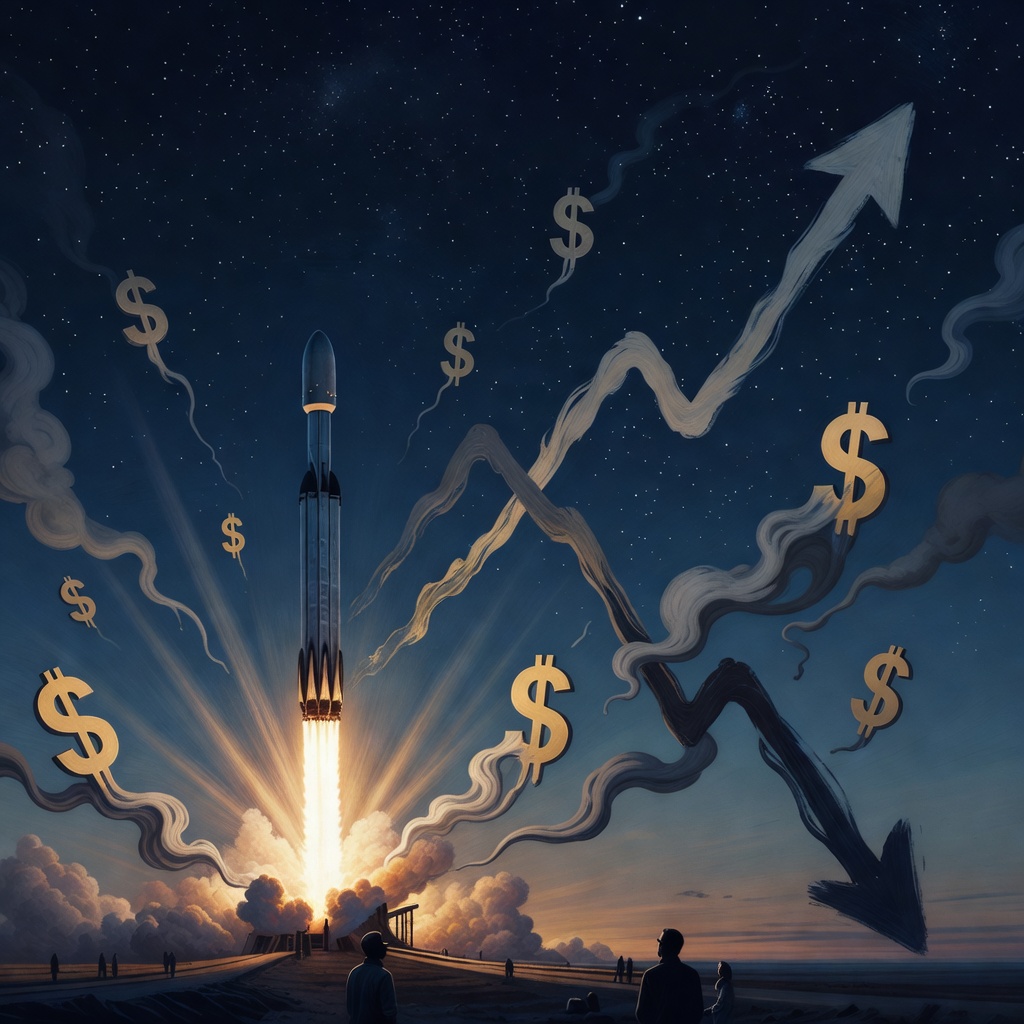
SpaceX is valued at $1.77 trillion but has never turned a profit — can it justify the gap? · Onpode