Finn Brooks: Okay, real quick — before we do anything else — have you ever booked a flight and then gone back to check the price and the route just doesn't exist anymore, no explanation?
Juniper Vale: Once, yeah — it was a red-eye to Denver that vanished overnight.
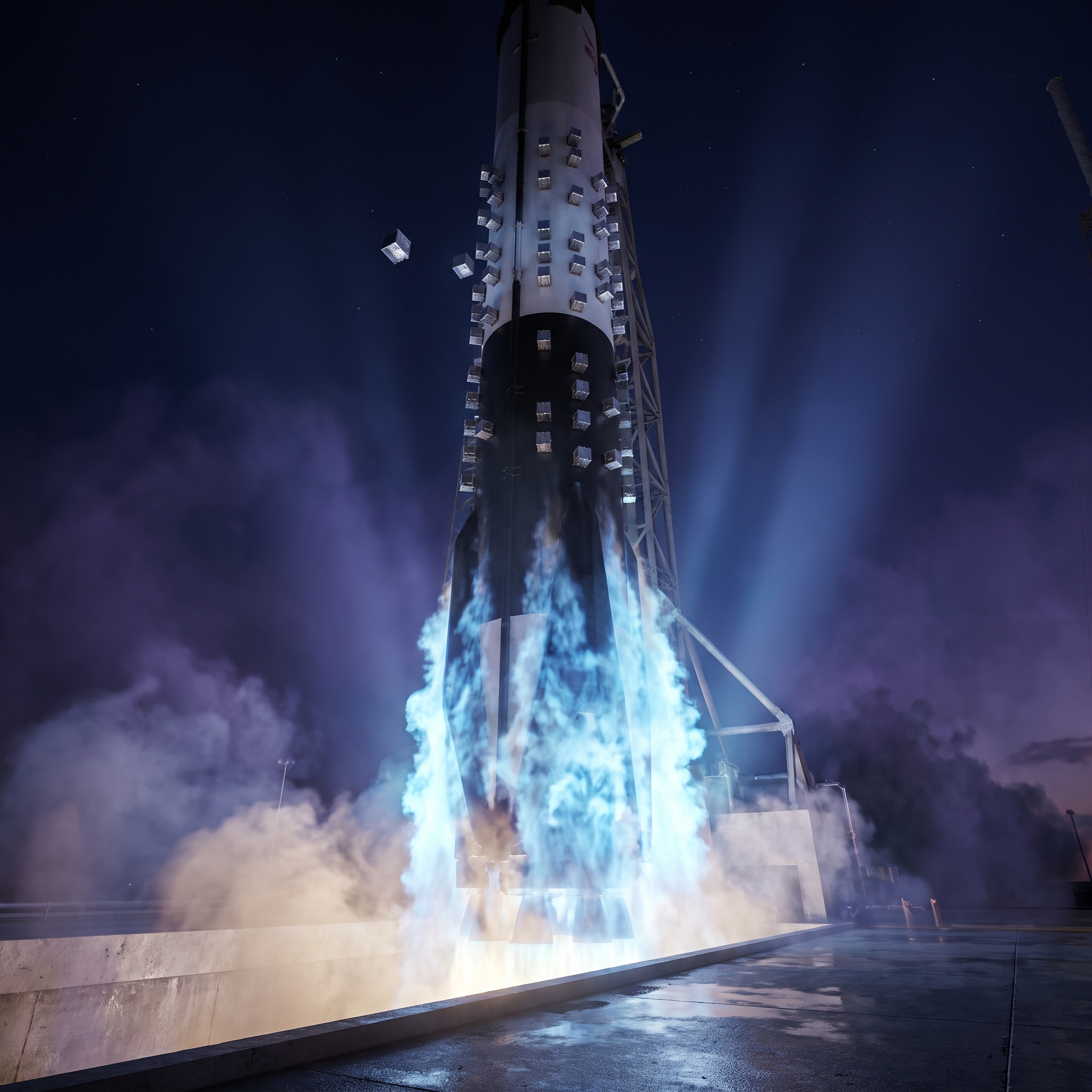
Finn Brooks: Right, so SpaceX just did that to the entire small satellite industry. Transporter-17 lands July 7th — Falcon 9, Vandenberg, eighty-one payloads, beautiful booster recovery on Of Course I Still Love You, eleventh flight on that stage — genuinely a triumph. They tick over 1,800 cumulative payloads delivered for the program. And then the booking page for the next rideshare window is just... not there. No slots through 2028. No statement.
Juniper Vale: And the thing that strikes me is the timing — they didn't close it before the milestone, they didn't announce it after. It just quietly disappeared alongside what should have been a celebration.
Finn Brooks: And this specific mission had BOHR on it — City Labs, the Betavoltaic Orbital High-Reliability satellite, NanoTritium battery, first commercial nuclear-powered payload America has ever put in orbit — like that fact alone should dominate the news cycle.
Juniper Vale: Nuclear-powered. On a rideshare. That's — I mean, let me back up for a second — that's not a small thing. A CubeSat running on nuclear power is a completely different category of what these missions can carry.
Finn Brooks: And the program that made it possible just stopped accepting customers. That asymmetry is what I can't get out of my head.
Juniper Vale: So that's what we're working through today — whether this is a natural pivot or something that leaves a gap nobody's ready to fill.
Finn Brooks: But wait — that asymmetry only hits you if you know the door was even open to begin with. Like, what is rideshare actually doing? Because I think people hear 'eighty-one payloads' and picture a cargo plane, not — I mean, what's the actual model here?
Juniper Vale: Okay, the cleanest way I can put it: imagine a highway that let anyone rent a lane for cheap, no matter how small their car. That's rideshare. SpaceX is going to orbit anyway — Starlink, whatever — and you can buy a seat for your tiny satellite and come along. The whole premise is you don't need your own rocket.
Finn Brooks: Which is why BOHR is the perfect example — City Labs didn't charter a dedicated rocket for a nuclear CubeSat. They hitchhiked.
Juniper Vale: Exactly. And Peter Cabauy at City Labs has said the regulatory clearance on that mission was the breakthrough — getting a tritium-powered payload approved for a commercial rideshare is a different kind of milestone than the payload count. That only happens because the bar to get on the rocket is low enough for a small company to try.
Finn Brooks: What's actually NEW then, because — wait, actually — the 1,800 number, is that the news or is that backwards-looking window dressing?
Juniper Vale: It's real, but it's a rearview mirror. The forward question is whether France, India, the Netherlands, Spain, the US — operators like Spire Global, integrators like SEOPS — whether any of them can book the next slot. And the answer right now is no. No announcement from SpaceX, no posted reason. The highway just has a 'full through 2028' sign that nobody officially put up.
Finn Brooks: No formal statement. That's the part that's genuinely new — not the milestone, the silence after it.
Juniper Vale: That silence is doing real damage, because those operators built plans around a door that closed without a sign. And Arianespace isn't stepping in until 2029 at the earliest. So the gap isn't a delay — I mean, it's structural. That's what the headline missed entirely.
Finn Brooks: But the take going around — and I keep seeing this — is that SpaceX is being villainous. Like, they built the community and now they're burning it. And I want to push back on that, because I think that take is wrong. Not wrong like incorrect wrong, wrong like boring wrong.
Juniper Vale: Walk me through it.
Finn Brooks: Starlink. Starlink is a satellite constellation that runs on — wait, this is the part people skip — Falcon 9 manifest priority. Like, internally, Starlink replenishment is competing with rideshare for the same rocket. So it's not SpaceX being cruel, it's SpaceX choosing between their own constellation and a low-margin program. That's just a spreadsheet. Starship is pulling engineering attention on top of that. So rideshare loses every internal budget fight because it was always third in line.
Juniper Vale: Okay — I don't actually disagree with the math. But the rationality argument has a hole in it.
Juniper Vale: If it's just cold economics — if rideshare is low-margin and Starlink needs the manifest slots — you raise prices. You run it at slower cadence. You don't just ghost the market with no formal statement while operators are trying to plan two years out. That silence isn't rational profit-maximizing, that's — I mean, it's the damaging part. The math I'll grant you. The communication strategy I won't.
Finn Brooks: No, that's — yeah, okay, that lands. Because there's a version of this where they say publicly 'Starship takes over rideshare in 2028, here's what that looks like' and the market can plan. Instead everyone's reading tea leaves off a booking page that just went dark.
Juniper Vale: And that gap is what actually breaks things — which, honestly, is the part we haven't even gotten to yet. Who's left standing when the door's closed and Arianespace isn't ready until 2029.
Finn Brooks: And the door being closed is only half the damage — because the operators who built around Transporter slots, they can't just pivot to Arianespace. Arianespace isn't even operational for European rideshare until 2029 at the earliest.
Juniper Vale: Which is the number that should be everywhere. The smallsat market is projected to keep growing through 2034. Demand goes up, supply just collapsed. That's not a gap, that's a — I mean, structurally, that's a drought.
Finn Brooks: Okay but picture this specifically — a climate-monitoring startup, Series A closed, investors on board, launch manifest built around a Transporter slot in 2027. That slot does not exist. What do they tell the board?
Juniper Vale: They can't answer it. Their deployment schedule, their funding milestones, their data pipeline — all of it assumed a rideshare window that's gone. And Arianespace can't absorb that in time. So you've got a two-to-three-year gap that is real and structural, not a weather delay.
Finn Brooks: RIDE! Space — Valentin Benoit — he's calling for a European-controlled sovereign rideshare program entirely independent of SpaceX. Which is the right instinct.
Juniper Vale: Years too late, though.
Finn Brooks: Years too late, yeah — because sovereignty as a concept doesn't help the university physics department whose next deployment window just evaporated. Like, a sovereign program doesn't exist yet, Arianespace isn't ready until 2029, and the gap starts now.
Juniper Vale: So what you actually watch for — consolidation. The operators who can't survive a two-year limbo fold or get acquired. The ones with runway pivot to dedicated small-launch providers, pay more, slow down. And whoever's still standing when Arianespace comes online in 2029, or whenever Starship rideshare actually materializes — those are the ones who get to play in the next era.
Finn Brooks: And the wild thing is Transporter-17 — eighty-one payloads from France, India, the Netherlands, Spire Global, SEOPS, a nuclear CubeSat — was basically the high-water mark. The program democratized access, proved it worked, and then the door closed on the exact people it created.
Juniper Vale: And that's the part I can't quite resolve — whether SpaceX knows it built something it's now quietly dismantling. Like, did they intend that? Does it matter if they didn't?
Finn Brooks: I mean — I keep landing on the same spot and I don't love it. The 81 payloads on Transporter-17, the BOHR satellite, researchers from four continents on a single Falcon 9 — that was the thing. That specific configuration of scrappy, weird, multinational access. And the question I genuinely can't answer is whether that still exists in 2029, or whether by the time Arianespace is operational and Starship rideshare is actually a thing, the operators who made it that way are just... gone. Consolidated out. Funded out. Waited out.
Juniper Vale: Yeah. I don't think anyone knows.
Finn Brooks: Which is a genuinely uncomfortable place to leave it. But I think that's where it actually is.