Marcus Vale: Ben, good — you caffeinated? Because I've got a number I want to hand you and I need your brain actually on.
Ben Okonkwo: Two coffees in, hit me.
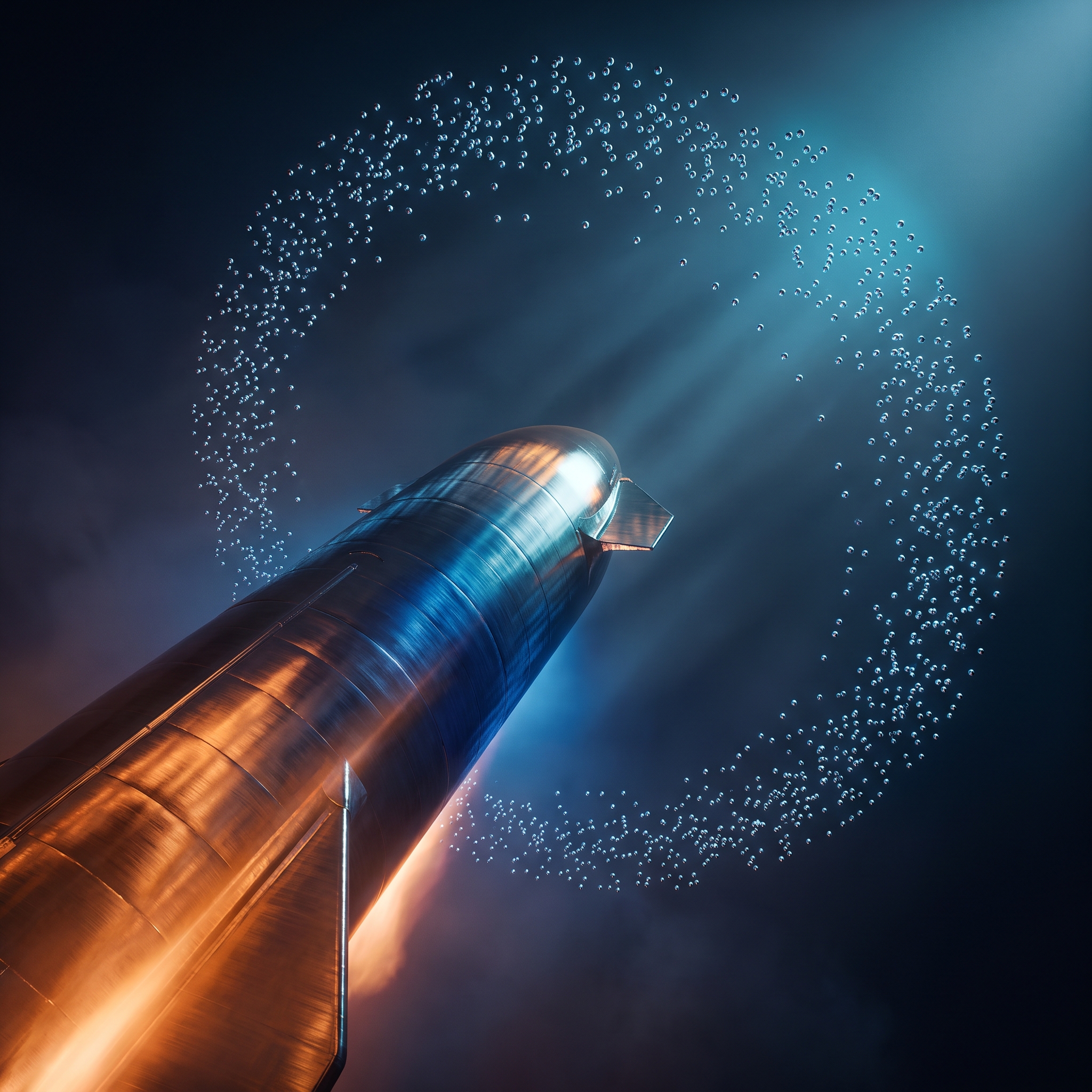
Marcus Vale: September 28th, 2026. Starship Flight 14 goes up, deploys 26 Starlink V3 satellites — first operational V3s ever placed in orbit — and Morgan Stanley's Adam Jonas looks at the throughput and says one of those flights equals somewhere between one and more than two months of Falcon 9 Starlink capacity. One. Flight.
Ben Okonkwo: Wait — more than two months? That's not incremental, that's a different category of vehicle entirely.
Marcus Vale: Right. So the instinct is — okay, if that's real, what's the debate? And yet SpaceX's analyst price targets run from $75 at Phillip Securities to $800 at Raymond James. That's not a disagreement. That's two analysts pricing two completely different companies.
Ben Okonkwo: Ten-to-one spread on the same asset — I mean, what's the load-bearing assumption that explains that gulf? Because it can't just be launch vehicle uncertainty.
Marcus Vale: It's the gap between demonstrated capability and required cadence. Starship has done this — operationally — twice. Twice is not a pattern. Twice is a very exciting data point.
Ben Okonkwo: So the whole valuation argument basically hinges on whether Flight 14 is a preview or a proof. And right now we genuinely don't know which one it is.
Marcus Vale: Preview or proof — that's the right frame. But before we get to cadence, let's just nail down why the throughput gap exists at all, because I don't think the raw physics of it is obvious.
Ben Okonkwo: Right — okay, so think of it this way. Falcon 9 is a fleet of sedans running deliveries across a city. Reliable, every one goes out, comes back, goes out again. Starship is a cargo container truck. One truck trip moves what ten sedans move. That's the multiplier. Not magic — just volume per trip.
Marcus Vale: But what's actually in the truck? What makes a V3 satellite worth ten sedan trips?
Ben Okonkwo: Each Starlink V3 satellite delivers roughly one terabit per second of capacity. One satellite. The V2 Minis on Falcon 9 — I mean, they're not even in the same class. So when Flight 14 dropped 26 V3s on September 28th, that was approximately 26 terabits of capacity added in a single launch. In one flight.
Marcus Vale: 26 terabits. From one flight.
Ben Okonkwo: In one flight, yeah. And that's — wait, that's not even the ceiling. Starship's theoretical maximum is 60 V3 satellites per flight. Sixty. So if SpaceX gets there, one Starship run is roughly 60 terabits of new capacity. That's why Adam Jonas at Morgan Stanley said one mission equals one to more than two months of Falcon 9 output — he's not rounding up, that math actually lands.
Marcus Vale: Okay but — sixty is theoretical. We've flown twenty-six once. What's the delta between twenty-six and sixty, mechanically? Is that a Starship problem or a satellite manufacturing problem?
Ben Okonkwo: That's — honestly, that's the question I don't think anyone has cleanly answered yet. Could be payload fairing constraints, could be how fast SpaceX can actually build V3s at the factory. The throughput multiplier is real, but it only matters at scale — sixty per flight means nothing if you're producing twenty-six satellites a launch cycle.
Marcus Vale: Which is exactly where the cadence argument bites. The truck is big enough. The question is whether the factory can keep it full.
Ben Okonkwo: Right — but keeping the truck full isn't even the hardest part. Picture the ops manager at SpaceX the morning after Flight 14. Spreadsheet open, 26 satellites logged, and she's staring at a column that says 7,500 in orbit by October 7, 2032. That's the FCC hard floor. Fifty percent of the licensed 15,000-satellite constellation. And she's doing the arithmetic on one flight.
Marcus Vale: The math doesn't close. Not even close.
Ben Okonkwo: No, it doesn't. Gwynne Shotwell said on the Q2 2026 earnings call that Starlink Mobile V2 is the near-term Starship priority. So Starship isn't first in line to build the V3 constellation. It's first in line to launch Mobile V2.
Marcus Vale: Which are different satellites. Mobile V2 — large, next-gen mobile connectivity hardware, can only fly on Starship. So you've got Starship carrying Mobile V2, Falcon 9 still running V1 and V2 Mini deployments, and somehow the V3 constellation also needs to get to 7,500 by 2032. Those are three simultaneous programs.
Ben Okonkwo: Has anyone publicly resolved how those share engineering bandwidth?
Marcus Vale: Nobody has. And frankly — that's not a physics problem, that's a management problem. Which is the kind of thing that actually sinks infrastructure timelines. John Hodulik at UBS pointed out that vehicle catching and the Louisiana spaceport are what unlock a steadier Starship cadence. Louisiana. That spaceport is still under construction. The infrastructure required to sustain the cadence needed to meet the FCC clock doesn't fully exist yet.
Ben Okonkwo: So the 2032 deadline is real — FCC doesn't move that date — but the launch infrastructure to hit it is still being built in parallel with the actual launches.
Marcus Vale: And the 2035 deadline for 100% is sitting right behind it. Miss the 2032 floor publicly and you've got a regulatory disclosure moment that no amount of analyst modeling papers over.
Ben Okonkwo: That analyst modeling question — the $75-to-$800 spread we mentioned at the top isn't a normal valuation disagreement, and what Starlink's $4.3 billion in profitability does and doesn't prove for that math is something we need to pull apart.
Marcus Vale: The profitability number is real — $4.3 billion of SpaceX's $7.8 billion in Q2 2026 revenue, only profitable operating segment they have. That part is settled. What it doesn't prove is anything about 2031.
Ben Okonkwo: Right — and that's the crack in the valuation logic. Raymond James gets to $800 by projecting $837 billion in revenue by 2031. That's not a price target, that's almost — I mean, that's a different company than the one generating $7.8 billion today.
Marcus Vale: Phillip Securities at $75 is essentially saying: capex is crushing, customer concentration risk is real, and none of the Starship upside is bankable yet. Those aren't crazy inputs.
Ben Okonkwo: They're not even disagreeing about discount rates — they're modeling different execution realities.
Marcus Vale: TD Cowen's John Blackledge splits the difference — $200 target, Buy rating — but his thesis is weirder than either extreme. He's projecting AI compute leasing as the majority of SpaceX revenue by Q1 2027. That's not a satellite story at all.
Ben Okonkwo: Wait — majority by Q1 2027? That's, what, two quarters from now? What experiment would have to fail for Blackledge to pull that call?
Marcus Vale: That's the right question and I don't think he's answered it. But the EchoStar piece compounds this — SpaceX acquires that 800 MHz block, 65 MHz of low-band spectrum, folds it into Starlink Mobile. FCC license transfer still pending. And T-Mobile is sitting there watching a competitor potentially absorb spectrum that strengthens a direct rival.
Ben Okonkwo: Hm — and BofA flagged that SpaceX's existing spectrum position is actually thin, unresolved interference trade-offs still on the table. So the EchoStar deal isn't just upside, it's filling a hole. The market may have already repriced T-Mobile's competitive position for a deal that isn't closed.
Marcus Vale: Pricing in a spectrum moat that hasn't cleared the FCC. That's the bet — and it's sitting inside every one of those targets, priced differently.
Ben Okonkwo: And that's — I mean, that's actually the thing that settles for me after all of this. The profitability is real, the throughput multiplier math is real, Flight 14 actually happened. But one flight is not a reusability data point. One flight is a single entry in a launch log.
Marcus Vale: The $75-to-$800 spread closes when the launch log says so. Not when an analyst says so. The next handful of Starship missions — those are the thing that forces every model to update. Raymond James, Phillip Securities, all of them. The log either fills or it doesn't.
Ben Okonkwo: And if cadence stalls, the FCC 2032 milestone becomes the disclosure. SpaceX can't hide a launch shortfall from a regulator counting satellites in orbit.
Marcus Vale: Nope. That one's public by definition.
Ben Okonkwo: Good place to land, I think. Appreciate you walking through the actual numbers — the 26 terabits, the FCC clock, all of it. Felt like we actually got somewhere.