Cole Bryant: Dude. You look like you've been staring at a chart for six hours.
Jonathan Ingles: I have been staring at a chart for six hours.
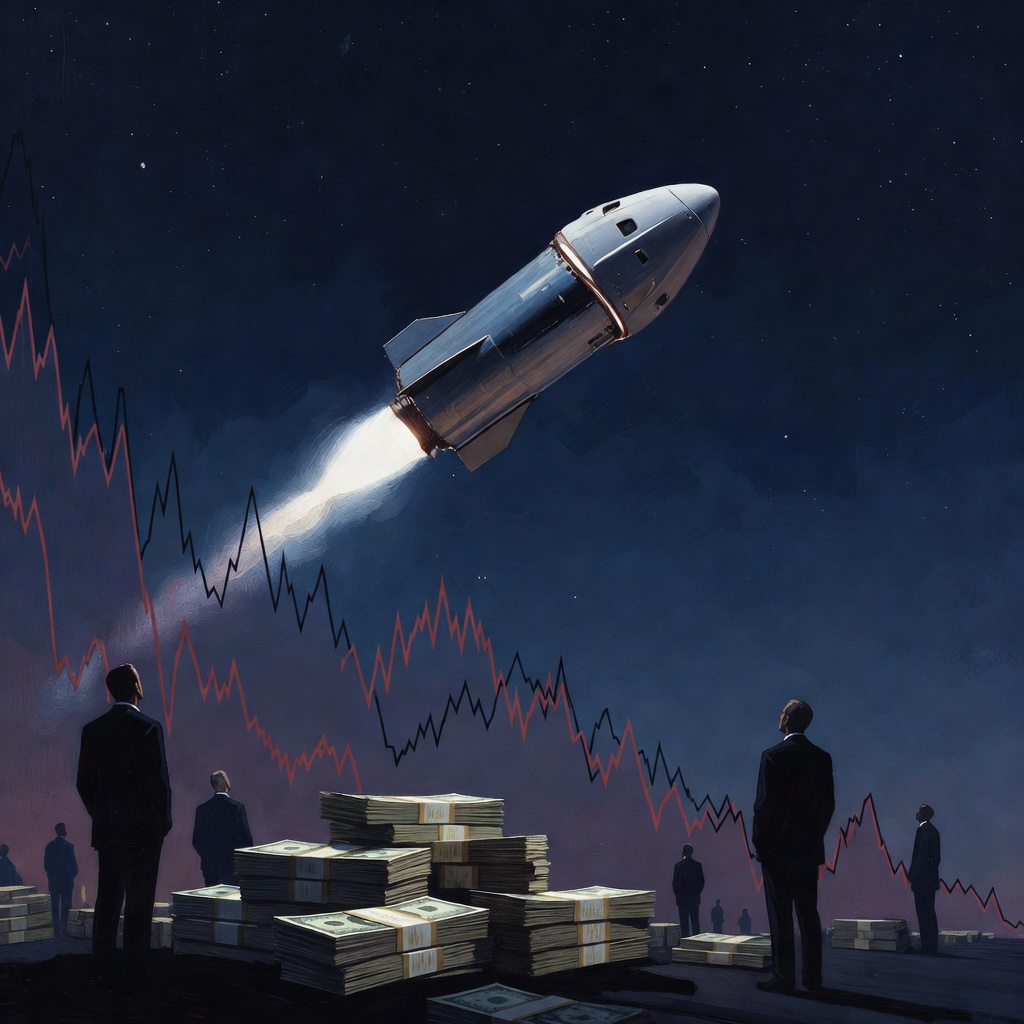
Cole Bryant: Wait, no — I can't get past this. SPCX opens June 12th at $135. That's the IPO price on Nasdaq, largest IPO in history, $75 billion raised. Fine. First day closes at $160.95 — that's a 20% pop, that's normal hype stuff. But then — bro — four days later, June 16th, the stock hits $225.64. That is 67% above the price it was four days ago. SpaceX is now bigger than Amazon. Bigger than Microsoft. Elon Musk is literally, on paper, the world's first trillionaire. And then — June 22nd — it's at $154. $620 billion in market cap just... gone. So my question is: which number was real?
Jonathan Ingles: None of them.
Cole Bryant: None of them?
Jonathan Ingles: Look, if $225 was irrational exuberance — and it was — then $154 is also a narrative. You don't get to call the top a story and the bottom a fact. Both numbers are untethered from cash flows. SpaceX has no public earnings to anchor any of this. So the people saying 'the market corrected' are just as deluded as the people who bought at $225 thinking they'd found fair value.
Cole Bryant: Okay but wait — something specific had to crack it. Like, it didn't just... drift down.
Jonathan Ingles: June 17th. SpaceX announces a sixty billion dollar all-stock acquisition of Cursor — an AI code editor. Equity investors looked at that and said: you just went public four days ago, raised seventy-five billion dollars, and your first major move is a sixty billion dollar bet on AI software? That's not a space company anymore. That's the tell.
Cole Bryant: Sixty billion? For a code editor?
Jonathan Ingles: All-stock. Then — ten days after the largest IPO in history — SpaceX prices twenty-five billion dollars in corporate bonds. Their first ever bond sale. And here's the analogy: imagine a friend maxes out their credit card buying their dream house. Then two weeks later takes out a second mortgage. That's not confidence. That's a capital need the first transaction didn't solve. The IPO didn't close the gap. It just opened a window to layer debt before the window shut.
Cole Bryant: And debt investors — they handed them eighty-nine billion in orders while the stock was actively falling. I mean — wait, that's almost four times oversubscribed. That's not a coincidence, that's two completely different verdicts on the same company at the same moment.
Jonathan Ingles: Because debt investors don't care about Mars. They want a fixed yield and a senior claim if it all goes wrong. Frankly, the bond demand isn't bullish on SpaceX — it's bearish on the equity. And Musk spent years saying public shareholders would corrupt the mission. Now they exist. That tension is live.
Cole Bryant: But wait — here's where I think my take actually holds. The greenshoe. Underwriters exercised the overallotment option — lifted total proceeds from $75 billion to $85.7 billion. That's not incidental. They looked at $225 and said: extract maximum capital right now, at peak enthusiasm, before this reverses. That's — I mean, that's a designed outcome, right? The machinery was built to do exactly what happened.
Jonathan Ingles: That's correct. The structure optimized for extraction at the peak.
Cole Bryant: And retail got caught holding it. Because — okay, picture a Fidelity fund manager, Tuesday June 17th, she's watching SPCX at $225. She's up billions on paper. She knows the Cursor acquisition just dropped. She doesn't short SpaceX — you can't, really — so she shorts Rocket Lab to hedge. And Rocket Lab has done nothing wrong. Nothing. That's the contagion.
Jonathan Ingles: Bear ETFs surged on exactly that dynamic. Space sector peers getting shorted for exposure that has nothing to do with their fundamentals.
Cole Bryant: And then Tesla drops too — which pulls Musk below trillionaire, which is its own insane sentence to say out loud — and $620 billion evaporates sector-wide in days. SPCX actually dipped below its first-day opening price in premarket. The IPO pop was fully erased.
Jonathan Ingles: So the $89 billion in bond demand isn't bullish for the retail buyer at $210. They got structurally harvested.
Cole Bryant: That's — yeah. That's actually where I land. SpaceX survives fine. The business is fine. Debt investors are saying exactly that. But the IPO was built to do this to whoever bought above the opening price.
Cole Bryant: But then — okay, wait — does that pattern just become the template? Like, if Anthropic goes public next year, if OpenAI goes public, do investors just... price in the crash now? Like they know the pop is coming and they know the correction is coming and they're just — I mean, is that the new normal or is that the new trap?
Jonathan Ingles: Analysts are already saying the SpaceX correction could worsen market conditions for every large company planning a mega-IPO. And they're right, for the wrong reason. The problem isn't that investors learned caution. The problem is they learned the pattern. The pop is priced in. The extraction window is priced in. So whoever goes public next — Anthropic, OpenAI, whoever — retail shows up expecting sixty-seven percent in four days, institutions sell into it, and the bag lands exactly where it landed with SPCX. Musk spent a decade saying public shareholders would corrupt the Mars mission. The twenty-five billion dollar bond offering is the honest answer to why he went public anyway. It wasn't a change of heart.
Cole Bryant: So the hot take was right, just for completely wrong reasons.
Jonathan Ingles: The next founder who says going public would destroy their mission is telling you exactly when they're going public.