Brian Reed: Hey. Were you up at six-thirty this morning?
Eliza Ward: I was not. Should I have been?
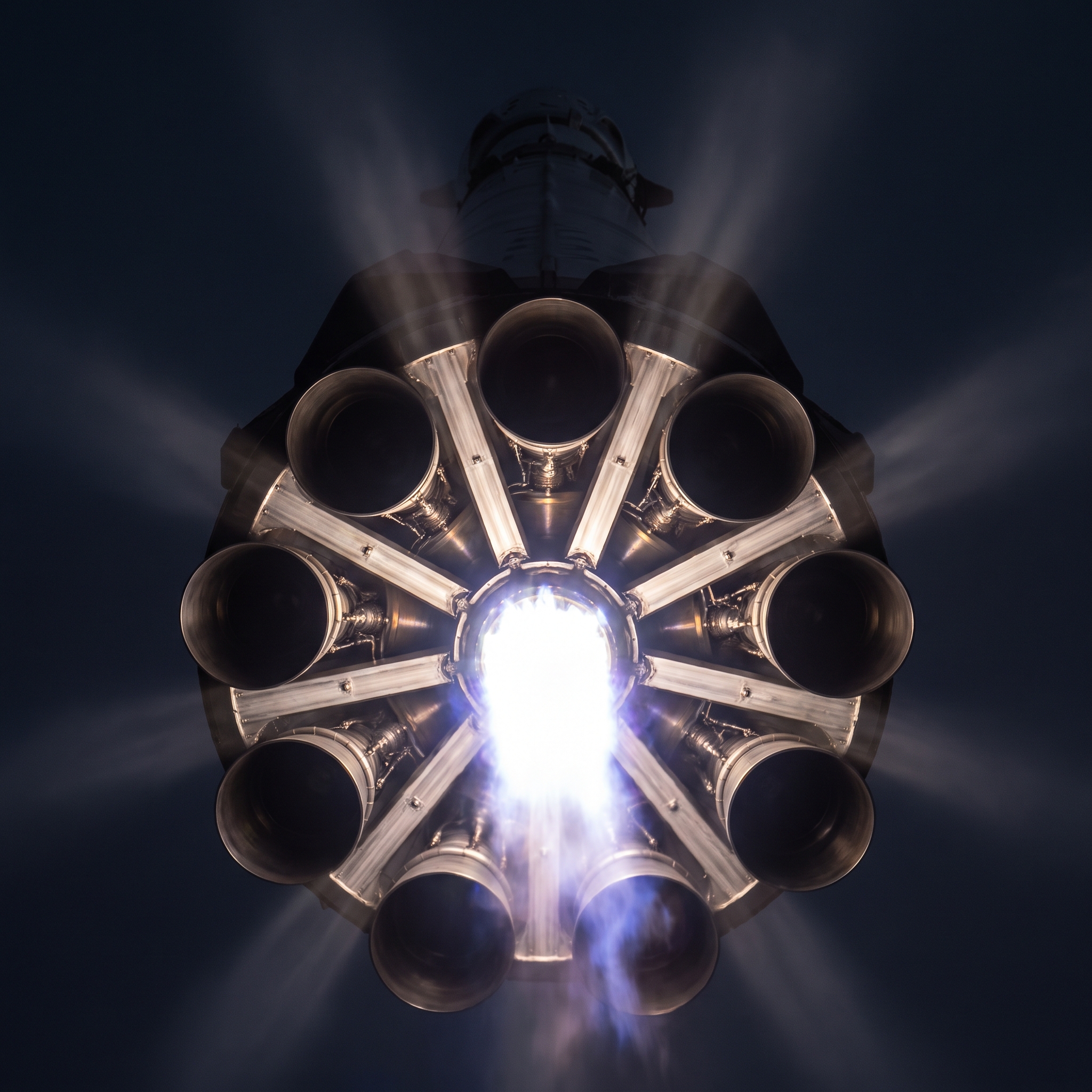
Brian Reed: SpaceX put a Falcon 9 off SLC-40 at Cape Canaveral — six thirty-three, give or take — Dragon's on its way to the ISS right now. CRS-35. Thirty-fifth commercial resupply mission under the NASA contract.
Eliza Ward: And docking hasn't happened yet.
Brian Reed: Right — targeted for Thursday morning, roughly eleven a.m. Eastern. October fifteenth. So as of right now, Dragon is just... en route. No anomalies reported through yesterday.
Eliza Ward: Okay, but the part I don't want to skim past — there are iROSA arrays on this one. The seventh and eighth. That's the full set for the ISS.
Brian Reed: The last two. Out of eight total.
Eliza Ward: Yeah — and more than sixty-three hundred pounds of cargo total, so it's not just the arrays. But those are the piece that actually closes something. The first six iROSA blankets went up starting June 2021. This finishes it.
Brian Reed: Five years to close an eight-array set. That's the part that doesn't fit the routine framing.
Eliza Ward: Think of it like — okay, imagine you've been running your house on partial power for five years. Flickering lights, can't run everything at once. Arrays seven and eight are the last breakers you flip. The house doesn't get bigger. It just stops bleeding electricity it was already counting on.
Brian Reed: And NASA's published nothing about a phase two.
Eliza Ward: Nothing. The October 7th launch preview — NASA laid out the science payload in detail, the retina manufacturing hardware, the 3D heart tissue models for drug testing — but on power? The ceiling is just... set. No next phase mentioned.
Brian Reed: Wait — heart tissue models?
Eliza Ward: Yeah. Microgravity lets you grow biological structures — heart tissue, retinal cells — that you actually can't replicate on the ground. Gravity interferes with how the cells assemble. So Dragon's carrying hardware to do that manufacturing in orbit.
Brian Reed: So the science payload is genuinely new — I mean, that's not background. But the headline everybody ran was 'sixty-three hundred pounds of supplies.' The iROSA completion is, what, the one concrete thing that doesn't repeat next mission?
Eliza Ward: That's — yeah, exactly that. The supplies come back. The Dragon comes back — this vehicle's already flown to the ISS three times before this. B1096 is on its eighth flight. All of that repeats. The iROSA set closing? That doesn't. Spacewalks scheduled late October, early November — once those arrays are bolted on, the power story is done.
Brian Reed: And 'done' means fixed. Not expandable. That's the signal buried in the manifest.
Eliza Ward: Fixed — and that's the word I want to push on, because the take running around right now is 'thirty-five missions in, commercial resupply is mature.' And I think that's — wait, actually mature is doing a lot of work there that it shouldn't be.
Brian Reed: The booster number is the thing that's been sitting with me. B1096. Eighth flight. Previous missions — NASA's IMAP, CRS-34, NROL-77, NROL-95, GPS-III 9, Kuiper Falcon 01, Starlink 6-87. That booster has been to orbit eight times and nobody in the general coverage mentions it at all.
Eliza Ward: Because it landed. It always lands now.
Brian Reed: Right, and that's — I mean, that's the problem. It's become invisible. The Dragon's on its fourth ISS flight. The booster's on its eighth. Two Dragon missions to the ISS in under two weeks. And the coverage treats all of that as background, not story. But invisible doesn't mean invulnerable.
Eliza Ward: No, and — hang on, here's where the 'mature' frame actually breaks. The CRS program replaced the Space Shuttle after 2011. Reduced dependence on Roscosmos. Those are real structural wins. But what NASA did was trade one concentration for another. One company. One docking port on Harmony. Dragon still has to hit that autonomous approach Thursday at eleven a.m. Eastern and — that hasn't happened yet.
Brian Reed: It hasn't. And if that slips — even six hours — what does that actually do to six people waiting on those supplies?
Eliza Ward: We don't know. That's the honest answer. The cadence is real — two missions in under two weeks is operationally intense. But cadence is not the same as resilience. Those are different things.
Brian Reed: And Crew-14 is targeting Spring 2027 — so the ISS operational calendar is already stacked, already depending on this pipeline holding. One anomaly on a Harmony docking approach and you start pulling on a thread that goes a lot further than one delay.
Eliza Ward: Which is why the docking Thursday morning matters more than the launch did — and the iROSA spacewalks in late October and November, what a fixed power ceiling actually means for what NASA can run on the station going forward, that's the part that needs a harder look than the mission got.
Brian Reed: And that harder look starts Thursday at eleven — because until the port locks with Harmony, none of the science aboard even begins. Think about the researcher who spent the last two years designing that retinal tissue manufacturing hardware. She's watching the docking tracker Thursday morning, not a launch replay. The launch already happened. The clock for her doesn't start until Dragon physically connects.
Eliza Ward: That's the actual stakes of 'targeted for eleven a.m. EDT.' Not a scheduling note. A start gate.
Brian Reed: Right — and then the iROSA spacewalks, late October, early November. That's when 'fixed' becomes physical. The arrays get bolted on, and the power ceiling stops being a budget line and becomes a wall.
Eliza Ward: And I want to be precise about what 'wall' means — because NASA hasn't described it that way publicly. What they've said is the iROSA installation completes the upgrade. What they haven't said, loudly, is: there is no phase three. No further expansion currently planned. The October 7th preview doesn't mention one.
Brian Reed: So we're inferring 'closed' from the absence of a next announcement.
Eliza Ward: We are — and that's the honest version of it. What's confirmed: eight arrays, installation completes late October to early November, no subsequent phase in any published NASA document. What we're inferring is that 'no phase announced' means 'no phase coming.' That could be wrong. But nobody has named a phase three.
Brian Reed: And with Crew-14 training now for Spring 2027 — I mean, that operational calendar implies NASA is running the station as-is for at least another year and a half, maybe longer. Every mission in that window depends on a fixed power budget and one docking port.
Eliza Ward: Which is why the spacewalks in late October and early November are the real endpoint of a five-year project — not a maintenance item. When those two blankets go in, that's it. That's the ceiling, set.
Brian Reed: So the two things to actually watch: eleven a.m. EDT Thursday, Dragon and Harmony. Then the October-November spacewalks. And after those — what NASA says, or doesn't say, about what the station can actually run at that power level going forward.
Eliza Ward: And that's — actually, that's where I want to leave it, because the honest version is: we don't have a verdict. Thursday at eleven a.m. EDT, Dragon either docks clean with Harmony or it doesn't. That's not inference. That's just the next fact we don't have yet.
Brian Reed: And if it slips — even a few hours, not a catastrophe — do we still call this mature infrastructure? Or do we start asking what margin NASA actually built into a model where one port, one company, one docking window is load-bearing for six people and a multi-year science agenda running through Spring 2027 and Crew-14?
Eliza Ward: I don't think we can answer that until something actually slips. Which is — wait, that's the uncomfortable part. The model looks robust right up until the moment it doesn't.
Brian Reed: Crew-14, Spring 2027. That's the next hard data point. If the pipeline holds clean from Thursday's docking through those October-November spacewalks and into that crew rotation — NASA will call it mature and they'll probably be right. If anything breaks in that window, the word 'mature' is going to need a rethink.
Eliza Ward: Thursday morning, then. That's where we are.