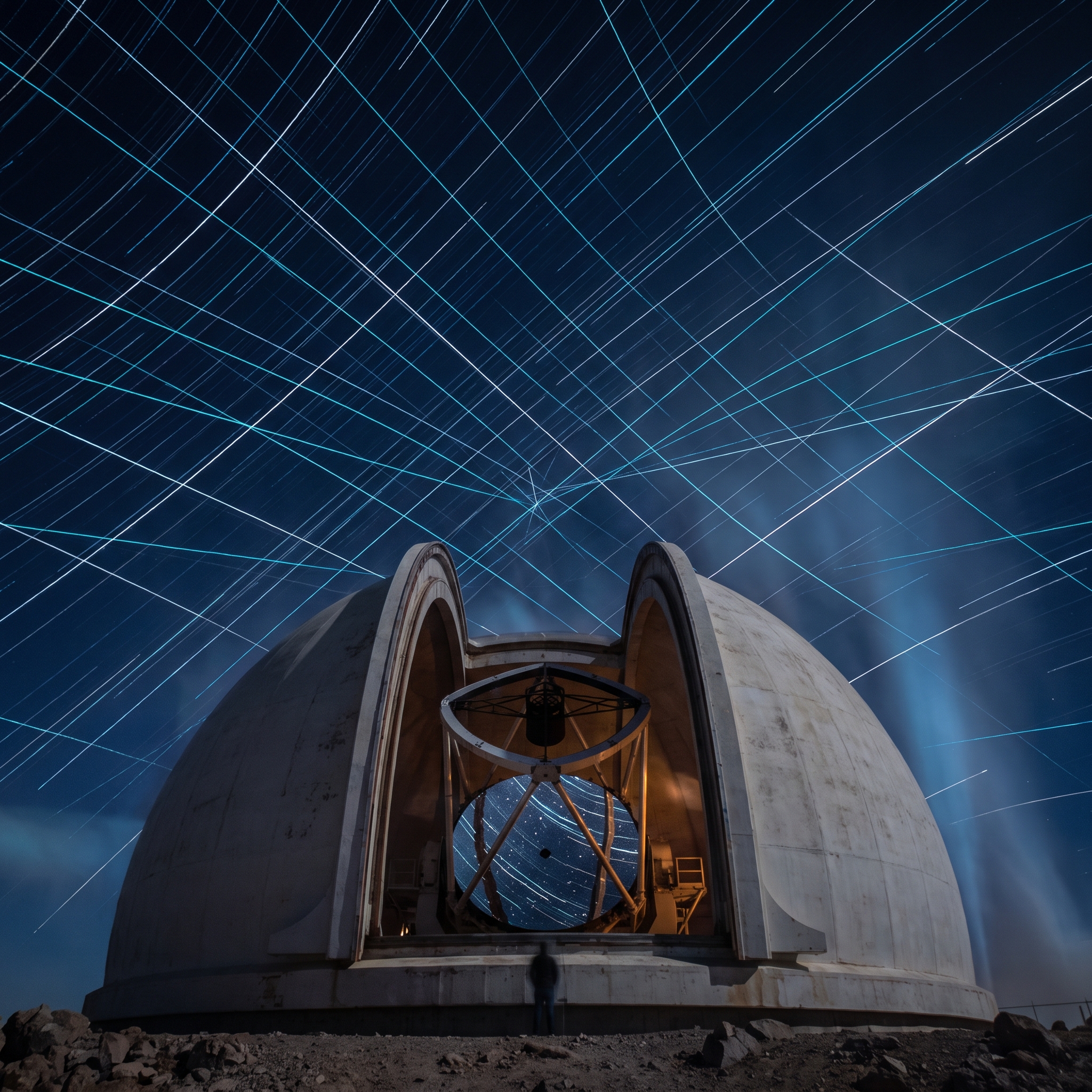
Juniper Vale: You had that look when you walked in — the one that means you've found something that either delights you or deeply upsets you.
Hope Sterling: Both. It's both. Okay so — wait, no, let me just start with the thing — the European Southern Observatory released a study on July 1st, like four days ago, and the lead astronomer is Olivier Hainaut, and they calculated a specific number. One hundred thousand satellites. That is the ceiling. Stay under it, ground-based astronomy survives. Go over it—
Juniper Vale: And we're over it already?
Hope Sterling: Not yet — but the filings are. There are proposals totaling over 1.7 million satellites already sitting with the FCC. SpaceX filed for up to approximately one million Starlinks alone. The study found that would brighten the night sky by 300%. Not a little brighter — three times brighter. Betty Kioko from the ESO used the phrase 'existential threat.' Tereza Pultarova basically said 'astronomy would be dead.'
Juniper Vale: Hold on — 300% is a real number, not just dramatic framing?
Hope Sterling: It's in the study. Published, peer-reviewed, accepted by Astronomy and Astrophysics. That's the thing that's messing with me — the science is done. They have the threshold. They ran the models. And one regulator — the FCC — is holding literally all the decisions right now. Like, is there any world where the FCC looks at 1.7 million satellites and says 'yeah, fine'?
Juniper Vale: I mean — that's the episode, isn't it. Whether 'existential threat' is the right frame, or whether we're talking about something more like slow degradation that nobody notices until it's too late.
Hope Sterling: Okay but — slow degradation is still kind of terrifying? Like, that framing almost makes it worse because nobody sounds the alarm until it's already gone.
Juniper Vale: That's fair — but I want to be precise about what 300% actually means mechanically, because 'existential' and 'severely impaired past recovery' are doing different work. Here's the intuition: imagine you're a photographer trying to capture a candle flame from across a football field. The candle is there, it's real — but someone is slowly turning up stadium floodlights around the whole field. You don't just get glare on one shot. The entire sky behind the candle gets washed out. That's what a million satellites in low orbit do. And it's actually two separate problems happening at once.
Hope Sterling: Wait — two problems?
Juniper Vale: Discrete trails — a satellite physically streaks across your image and ruins that frame. But then there's general sky glow, which is all those satellites scattering sunlight diffusely, constantly. That second one is the harder problem because you can't just mask it out.
Hope Sterling: And the Breslin et al. 2024 study — the MASCARA one — that found hundreds of Starlinks visible in all-sky observations right NOW, at 14,000 satellites. Before any expansion. That's not a future problem.
Juniper Vale: Right — and that's the part I don't want us to skip past. We're already past 14,000 satellites largely because of Starlink since 2019, and the glow is already measurable. So the 100,000 threshold isn't a distant cliff — it's, I mean, we're walking toward it with the gas on.
Hope Sterling: So 'dead' might be too dramatic but 'cooked past the point of fixing it' is basically accurate?
Juniper Vale: Hainaut's own modeling is what pins it — beyond 100,000 satellites, mitigation by individual telescopes stops being possible. It's not that it gets harder. The math breaks. That's not degradation on a curve, that's a threshold where the tool stops functioning.
Hope Sterling: Okay that — yeah. That's the click. It's not linear. You don't just lose a little more every year, you hit a wall.
Juniper Vale: And that wall is exactly where it gets worse — because the FCC is the only body with any actual authority here, and they're making a call that affects every observatory on Earth. No treaty, no UN body, no ITU rule enforces a hard orbital population limit. It's one agency.
Hope Sterling: Okay wait — so I have to drop this now because it's — it changes the whole shape of what I thought we were talking about. Reflect Orbital. They filed with the FCC in July 2025 for 50,000 satellites. But not for internet. They're designed to redirect sunlight toward Earth. Like, intentionally bounce it.
Juniper Vale: That's not incidental glare.
Hope Sterling: No! It's the whole point of the satellites. And that filing is sitting in the same FCC inbox as SpaceX's, with no distinct standard — like, the FCC has no separate framework for 'satellites designed to alter how bright the sky is' versus 'satellites that just happen to cause glare.' Same inbox. Same process.
Juniper Vale: Okay, that I did not know. And the public actually showed up on that one — over 1,800 comments on Reflect Orbital's application. That's more than the nearly 1,500 on SpaceX's filing.
Hope Sterling: Which is kind of wild because SpaceX is — I mean, that's the bigger constellation by a mile. But I think people sensed something different and darker about Reflect Orbital. John Barentine said it directly — if the FCC agrees to these filings, 'large corporations will determine the view of the sky.' That's not a metaphor.
Juniper Vale: And Amazon's Project Kuiper is already operational — enough satellites up to begin LEO broadband service. So this isn't a hypothetical queue anymore, the pressure is compounding right now.
Hope Sterling: Right — but the part that doesn't fit yet is what we lose that we genuinely cannot replace. And that's actually where this gets irreversible in a way that even the Reflect Orbital stuff doesn't fully capture.
Juniper Vale: Yeah, and that's the thread I want to pull — because the 'just use space telescopes' argument sounds reasonable until you actually look at what ground-based wide-field surveys do that nothing in orbit can replicate.
Hope Sterling: Okay but like — the space telescope thing is the move everyone reaches for, and I want to actually kill it dead. Because Hubble is incredible, right, but Hubble cannot do a wide-field asteroid survey. It literally cannot. The field of view is too narrow, the time is too expensive, the — like, Rubin Observatory was built to sweep enormous swaths of sky every single night looking for things that appear and disappear. Transient events. You cannot do that from orbit at any price that makes sense.
Juniper Vale: And asteroid detection is not an aesthetic concern.
Hope Sterling: That's the part — yeah, that's exactly it. We're talking about the infrastructure that finds things heading toward Earth.
Juniper Vale: And Andrew Williams — he co-modeled the early Starlink impacts with Hainaut at ESO, so this isn't a new alarm, it's a scaled-up version of work that started when Starlink was a few hundred satellites. Hainaut's new study, ESO2607, takes that same modeling framework and runs it at 1.7 million. The output isn't a gradual curve. It's threshold behavior — the system functions, functions, functions, and then it doesn't.
Hope Sterling: Wait — not linear at all?
Juniper Vale: That's the finding. Which is — I mean, that's actually the scariest part of the ESO2607 result. And there's a 2021 Scientific Reports study that extends this beyond astronomy entirely — orbital debris cascades, atmospheric re-entry pollution from the mass of satellites burning up. The orbital commons degrades for everyone, not just telescope operators.
Hope Sterling: And E-Space, the Cinnamon constellation — that adds to the 1.7 million total. It's not just SpaceX's filing sitting there.
Juniper Vale: So the calibrated version — not 'astronomy is dead tomorrow,' but — the loss is irreversible in a specific, nameable way. You cannot substitute wide-field ground surveys with anything that exists in orbit. The 300% brightening doesn't reduce detection of faint objects, it eliminates it. And the FCC is being asked to make a permanent global call with no international body backing the stop sign.
Hope Sterling: The science is settled. The policy mechanism genuinely isn't. That's the thing you can't argue your way out of.
Juniper Vale: And the thing is — that's exactly where I started this morning. You walked in with that look. Both delighted and upset. And I think I get it now in a way I didn't an hour ago. Hainaut drew the line at 100,000. That's not a preference, that's physics. And the FCC holds both filings — Starlink's million, Reflect Orbital's 50,000 mirror satellites — with no hard cap in its rulebook.
Hope Sterling: Okay I'll half-walk it back — like, 'astronomy would be dead,' that was Tereza Pultarova's framing and I ran with it maybe a little hot. But — I mean, the math is Hainaut's. One hundred thousand: survivable. One million: not. That line is real. And the only body with any authority to draw it is a national regulator that has approved round after round of Starlink expansion already. That's not cynicism, that's just the track record.
Juniper Vale: The science gave us the number. Whether anyone enforces it — that's a completely different question.
Hope Sterling: Yeah. And that's the part I keep sitting with.
Juniper Vale: Good talk. Really.