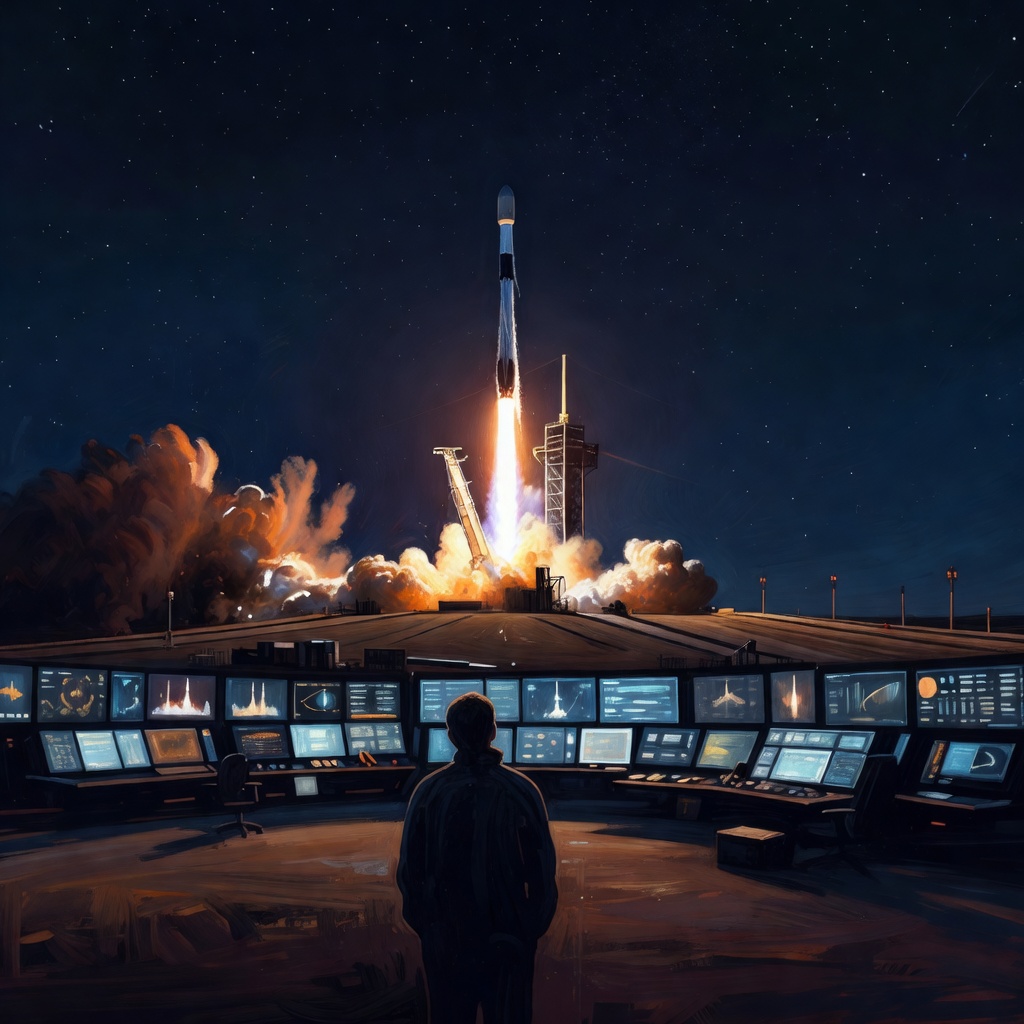
Jordan Hale: 555.6 million shares. That's how many SpaceX put out into the world on June 12th, priced at $135 each on Nasdaq, ticker SPCX. And I keep staring at that number because — you know, when you do the math, that's $75 billion raised in a single day. More than triple the size of the Alibaba IPO, which used to be the record.
Ryan Castillo: Largest in history. The $1.77 trillion valuation at pricing.
Jordan Hale: And the stock closes day one at — what, $160.95? A 19% gain. Market cap goes above two trillion. It's this enormous, historic, almost impossible-to-hold-in-your-head moment.
Ryan Castillo: And then ninety-six hours later.
Jordan Hale: Ninety-six hours later. Sixty billion dollars, all-stock, to acquire Cursor.
Ryan Castillo: An AI coding company. Through its parent, Anysphere.
Jordan Hale: Which — okay, I want to hold off on the math for a second, because before we get into all of that, I think the thing worth just sitting with is: what did investors think they were buying on June 12th? Like, what was the pitch?
Ryan Castillo: Space. Launch. Starlink. That was the prospectus story.
Jordan Hale: And then four days later Elon Musk pivots the whole identity of the company in public. While the stock is still — you know, it's still running. It hit $229.40 at its peak in that first week.
Ryan Castillo: Which is exactly why the timing isn't just dramatic. It's load-bearing. That's what we're going to get into.
Ryan Castillo: The April option agreement is where this stops looking opportunistic and starts looking planned. SpaceX had already locked in the right to acquire Cursor for $60 billion — or pay $10 billion just for joint compute access and walk away. That existed before the IPO. Months before.
Jordan Hale: Wait — so this wasn't a four-day decision.
Ryan Castillo: Not even close. The option was signed in April 2026. The IPO was June 12th. So they went public with this sitting in a drawer. The question is why they pulled the trigger on day four instead of, I don't know, month four.
Jordan Hale: And that's — okay, you know what that reframes for me entirely? The $229.40 peak. Like, if you knew you had this option, and you watched your stock nearly double in a week... you're doing math in real time, right? You're not waiting.
Ryan Castillo: That's exactly Chamath's argument on All-In. He said the effective cost of the Cursor deal — through Anysphere — wasn't $60 billion. It was closer to $15 billion. Because the shares SpaceX issued to pay for Cursor were shares that had already doubled from the IPO price of $135. The dilution in real-dollar terms is a fraction of the headline.
Jordan Hale: I mean, I find that genuinely fascinating but — wait, no. That math only works if you're the person who got shares. What about the person who bought at $135 on day one?
Ryan Castillo: That's the number that matters here. Picture a venture partner — runs a mid-market fund, bought 10,000 shares of SPCX at the IPO because they modeled Starlink's subscriber economics. Revenue, churn, margin. Clean infrastructure thesis. Tuesday morning, four days later, they wake up and SpaceX has issued stock to acquire Cursor. The shares they bought at $135 just got diluted by a deal that only looks cheap because those same shares ran to $229. They funded the discount.
Jordan Hale: They funded the discount. Yeah. That's — that's a brutal way to put it.
Ryan Castillo: And look — Cursor crossed a billion in annualized revenue back in November. It wasn't distressed. It was reportedly headed for its own IPO. So SpaceX didn't rescue anything. It preempted a separate public company from existing.
Jordan Hale: Which is — you know, Cursor already had more than half the Fortune 500 using it. That's not a scrappy experiment, that's an embedded platform. Why not just... stay in the option? Pay the $10 billion, get the compute access, keep the relationship. Why swallow the whole company at the exact moment your stock is at its most expensive?
Ryan Castillo: That's what I can't fully close. If you trusted your valuation at $135 — if you thought $1.77 trillion was fair — you use cash or you wait for the stock to normalize. The fact that it's all-stock, and it's day four, tells me insiders thought: lock this in before the market figures out what we're actually worth.
Ryan Castillo: Strip out Mars colonies. Strip out space data centers — which, by the way, no serious analyst will model right now. What are you left with? Starlink, maybe $10 to $12 billion annualized. Launch revenue, call it $3 to $5 billion. The valuation settled at $2.4 trillion by June 19th. That's roughly Amazon's market cap. You're telling me Starlink and launch justify Amazon-level pricing?
Jordan Hale: But — wait, that's the wrong frame, isn't it? You're not buying Starlink and launch anymore. That's what I'm saying. You've got Colossus, you've got xAI, you've got Grok, you've got Cursor's seven million developers. That's a closed vertical stack. That's — I mean, that's the argument. You're buying something that looks like AWS plus an AI model plus a developer platform, all inside one company.
Ryan Castillo: But xAI had real problems before this IPO. Allegations — documented — that SpaceX's AI division allowed generation of non-consensual deepfakes. Of women and children. That's not a footnote, that's a restructuring-level scandal. You're building a bull case on a stack whose AI layer has that in its recent history.
Jordan Hale: No, I know. That's — yeah, that's genuinely awful and I'm not dismissing it.
Ryan Castillo: It also tells me the AI strategy is reactive. They merged xAI into SpaceX before the IPO — fine, that's the foundation. But Grok isn't leading the market. Cursor gets acquired four days in. That's not a visionary build, that's catch-up purchasing with an inflated currency.
Jordan Hale: Okay but — every platform that ended up dominant looked like catch-up purchasing at the moment it mattered. Amazon didn't look like AWS in 2003. You know? The question isn't whether the stack is complete today, it's whether Colossus plus Grok plus seven million Cursor developers is a defensible position three years out.
Ryan Castillo: What's the revenue synergy though? Walk me through it.
Jordan Hale: I mean — okay, it's not obvious on day one, I'll give you that. But Cursor had a billion in ARR and was accelerating toward its own IPO. If that company goes public as a separate entity, it prices at an AI-platform multiple. Now SpaceX has to compete with it instead of owning it. That's the threat they bought out.
Ryan Castillo: That's a defensive acquisition dressed up as vertical integration.
Jordan Hale: Are those mutually exclusive?
Ryan Castillo: At $2.4 trillion? Yes. At that valuation you need the bull case to be real, not just plausible. The Amazon comparison — people are citing it like it validates the price. Amazon is there because AWS generated verifiable cash flows at scale. The speculative optionality in SpaceX's cap — Mars colonies, space data centers — experts won't assign those a number. So you're paying Amazon prices for a fraction of Amazon's proven earnings base.
Jordan Hale: But — no, wait. Tom Lee flagged the $90 billion float as a potential market bear trigger later in 2026, right? Which means even the skeptics think this is big enough to move the whole market. That's not a company trading on hype. That's a company that's actually systemically significant.
Ryan Castillo: Systemically significant and correctly priced are not the same thing. That's exactly the assumption I'd push on.
Jordan Hale: But that's — Tom Lee didn't say SpaceX is overpriced. He said the $90 billion float itself is the risk. Like, the sheer size of the liquidity that's now sitting in SPCX could act as a magnet. Pull capital away from everything else. And if it corrects, you don't just have a bad week for one stock, you potentially trigger a broader market bear shift later in 2026. That's a different kind of warning.
Ryan Castillo: That's the Fundstrat read, yeah.
Jordan Hale: And it's — you know, it's almost like the IPO is too successful to be safe? Which is a sentence I did not expect to say out loud.
Ryan Castillo: The mechanism is real. $90 billion in float means $90 billion of positions that need to be managed, hedged, or unwound. That's not abstract. That's margin calls, rebalancing, forced selling in adjacent assets.
Jordan Hale: Right. And then layer the Cursor deal closing — expected Q3 2026 — on top of that. So you've got this potential liquidity crunch sitting out there, and then the moment the deal actually closes, you get another round of share issuance, another dilution event, more float entering the system.
Ryan Castillo: Q3 close is the pressure point.
Jordan Hale: And I keep thinking about — like, picture a developer. Not a fund manager. Just someone who works at a Fortune 500 company that uses Cursor every day. More than half of them do, right? That's an insane penetration number for a company that was founded in 2022 by MIT dropouts. Two years. Half the Fortune 500.
Ryan Castillo: Founded 2022. $1 billion ARR by November. That's the trajectory Cursor's own IPO would have been selling.
Jordan Hale: Exactly — and that developer at that Fortune 500, their Tuesday morning workflow doesn't change the day after the Anysphere acquisition gets announced. They're still in Cursor, writing code, autocomplete is still running. But the company they're building inside? It's now a SpaceX product. The pricing, the roadmap, the integrations — all of that flows through SPCX now. And I wonder if they even noticed.
Ryan Castillo: That's the lock-in. That's what $60 billion actually bought — not the ARR, the switching cost.
Jordan Hale: Which means — wait, actually — is Tom Lee's warning basically saying the market hasn't priced the Q3 close yet? Like, everyone celebrated the IPO, everyone processed the Cursor headline, but nobody's modeled what happens when the Anysphere deal actually settles and that stock hits the open market?
Ryan Castillo: That's the lag. The float warning isn't about today's price. It's about what the float does to market structure when it fully circulates. Lee's point is structural, not directional.
Jordan Hale: So the risk isn't necessarily that SpaceX crashes. It's that SpaceX being this big creates gravitational drag on everything else.
Ryan Castillo: At $2.4 trillion, roughly Amazon's market cap, you're a systemic variable. That's not a metaphor.
Jordan Hale: No, I — yeah. That lands differently when you say it that way.