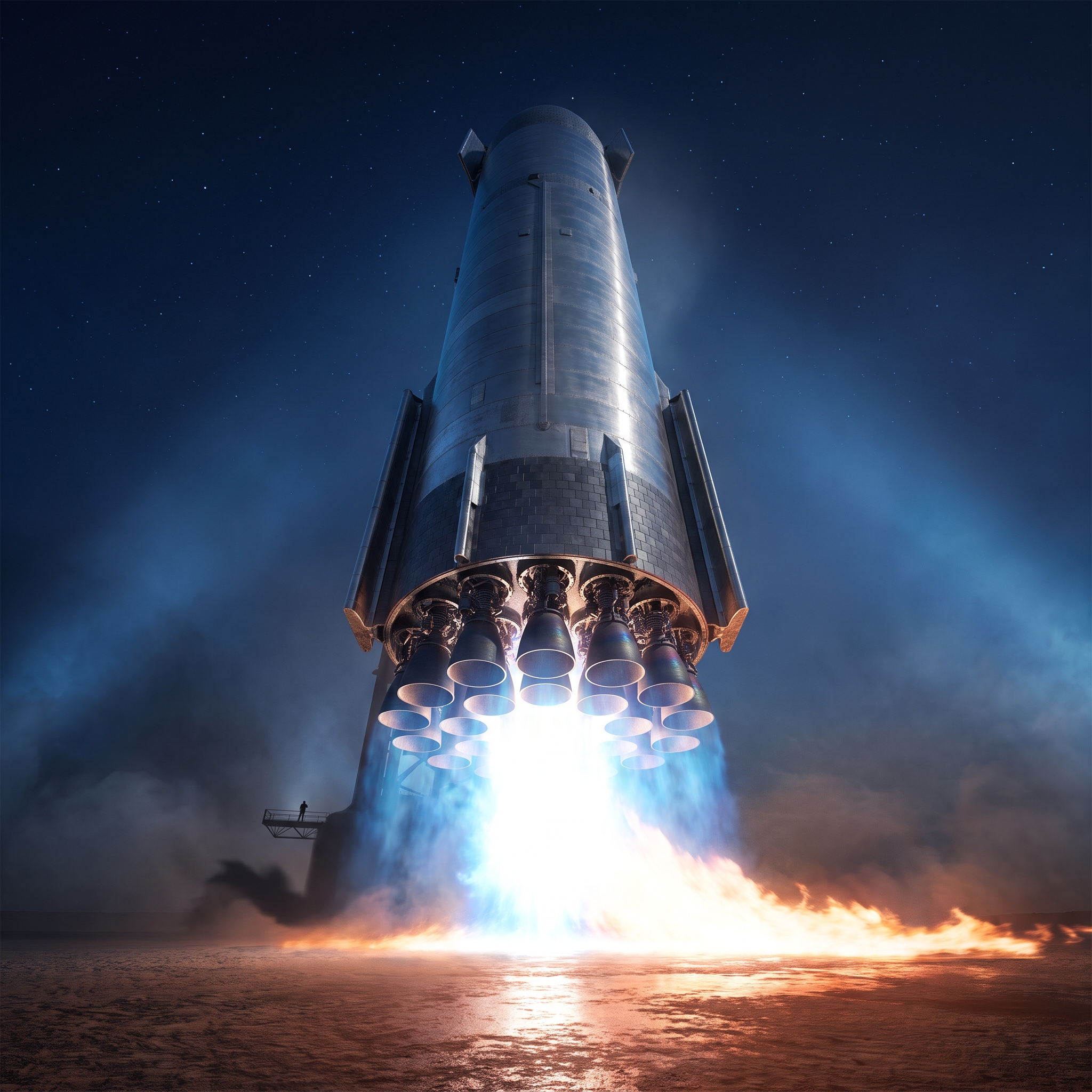
Juniper Vale: I'm handing you a number and I want your first, unfiltered reaction — sixteen million pounds of thrust, all at once, from a rocket that was sitting on the ground bolted to a pad.
Hope Sterling: Wait — all at once? Like, not staged, not one cluster then another, just... every single engine?
Juniper Vale: All thirty-three Raptor 3 engines on Booster 20, simultaneously, July 10th at Orbital Launch Pad 2 at Starbase. Twenty-four to twenty-five seconds. That's the static fire.
Hope Sterling: STOP. Okay — I need you to know that I have been telling everyone this week that this is insane and they keep looking at me like I'm being dramatic, and I am NOT. SpaceX didn't even do a partial test first! No five-engine run, no warmup, nothing — they had Mechazilla hoist Booster 20 onto the launch mount on July 9, and then literally the next day it was thirty-three engines all firing. My take? Traditional incremental testing is for people who aren't sure their stuff works.
Juniper Vale: I mean — I don't fully disagree, but I think the story is a little more complicated than that.
Hope Sterling: Okay but does it matter? Starship Flight 13 is targeting mid-July — like July 14, July 15. The static fire worked. What's the complication?
Juniper Vale: The FAA still has to issue a launch license. SpaceX's hardware being ready and the FAA being ready are two very different clocks.
Hope Sterling: Ugh — okay, yes, let's talk about that because I have thoughts and also anxiety.
Juniper Vale: Before the FAA anxiety, though — I want to push back on something you said, because 'they skipped the incremental tests' isn't quite the full picture. Think of it like this: a static fire is stress-testing a bridge by loading it with maximum weight while it's still bolted to the ground. If a cable snaps, nothing falls into the river. That's the whole point of doing it bolted down.
Hope Sterling: Okay but — wait, so you're saying the static fire IS the cautious choice?
Juniper Vale: That's exactly what I'm saying. An anomaly you find during a static fire is recoverable. The same anomaly at actual liftoff — with the vehicle free — is not. That's not a philosophy, that's just physics.
Hope Sterling: Okay that reframe just — I mean, I was out here thinking full-send, reckless energy, and you're telling me bolting it down and lighting all thirty-three is actually the conservative move.
Juniper Vale: Right — but the part that doesn't fit the 'they skipped steps' narrative is Massey's test site. Booster 20 did cryogenic proof tests there first — tanks, plumbing, structural integrity all under load — before it ever touched Orbital Launch Pad 2. So SpaceX didn't skip validation, they moved it earlier and somewhere else.
Hope Sterling: Wait — so by the time Mechazilla hoisted it onto the pad on July 9, the tanks had already been stress-tested? Like, the July 10 fire wasn't their first hard look at that booster?
Juniper Vale: Exactly. The 33-engine fire was the first full-system check — engines, software, fuel flow, the whole airframe under 16 million pounds of thrust simultaneously. But it wasn't a shot in the dark. Booster 20 is also a V3 Super Heavy running Raptor 3 engines, which are built for higher thrust and cleaner manufacturing than earlier versions, so there's accumulated learning baked into the hardware itself.
Hope Sterling: It's less 'we trust vibes' and more 'we did the boring structural work first and then went big.' That's — honestly that makes way more sense than how everyone's been framing it.
Juniper Vale: And that's actually the part that matters — because here's where your hot take was right all along. The 24 to 25 seconds isn't arbitrary. That's not 'run it until we feel good.' That's the exact duration of a Super Heavy launch burn phase. SpaceX designed the static fire to impose the same thermal load, the same pressure, the same acoustics Booster 20 will face at actual T-zero.
Hope Sterling: Wait — they literally mirrored the launch? Like, on purpose?
Juniper Vale: On purpose. And — okay, layer on top of that — this was simultaneously the first time 33 Raptor 3 engines had ever fired together at that scale. Brand new engine generation. No section-by-section rehearsal. Imagine a sound engineer doing the very first full orchestra run on opening night, no individual sections warmed up separately. That's what July 10 was.
Hope Sterling: No, wait, that analogy is doing something to me. Like, the violin section and the brass and the drums all at once, first time ever — and it has to work because the audience is already seated.
Juniper Vale: That's the bet Elon Musk and SpaceX made. The cryo work at Massey's justified the confidence — but the scale of the wager? Thirty-three brand-new engines, full duration, first orbital pad attempt? That part you called reckless — I think reckless is the wrong word, but audacious? Yeah. That's fair.
Hope Sterling: So I get partial credit. I'll take it. The boldness is real, the method is just — smarter than I gave it credit for.
Juniper Vale: Partial credit, yes. Though — and I want to flag this because it's going to matter in a minute — the static fire resolved the engineering question. What it did not touch is the FAA's licensing clock, which runs on completely different logic.
Hope Sterling: Oh I feel the anxiety coming back. We're getting to that, right?
Juniper Vale: Yeah, and the anxiety is warranted — because the FAA doesn't care that the static fire was clean. Genuinely does not factor in. An FAA launch license for Starship Flight 13 is a separate legal document, separate process, separate clock entirely.
Hope Sterling: So July 14, July 15 — those are, like, wishes? Not confirmed windows?
Juniper Vale: Targets. SpaceX is targeting those dates. The FAA hasn't — I mean, to be honest, our sourcing on the exact regulatory timeline is thin, so I want to be careful here. What I can say with confidence is that the license has to be independently issued. SpaceX can have every Raptor 3 engine on Booster 20 primed and perfect, and if that document isn't signed, nothing lifts off Orbital Launch Pad 2.
Hope Sterling: That is — okay, that's a little sobering actually. Like, they did the hard engineering part and now it's just... waiting on paperwork?
Juniper Vale: Not just paperwork — regulatory review has real stakes behind it. The FAA isn't a rubber stamp. But the structural mismatch is real: SpaceX compresses timelines aggressively, that's the whole philosophy. Regulatory review doesn't compress on demand. Those two things are genuinely in tension.
Hope Sterling: And if the FAA slips past the 15th — does that tell us something? Like, is that a signal, or just bureaucracy doing bureaucracy?
Juniper Vale: Honestly? Probably just the clock running at its own pace. Though — wait, here's what I think actually matters for the bigger picture. Flight 13 isn't just a launch test. It's the next proof point for full reusability — Mechazilla catching the Super Heavy booster mid-air instead of landing on legs. That whole vision depends on Flight 13 happening, and happening soon. A regulatory slip doesn't break the engineering case, but it does sit between SpaceX and that milestone.
Hope Sterling: So the calibrated version is — static fire: resolved. FAA license: genuinely open. Mid-July: maybe, not promised.
Juniper Vale: That's exactly it. The engineering question has an answer. The legal question doesn't yet. And those aren't the same thing.
Hope Sterling: Okay, fine — I'll give you Massey's test site. Like, the cryo work was real prep, it wasn't just vibes and confidence. That's not pure cowboy engineering. I concede that.
Juniper Vale: Partial credit again.
Hope Sterling: I keep accumulating partial credits, it's fine. But — wait, where does that actually leave us? Like, the honest version?
Juniper Vale: The honest version is — Booster 20 proved it can produce 16 million pounds of thrust on the ground. That question is answered. What nobody's proven yet is that SpaceX's philosophy of compressing test phases survives contact with the FAA's independent timeline. Or, for that matter, the first serious failure on a V3 vehicle. The static fire was clean. Flight 13 is still a target date waiting on a legal document.
Hope Sterling: Yeah. That's — honestly, that's where I'm sitting too. The engineering answered its question. The rest of it is just... still open.