Mateo Rivas: Hey — before we do anything else, I need you to tell me if this hits you the way it hit me, because it might just be a me thing.
Beau Lanier: Oh man, those are my favorite kinds of things — go.
Mateo Rivas: My abuela's kitchen. The way she stacks her tupperware — my tía can walk in and read that stack and know exactly what got cooked last week, what's been saved for Sunday, what matters. It's a sequence. And if you don't know the stacking logic, you just see containers.
Beau Lanier: Okay... I'm nodding but I don't have the thread yet.
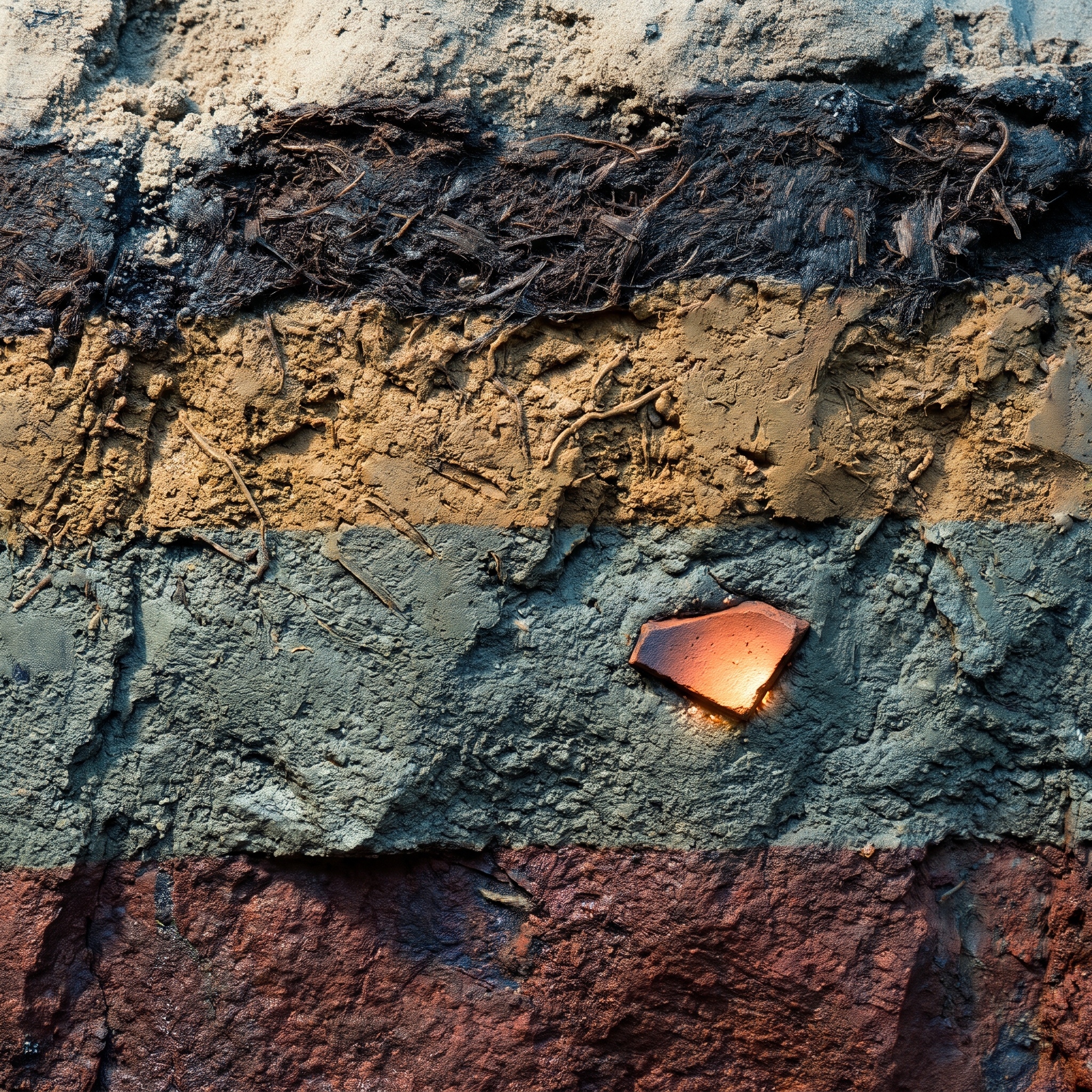
Mateo Rivas: Pues — that's stratigraphy. Like, that is the whole idea. You excavate a site and the soil layers are the stack: the one at the bottom got there first, the one at the top is most recent. Law of superposition — Nicholas Steno called it in the 1600s, geologists built on it, archaeologists borrowed it. Lower is older. The order is the clock.
Beau Lanier: It's the newspaper basement thing — the pile dates itself.
Mateo Rivas: Yes — and here's where Kathleen Kenyon comes in, because in 1952 she goes back to Jericho, same trenches already documented by her predecessor, and without finding a single new artifact she overturns the entire interpretation of the site. She just looked at the layer junctions — where deposits meet — and saw they didn't match his records. The reading was wrong because the layers weren't what he thought they were.
Beau Lanier: So if she hadn't gone back and looked again, we'd still have the wrong history.
Mateo Rivas: And the whole thing only works — the whole clock — if the assumption holds. That nobody moved the pile. What happens when they did?
Beau Lanier: Right — but the part that doesn't fit is, like, that only works if you've got a system for tracking what moved. And that's actually crucial, because Steno sees it in rock, right? 1660s, he's looking at rock strata in Tuscany and he formalizes it — lower layers formed before upper layers, full stop. But rock doesn't have postholes. Rock doesn't have a hearth somebody dug into an earlier floor. Dirt is messier, and Edward C. Harris is the person who figured out how to actually wrangle that mess.
Mateo Rivas: Harris — that's the matrix guy?
Beau Lanier: The Harris Matrix, yeah. He publishes 'Principles of Archaeological Stratigraphy' and what he's doing is — I mean, he doesn't just say 'lower is older.' He formalizes four actual laws. Superposition, sure. But also original horizontality — deposits form flat unless something disturbed them. Original continuity — a layer keeps going until it thins out or hits a wall, and if it stops short, you have to explain what removed it. And then stratigraphic succession, which is the kicker: every single unit has a unique position defined by what it comes after and what comes before it.
Mateo Rivas: Okay but — bueno, you're in a hole. It's uneven. Things are sloping. How do you even keep track?
Beau Lanier: That is exactly the question, man, because — wait, actually this is the thing — the matrix IS the answer to that. It's a diagram. Every discrete layer, every feature, every interface, each one gets called a stratigraphic unit, a context, and you draw it as a box. And then you draw lines between boxes: this one is earlier than that one, these two are contemporary. You're not drawing a picture of the trench. You're drawing a map of time.
Mateo Rivas: Huh. So it's more like a family tree than a cross-section.
Beau Lanier: Yeah — yeah, that's closer. Picture... okay, Çatalhöyük, central Anatolia, some archaeologist kneeling at the edge of a one-meter trench, penciling boxes onto a Harris Matrix sheet. Eighteen distinct occupation levels on that site, spanning like 7,400 to 6,200 BC. Twenty meters of accumulated city. Nobody wrote any of that down. No king list, no chronicle. And the only reason we can reconstruct the full arc of that settlement is because every context got its box, every box got its arrows, and the sequence held.
Mateo Rivas: Dieciocho levels. That's — órale, that's a whole civilization in the dirt.
Beau Lanier: And you can get it *out* of the dirt because of the matrix — because Harris gave you a way to say 'this context is earlier than these three, and later than these two, even if they're not physically touching each other in the trench.'
Mateo Rivas: So what you're getting out of all of this is — this layer is older than that one. But you don't know *when* either of them is. Like, not an actual year.
Beau Lanier: Relative dating. That's the word — that's all stratigraphy gives you on its own. Older than, younger than. The sequence. Not the calendar.
Mateo Rivas: So the matrix is the skeleton, but it doesn't have a birthday.
Beau Lanier: Right — and that gap, between knowing the order and knowing the actual dates, that's kinda where everything gets complicated.
Mateo Rivas: And that gap gets a lot scarier once you realize the skeleton might be lying to you in the first place. Because the pile — your newspaper pile — somebody was moving it the whole time.
Beau Lanier: Wait, like — actively? While the site is just... sitting there?
Mateo Rivas: Rodents. Burrowing insects. Plant roots. Bioturbation — that's the word. A rodent tunnels down through a Mousterian occupation layer and physically carries a bone upward into a completely different layer. Now that bone reads younger than it is. The archive is being rewritten by a mouse.
Beau Lanier: No way, man.
Mateo Rivas: Hayonim Cave, Israel — they documented exactly this. Bones moved between distinct Mousterian layers. Not metaphorically moved. Physically displaced by biological agents. And it's not just animals — plowing, construction, looting, later burials — all of it intrudes into existing deposits.
Beau Lanier: Okay so — wait, I keep coming back to this — the soil being a living thing, I kinda always said that as a vibe, but that's literally true. The stratum is not frozen. It's being renegotiated.
Mateo Rivas: Which means the fundamental question stops being 'what layer is this in' and becomes 'is this object where it originally landed, or did something move it?' Primary deposition versus secondary. And that — pues, that is not a question you can always answer definitively.
Beau Lanier: So how do you even — like, how do you decide when to trust the sequence?
Mateo Rivas: You stop relying on one line of evidence. Barber Creek, North Carolina — team comes in, there are signs of bioturbation throughout the deposit, and they don't just say 'well the layer looks intact.' They bring radiocarbon dating, optically stimulated luminescence — OSL — and stratigraphic analysis all at once. Three independent methods converging on the same answer before they'll say the deposit is reliable.
Beau Lanier: It's like — I mean, it's not reading the dirt anymore, it's building a case. Like you're a prosecutor and the dirt is a witness you don't entirely believe.
Mateo Rivas: Claro — stratigraphy isn't a camera. It's a court case. You're assembling converging evidence. And the moment you think it's just observation, some rodent at Hayonim has already filed a counterargument.
Beau Lanier: And what I'm sorta sitting with now is — y'know, all of that is about the sequence holding or not holding. But there's a whole other level, what this actually unlocks when you combine it with absolute dating for cultures that never left a written word. And it gets genuinely strange and also maybe a little uncomfortable.
Mateo Rivas: Oh — yeah, hold onto that. Because 'speaking for themselves' is doing a lot of work in that sentence and I'm not sure it survives contact with who's actually doing the translating.
Beau Lanier: And that's exactly the thing that sits uncomfortably with me — because okay, so Çatalhöyük, right? Eighteen levels, 7,400 to 6,200 BC, no written records from anyone inside that city or any literate neighbor looking in. The only way we can reconstruct how that community organized itself, how construction sequences unfolded, what was ritual and what was just Tuesday — that's all coming from stratigraphy. And radiocarbon, anchored by dendrochronology, those tree-ring sequences covering the whole Holocene, that calibration curve is what turns 'this level is older than that level' into an actual calendar year. That's genuinely extraordinary. But then I keep hitting the same wall, like — who decided what the layers *mean*?
Mateo Rivas: That's the translation problem.
Beau Lanier: It's the translation problem, yeah. And I mean — the promise is beautiful, right? Non-literate civilizations can speak through their own material record, not filtered through what a literate neighbor wrote about them, not mediated by some outside observer who showed up later with an agenda. The dirt is the voice. But the frameworks we use to read what 'ash deposit above a plastered floor' *means* culturally — those are built by modern Western scholars in offices in Cambridge or Chicago.
Mateo Rivas: My tía reads the tupperware stack. A stranger reads the same stack and gets it completely wrong.
Beau Lanier: Exactly that. And the Kenyon thing is — wait, actually it makes this even sharper. Same ground, same strata, Jericho. Prior excavators weren't incompetent. They just came in with a different stratigraphic logic, different assumptions about what layer junctions *mean*, and they got a different history out of the same dirt. The layers didn't change. The interpretive framework changed.
Mateo Rivas: So the culture isn't speaking — the method is.
Beau Lanier: I mean — kinda, yeah? Like, it's better. It's genuinely better than relying on what a Greek traveler wrote about people he barely met. Radiocarbon pinned to tree rings, that's not someone's opinion. The dendrochronological calibration curve covering the entire Holocene — that's real. But you still need a person to decide whether the charcoal you dated was from a hearth that people used or a hearth that somebody buried a century later.
Mateo Rivas: Pues — primary versus secondary deposition. Where it landed versus where it got moved.
Beau Lanier: And that call is a judgment call. Informed, rigorous, using the Harris Matrix to track every stratigraphic unit, every context, every interface — but still a judgment. The sequence is real. The calendar dates from radiocarbon are real. The interpretation of what a society *was doing* in that layer — that's still us.
Mateo Rivas: So what's the honest version of the promise? Like, what can you actually claim?
Beau Lanier: That you've replaced one kind of outsider narrative with something constrained by physical evidence. Which is — man, that's not nothing. The bones don't have an agenda. The ash layer doesn't have an agenda. The interpretive logic does, kinda, but it's tethered. It can be tested. Kenyon could go back and test her predecessor. Someone will go back and test Kenyon.
Mateo Rivas: That's a different thing than speaking for themselves, though.
Beau Lanier: It is. It's closer to — the culture left evidence that constrains what you're allowed to say about them. Which is maybe the most we can honestly claim. It's not their voice. It's the walls of the room their voice was in.
Mateo Rivas: Bueno — the walls of the room. That's a different thing than speaking. And I think that matters for where we go next.
Beau Lanier: And that image is gonna stay with me, man. The walls of the room. Because — I keep thinking about Kenyon, like, she went back to Jericho in 1952 and the walls were literally right there. Same dirt. Same junctions. And what she actually changed wasn't the site, it was — wait, it was the question she was asking of it.
Mateo Rivas: And that's the thing that doesn't let me go. If she could overturn everything just by reading the same layers differently — not by finding anything new — then what are we taking for granted right now that someone's going to come back and undo?
Beau Lanier: Yeah. Some future person standing in a trench somewhere, looking at a context we confidently logged into a Harris Matrix, thinking — no, that junction doesn't mean what they thought it meant.
Mateo Rivas: And we won't know what it is. By definition.
Beau Lanier: By definition, yeah. That's — I mean, that's kinda the honest place stratigraphy leaves you. It's genuinely powerful. The law of superposition, the matrix, radiocarbon pinned to tree rings — that's real. Çatalhöyük's eighteen levels are real. But the method keeps asking you to admit that how you're reading the dirt is never fully neutral.
Mateo Rivas: The soil remembers. We decide what it's saying.
Beau Lanier: Yeah. That's it, actually. That's the whole thing.
Mateo Rivas: Gracias for going down into it with me, man. Genuinely.