Sarah Lin: You texted me last night, like, eleven-something — just the dollar amount. Nothing else.
Dr. Nathan Hayes: Because I didn't know what else to say. $2,600.
Sarah Lin: Two thousand six hundred dollars. That's what DHS is offering Haitian TPS holders — not a removal order. A departure bonus. The state is literally paying people to disappear. And I keep — mm — I keep turning that over because it's not deportation, it's a bribe. There's a difference and I think that difference matters.
Dr. Nathan Hayes: And the context is: June 25th and 26th, the Supreme Court issues two 6-3 rulings — both along ideological lines — and overnight, thousands of Haitian TPS holders in Springfield, Ohio lose their legal status. Not gradually. Overnight.
Sarah Lin: Springfield. The same community that was everywhere in 2024 — all those cameras, that whole national argument — and now it's the first place where the ruling actually lands. On real people.
Dr. Nathan Hayes: 350,000 people across the U.S. now at direct deportation risk. And the White House called it — I'm quoting — 'a victory ten years in the making.'
Sarah Lin: Ten years. So this wasn't a surprise ruling. This was architecture.
Dr. Nathan Hayes: Now — before we stay in the 'bribe-and-banish' frame, I want to slow down and actually name what the legal engine is here. Because there are two separate rulings doing two very different things.
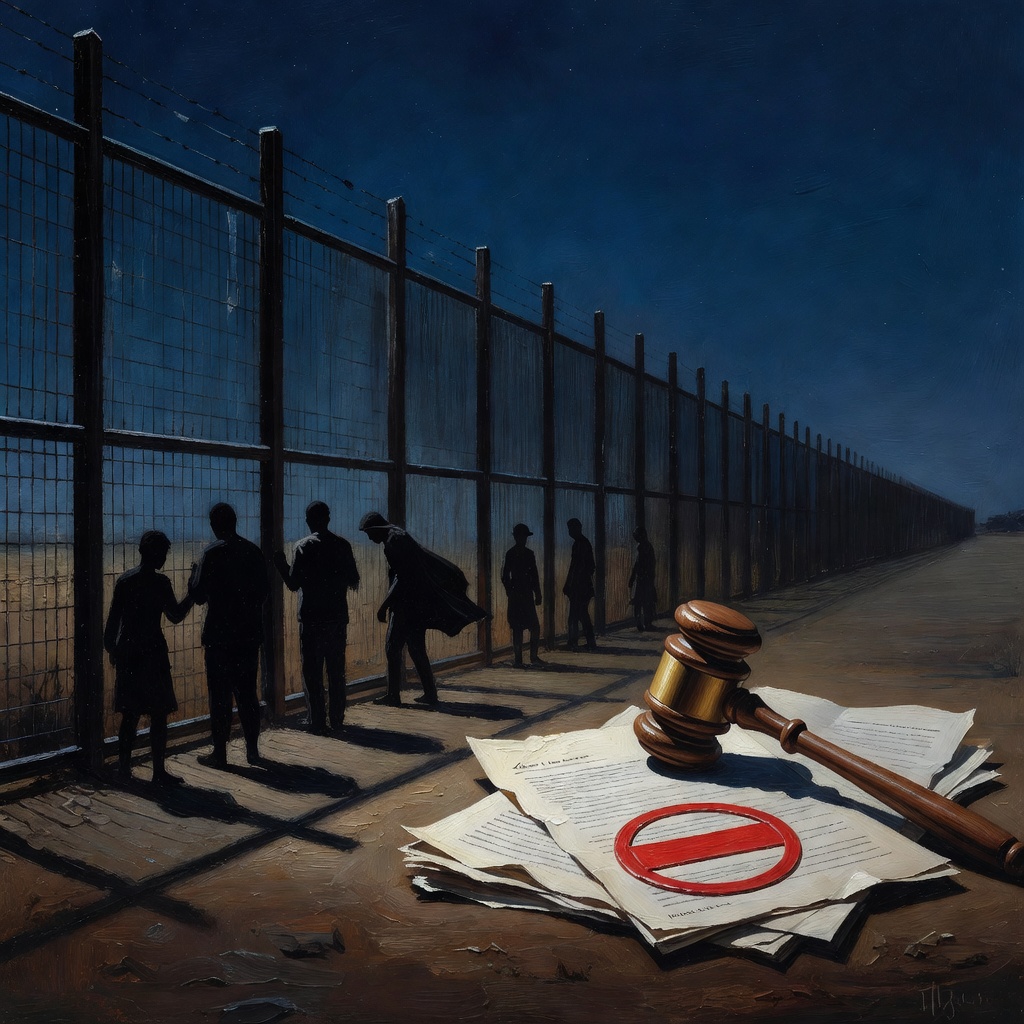
Dr. Nathan Hayes: The metering ruling — Mullin v. Al Otro Lado, written by Justice Samuel Alito — that one is actually the more structurally radical of the two. And here's the intuition that cracked it open for me: imagine a law that says anyone can apply for a library card. But the librarian stands in the doorway so you physically cannot enter. Then says — no one applied, so no cards today. That is metering. The right exists on paper. The physical blockade makes it unreachable. And the Court just said — that's fine.
Sarah Lin: Wait — and the Ninth Circuit had actually disagreed with that? Like, specifically?
Dr. Nathan Hayes: Explicitly. The Ninth Circuit held that asylum seekers approaching an authorized crossing were legally 'arriving in' the United States — entitled to file. Al Otro Lado, the advocacy organization that brought the case, had won on that basis. The Supreme Court reversed it entirely.
Sarah Lin: And the TPS ruling is — sort of the other half of that. Congress created TPS in 1990, it currently shields 1.3 million people from seventeen countries, and now courts can't... they just can't push back on what DHS decides.
Sarah Lin: So Tuesday morning, June 26th. A Haitian family in Springfield wakes up and — I mean, what is actually the question they're asking? Do you go to work? Do you pull your kids from school that day? Do you even call a lawyer you can't afford?
Dr. Nathan Hayes: And there were reports of people unable to breathe. Not metaphorically — physically. Scrambling to understand their status from news alerts like everyone else.
Sarah Lin: That's — yeah. That's a public health event.
Dr. Nathan Hayes: It is, clinically. Acute legal precarity activates the HPA axis — the hypothalamic-pituitary-adrenal axis. Sustained cortisol elevation has documented effects on immune function, cardiovascular outcomes, birth weight in pregnant women. That's measurable systemic load. Not a metaphor.
Sarah Lin: And the scale of who's watching this happen — um — okay, here's what stopped me cold. 1.3 million people currently hold TPS. That's roughly the population of Delaware. And the countries they'd return to — Haiti, Syria — they're still in the crisis conditions that originally justified protection. The humanitarian rationale hasn't changed. Only the legal protection has.
Dr. Nathan Hayes: Which is the structural piece. DHS now has near-unreviewable authority to terminate TPS for any of the seventeen designated countries. And with the birthright citizenship case also before the Court — this isn't an isolated ruling. The pattern is the point.
Sarah Lin: Springfield invited these families in. Deliberately. And now belonging — not just status — belonging got severed overnight.
Dr. Nathan Hayes: Now — I'll half-concede the 'bribe-and-banish' framing. It captures something real. But the colder thing, the thing that actually keeps me up, is what happens to the other 1.3 million. Because the White House called this 'a victory ten years in the making' — that's a conservative legal strategy being named out loud, not an accident. Seventeen countries. Near-unreviewable executive authority. Which means — what protection remains? Not in a rhetorical sense. Literally. What is the mechanism that stops DHS from terminating TPS for, say, Syrians next week?
Sarah Lin: Fine. Bribe-and-banish machine is — okay, slightly overstated. Only slightly.
Dr. Nathan Hayes: The crisis in Haiti hasn't changed. The crisis in Syria hasn't changed. The humanitarian rationale that Congress built TPS around in 1990 is still there. What changed is whether any court can say so.