Ryan Castillo: Jordan, quick — before we get into this, how's the hip holding up?
Jordan Hale: Oh, that's — okay, that's a weirdly perfect segue actually, because I've been nursing this thing and the physio told me my pelvis is quote 'not ideally configured for the mileage I'm putting on it,' and I just thought about that line constantly while I was reading this study.
Ryan Castillo: Which study?
Jordan Hale: So there's this paper — just out, August 17th, 2026, Scientific Reports — and the lead researcher is Prof. Yoel Rak, Tel Aviv University, Department of Anatomy and Anthropology. And the thing he's arguing is that paleoanthropology has spent decades looking at Neanderthal pelvises and going 'these are the strange ones, these need explaining.' And Rak basically turns the whole frame around and says no, no — it's the modern human male pelvis that's the weird one. We evolved something Neanderthals never had.
Ryan Castillo: Wait, so the field had the burden of proof on the wrong skeleton this whole time?
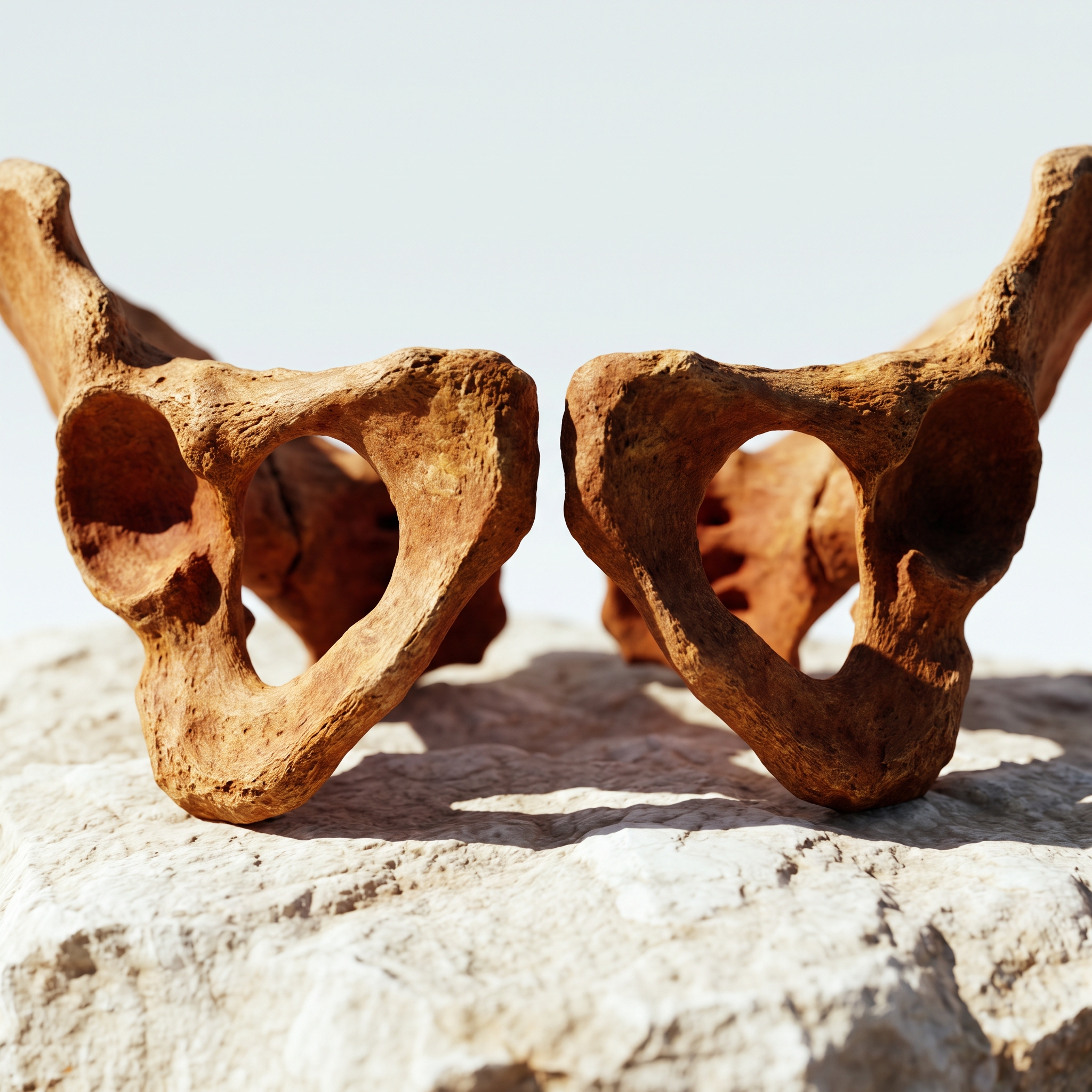
Jordan Hale: That's his exact argument. And he's working from — I mean, this is the part that's kind of stunning given how sweeping the claim is — two nearly complete male Neanderthal pelves. One dug up at Kebara Cave in Israel, one from Sima de los Huesos in Spain. Rak's quote is direct: 'It is not the Neanderthal pelvis that is the unusual structure requiring explanation, but rather the pelvis of the modern human male.'
Ryan Castillo: The evolutionary innovation — that's the phrase he uses. And two specimens is what it's resting on.
Jordan Hale: Two specimens, and yet — okay, so what *is* the thing that supposedly changed? Like, what did modern human males actually evolve that Neanderthals didn't?
Ryan Castillo: The acetabulum — the cup-shaped socket where the thigh bone slots into the pelvis — sits farther forward on the pelvic ring in modern human males. That's it. That's the structural delta.
Jordan Hale: Forward how much? Like, noticeably?
Ryan Castillo: Enough that when you compare it geometrically against the Kebara Cave pelvis and the Sima de los Huesos pelvis — the two specimens they're working from — the male Neanderthal configuration actually clusters with the modern human *female* pelvis. Not the male. Think about what that means: Technion and Bar-Ilan University were both on this study, it's not a solo call, and they're all landing on the same read. The Neanderthal male is ancestral. We're — I mean, modern human males are the outlier.
Jordan Hale: Wait — so every step I take, something is literally storing energy like a compressed coil under my hip?
Ryan Castillo: That's the spring model, yes. The forward position loads the anterior thigh muscles differently — they compress, store, release. Cheaper stride. The claim is that over long distances, that compounds into a real efficiency advantage. Which is — actually, no, here's what's interesting — it's not that Neanderthals were *bad* walkers. Prior research has them walking pretty efficiently overall. The gap this study is pointing to is specifically in that energy-return mechanism. The spring. Neanderthals apparently just didn't have it.
Jordan Hale: So the innovation is *in us*, not in them.
Ryan Castillo: That's Rak's word — innovation. And the reason females didn't get it is the obstetric constraint. The pelvis had to stay wide enough to birth large-brained infants, so that forward shift never happened. Which puts modern human females and male Neanderthals in — structurally, anyway — the same ancestral bracket.
Jordan Hale: But that's — wait, that's the part that keeps nagging at me. Two. Just two Neanderthal pelvises. Like, I keep trying to picture the actual fossil record here — one from Kebara Cave, one from Sima de los Huesos — and that's the whole population we're characterizing.
Ryan Castillo: Two individuals. Not a population. An observation.
Jordan Hale: And in paleoanthropology, you know, small samples are kind of the permanent condition — you work with what fossilized. But there's a difference between 'small sample' and 'two guys.' Like, imagine a forensic anthropologist in 3000 years finds two male skeletons from 2026 and tries to characterize human locomotion from them. One of them might have had hip dysplasia. You'd never know.
Ryan Castillo: And no gait data. No metabolic energetics. No biomechanical simulation run on actual Neanderthal conditions. The efficiency claim is entirely inferred from bone geometry.
Jordan Hale: Which is — I mean, is that normal for this kind of study?
Ryan Castillo: It's standard constraint. You can't run a Neanderthal on a treadmill. But here's what actually complicates the efficiency claim further — prior research already suggests Neanderthal walking wasn't dramatically less efficient than ours overall. So even if the forward acetabulum is a real structural difference, the implied efficiency gap the study is pointing to? That may not actually exist at the level they're suggesting.
Jordan Hale: Wait — so we're inferring an efficiency advantage from two skeletons, with no gait data, and the broader literature is saying Neanderthals walked fine anyway?
Ryan Castillo: That's the tension. And to be fair — no external expert has publicly critiqued or endorsed the study yet, as of publication. It's sitting in Scientific Reports unvetted by the broader paleontological community. Which means right now it's a compelling hypothesis. It's not an established pattern.
Jordan Hale: And the part that comes later — what this means when the female pelvis framing enters clinical conversation — honestly, that might be where this gets genuinely uncomfortable.
Ryan Castillo: And that's exactly where it gets uncomfortable — because the framing of the female pelvis as 'ancestrally conserved' is doing a lot of quiet work. Conserved sounds like frozen. Like she didn't go anywhere. But the obstetric dilemma is a real, well-documented set of competing pressures — wide enough to birth a large-brained infant, narrow enough for bipedal efficiency — and those pulled in opposite directions. That's not stasis. That's a body solving two problems at once.
Jordan Hale: Optimized for a different set of demands, not left behind.
Ryan Castillo: Right — but the study doesn't quite say that. And that gap matters. Because if you're a clinician reading Scientific Reports and you absorb 'female pelvis is ancestral, male pelvis is the efficient innovation,' you might reach a conclusion the data doesn't actually support.
Jordan Hale: Like — okay, give me the concrete version of that. What does that actually look like when it lands in a doctor's office?
Ryan Castillo: Twenty-seven-year-old female runner. Chronic hip pain. No clean diagnosis. She sits across from an orthopedist who's internalized this model and gets told her pelvis is — I mean, the phrase that actually gets used is 'not shaped for distance running.' And the thing is, we genuinely don't know if female pelvic geometry reduces walking efficiency or just distributes load differently. Those are not the same claim. But one of them sounds like a deficit.
Jordan Hale: And she leaves thinking something is wrong with her body.
Ryan Castillo: Before the biomechanical model the researchers are proposing has even been validated. The downstream applications they flag — musculoskeletal health, sports science, injury prevention — those all depend on confirming the model first. That step hasn't happened.
Jordan Hale: So the study gets reported, the framing seeps into clinical thinking, and real people are absorbing a verdict that's actually, you know, still a hypothesis sitting in a journal waiting for scrutiny it hasn't received yet.
Ryan Castillo: Two Neanderthal pelvises, no gait data, and a word — 'conserved' — that carries more judgment than the bone geometry can actually bear. That's the load-bearing problem.
Jordan Hale: Two bones. Sitting in a lab — one from Kebara Cave, one from a site in Spain — and everything we think we know about how humans learned to walk written into their geometry. I keep imagining that, like, the actual physical objects. That's the whole foundation.
Ryan Castillo: And the spring-energy model is mechanically plausible — I'll give them that. But plausible and confirmed aren't the same thing. You'd need biomechanical simulation, or a study of living populations with analogous pelvic variation, to actually validate it. That step is still ahead of them.
Jordan Hale: Which is — I mean, that's maybe the honest place this lands, right? Rak's team at Tel Aviv University found something real. Even in anatomy, a field this well-studied, they identified a structure nobody had quite framed this way. That's not nothing. It's just... not the last word either.
Ryan Castillo: It's in Scientific Reports now. People with biomechanical modeling tools are going to read it. People with access to larger fossil datasets. That's how a hypothesis either becomes a pattern — or doesn't.
Jordan Hale: Two specimens from Kebara Cave and Sima de los Huesos, waiting for more bones to either back them up or complicate everything. I can sit with that.