Onpode
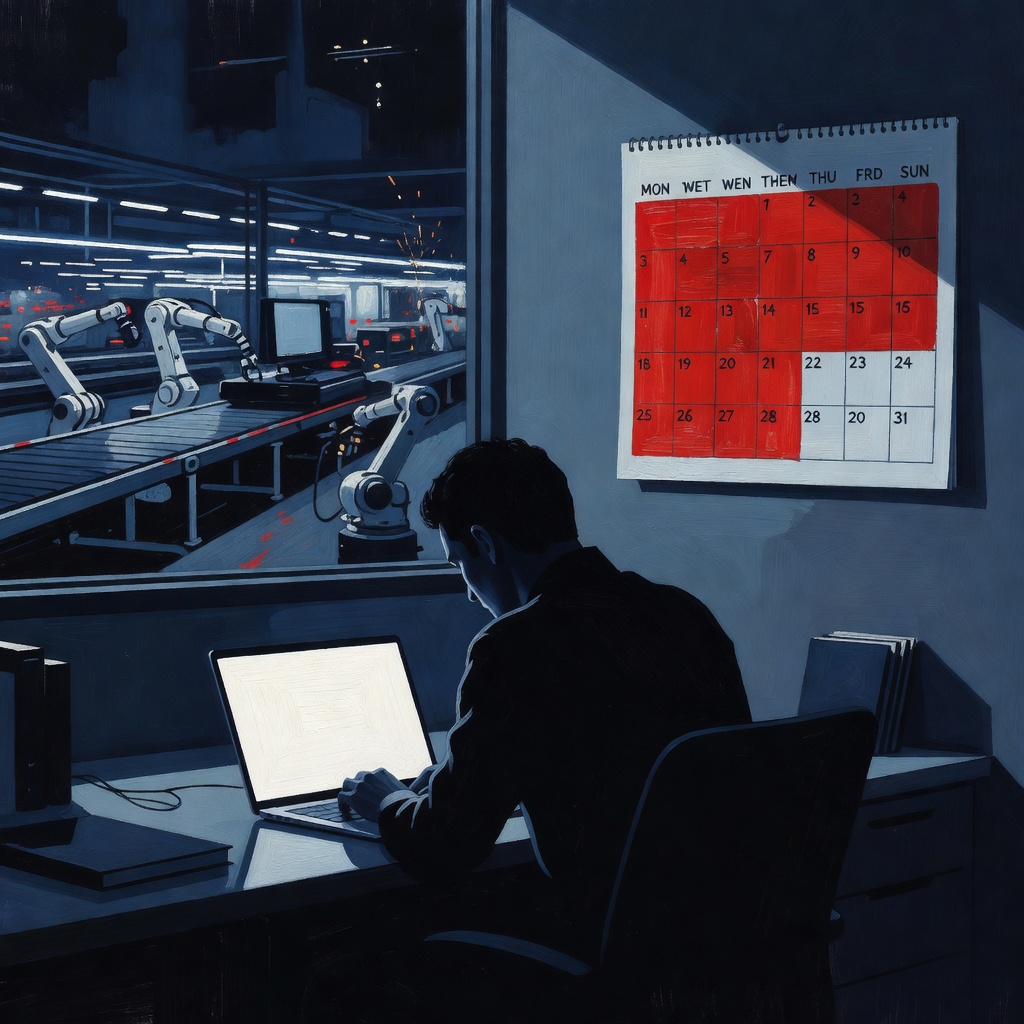
Cover art for Tesla employee's viral post revealing 7-day work weeks reignites tech industry exhaustion debate

Tesla employee's viral post revealing 7-day work weeks reignites tech industry exhaustion debate

June 23, 2026 · 5 min

Ryan Castillo & Jordan Hale

Tesla employee Mohammad Salman's June 2026 Instagram post showing a 54-hour, seven-day workweek sparked global debate — not because he complained, but because he didn't. The neutral, almost clinical tone revealed how thoroughly long-hours culture can be internalized as ambition rather than experienced as exploitation.

In June 2026, Tesla employee Mohammad Salman posted an Instagram video titled "How much I work in a week at Tesla," detailing a 54-hour, seven-day workweek. His schedule broke down as follows: 11 hours Monday, 9 hours Tuesday, 10 hours Wednesday, 11 hours Thursday, 7 hours Friday, 2 hours Saturday, and 4 hours Sunday — with no full day off. Salman is based in Seattle, Washington.

0:004:49
Make your own on Onpode

Describe any topic. Hear it in minutes.

More Onpode episodes on Culture

About this episode

When Mohammad Salman, a Tesla employee, posted his weekly schedule to Instagram in June 2026 — 54 hours, spread across all seven days, with Sunday as the lightest at four hours — he didn't frame it as a complaint. He barely framed it at all. That neutrality is what the episode keeps returning to, because it points at something more durable than any single manager demanding overtime. The episode works through what's actually happening when a workplace culture normalizes hours that research consistently shows erode performance. CBS News, reporting on the story, cited findings that output degrades significantly beyond 50 hours a week — a data point that sits awkwardly against Tesla's identity as an analytically rigorous company. A union official's response to Elon Musk's oft-repeated '40 hours never changed the world' line is worth hearing: she pointed out that the workers who fought for the 40-hour week, including people who died for it, did exactly that. But the episode doesn't let the outrage cycle off the hook either. Salman posted no context — no mention of whether this was a crunch week, a deadline push, or simply an ordinary Tuesday. The entire global reaction, from Bangalore to the UK to the US, was built on one data point with no baseline. What that says about how we process viral labor stories is its own uncomfortable finding.

Frequently asked

What did the Tesla employee post about his work schedule?

Tesla employee Mohammad Salman posted an Instagram video in June 2026 showing a 54-hour, seven-day workweek with no full day off. Thursday alone logged eleven hours; Sunday, his lightest day, was four hours. He posted it without complaint — described simply as how much he works in a week.

Is working 54 hours a week bad for your health and productivity?

Research cited by CBS News in coverage of the Salman post found that performance degrades significantly beyond 50 hours a week. The scientific consensus points to a roughly 50-hour ceiling after which output and cognitive quality decline, making extended schedules counterproductive regardless of time logged.

What has Elon Musk said about working long hours?

Elon Musk has stated in multiple interviews that 'nobody ever changed the world on 40 hours a week,' setting an explicit benchmark of 80 hours sustained, with peaks above 100. Union official Diana Hussein countered that the workers who fought for the 40-hour week — including those who died for it — did change the world.

Why did the Tesla employee's workweek post go viral?

Mohammad Salman's post went viral because he shared a 54-hour, seven-day schedule in a neutral, matter-of-fact tone — without expressing exhaustion or complaint. Global media and commenters across India, the UK, and the US received it as a cautionary tale about tech work culture, even though Salman posted it without distress.

What is 'cultural capture' in tech work culture?

Cultural capture in tech work culture refers to workers internalizing extreme hours as personal ambition rather than employer demand, making the norm self-enforcing. The Salman Tesla case illustrates this: no manager mandated his 54-hour week — he logged and posted it himself, framing it as unremarkable, which makes pushback structurally harder than resisting explicit overtime demands.

Grounded in 11 sources
Tesla's Elon Musk likes 80-hour workweeks -- science says no - CBS News · cbsnews.com
Elon Musk and Technology’s Role in the Struggle for Work-Life Balance | BizTech Magazine · biztechmagazine.com
Tesla Employee Shares 7-Day Work Schedule · hindustantimes.com
Tesla Employee Reveals Grueling Seven-Day Workweek, Raising Questions Over Work-Life Balance | IBTimes UK · ibtimes.co.uk
Tesla Worker's 7-Day, 54-Hour Week Raises Alarm: 'No Work-Life Balance,' Netizens React · one.news18.com
Elon Musk's Work Ethic Revealed: Advocates for Long Hours, But Does He Put in the Time? | OpenTools · opentools.ai
'Who works on weekends?': Tesla employee's 7-Day schedule sparks debate over work-life balance - Storyboard18 · storyboard18.com
Tesla Employee's 54-Hour Workweek Sparks Debate on Work-Life Balance - The CSR Journal · thecsrjournal.in
Tesla Employee's 7-Day Work Schedule Sparks Debate: Is Tech Industry Work Culture Sustainable? (2026) · thelarsonagency.com
Times of India Reports 54-Hour Tesla Workweek Backlash · timesofindia.indiatimes.com
Tesla Owners Silicon Valley Posts Elon Musk 7-Day Quote · x.ai
Read transcript

Ryan Castillo: Fifty-four hours. Seven days. No full day off. That's the schedule Mohammad Salman posted to Instagram in June 2026 and called it — nothing, actually. He called it nothing. Just 'how much I work in a week at Tesla.'

Jordan Hale: No way.

Ryan Castillo: Thursday alone — eleven hours. Sunday, his lightest day — four hours. The work-life boundary doesn't blur at that point, it just... ceases to exist as a concept.

Jordan Hale: And the comments went wild, right? Like people were horrified.

Ryan Castillo: Thousands of them. 'No work-life balance, who works on weekends' — personal testimonials, global media picks it up, the whole thing. But look — everybody's debating the hours. I want to talk about the tone. Salman didn't post this as a warning. He posted it the way you'd post a before-and-after at the gym. Neutral. Maybe a little proud. That's not exhaustion — that's someone who's been so thoroughly inside the culture that fifty-four hours across seven days reads as unremarkable.

Jordan Hale: Like, he's the fish who can't see the water.

Ryan Castillo: That's cultural capture. And it's a more durable problem than any manager demanding overtime — because you can't push back against a norm you've already internalized as ambition.

Jordan Hale: Okay but — wait, I want to pump the brakes on 'internalized' for a second, because like... he's not swimming in neutral water. Elon Musk literally, repeatedly, said 'Nobody ever changed the world on 40 hours a week.' Not once. Multiple interviews. Eighty hours sustained, peaking above a hundred — that's the benchmark he's set out loud, on the record, as messaging.

Ryan Castillo: That's messaging discipline, not philosophy.

Jordan Hale: Right, exactly — and Diana Hussein, a union official, came back and said the workers who fought for the 40-hour week — including people who died for it — quote, 'changed the world.' That's not a small rebuttal. That's just... pointing at history.

Ryan Castillo: So what's the actual tension, though?

Jordan Hale: The tension is — and this is the part that genuinely breaks the whole argument — CBS News reported the science when covering this. Performance degrades significantly beyond 50 hours a week. That's not a vibe, that's a finding. Tesla is a data company. They run on data. And they're ignoring a 50-hour ceiling that their own analytical culture should surface immediately.

Ryan Castillo: And then there are reports suggesting Musk himself doesn't consistently work the 80 hours he's prescribing. Which — if that's accurate — the philosophical scaffolding just... collapses.

Ryan Castillo: But here's where I'll give the take its partial win. Picture Tuesday. Salman is two hours into an eleven-hour day at his Seattle office. He's not being watched. Nobody's standing over him. He logs it himself, posts the tally that night — neutral, almost clinical. That's not coercion. That's someone for whom fifty-four hours is just... the waterline. And that's the kernel: long hours aren't producing more output, they're producing a signal. Commitment. Proof of seriousness. It's labor-market filtering dressed up as culture.

Jordan Hale: Wait — filtering how?

Ryan Castillo: Commitment is cheaper than paying top of market. If you can get someone to self-select into sixty-hour weeks because they've internalized it as ambition, you never have to mandate it. The mandate is the culture.

Jordan Hale: And then that same Tuesday night post lands in Bangalore. Someone in India scrolls it and goes — wait, no, like... that's my week. That's exactly my week. And suddenly it's not a Silicon Valley story anymore. India, the UK, the US — all in the comment section at once.

Ryan Castillo: Which is the selection bias concession — yeah, suffering people reply, fine people don't. But when the testimonials are coming from three continents, the scale of the signal matters even if it's not a perfect sample.

Jordan Hale: You know what's wild though? Salman posted it without a complaint — and global media received it as a cautionary tale. He didn't know he was sending a distress flare. He thought he was just... posting his week.

Jordan Hale: And we don't even know if that week was typical. Like, that's the part that keeps nagging at me — Salman posted zero context about whether the 54-hour seven-day thing was a crunch week, a deadline week, just... a Tuesday. And the entire global referendum happened anyway. India, the UK, the US, all of it — built on one Instagram video with no baseline.

Ryan Castillo: Fine. It's not pure cultural capture. It's cultural capture with a structural incentive package and a sample size of one.

Jordan Hale: One context-free Instagram video became a global referendum on work culture. That might be the most tech-industry thing that's ever happened.
Tesla employee's viral post revealing 7-day work weeks reignites tech industry exhaustion debate · Onpode