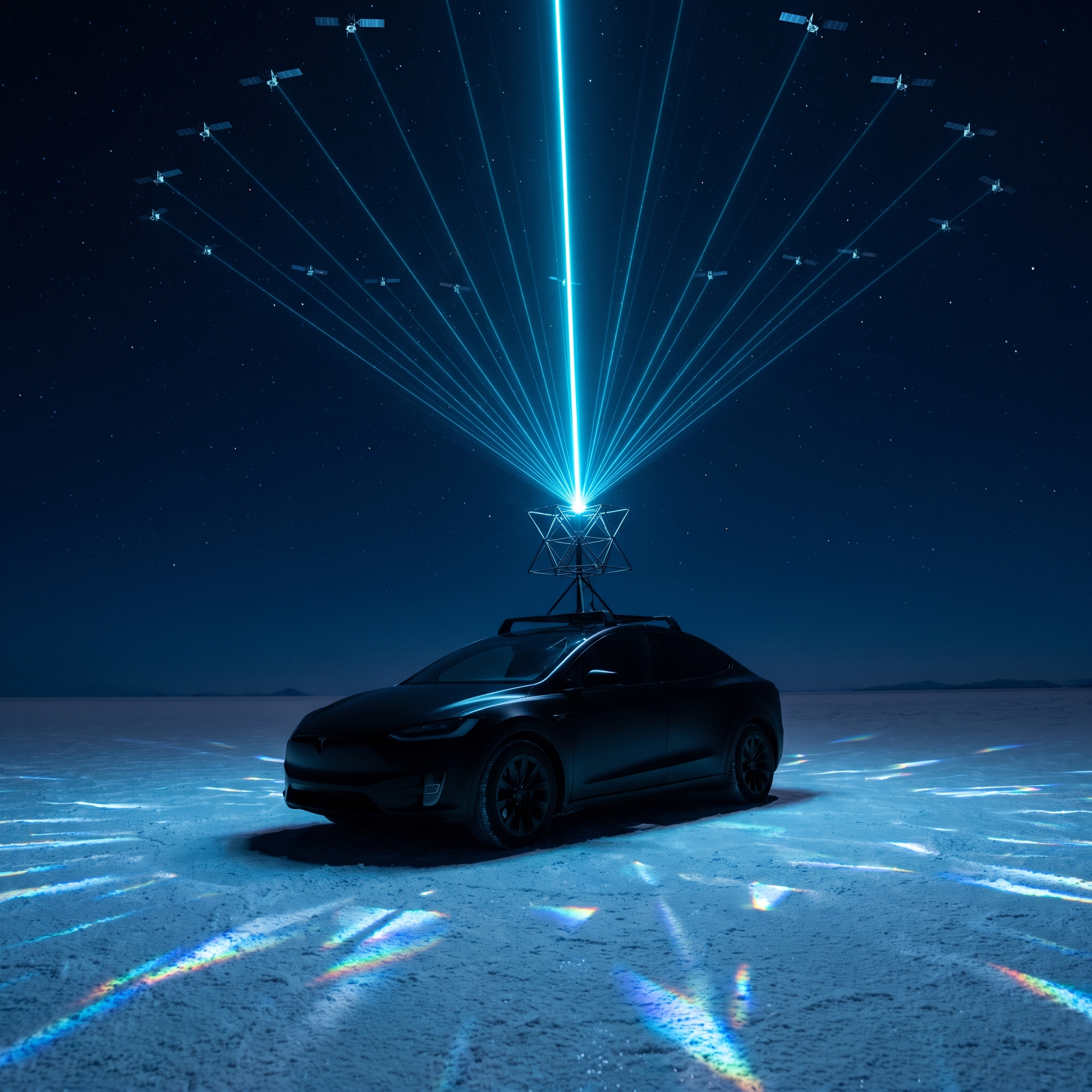
Adam: A satellite dish — designed to sit perfectly still — and someone announced it as a component inside a moving vehicle. With no explanation.
Adam: That's where this starts.
Adam: Around July 20th, 2026, Tesla and SpaceX ran coordinated posts on X confirming that Starlink V5 is directly integrated in the Cybercab — Tesla's autonomous robotaxi, no steering wheel, no pedals, first Tesla vehicle to get factory-fitted Starlink hardware.
Adam: No press release. No spec sheet. X posts and a showroom display.
Adam: The display was at Santana Row in San Jose — production Cybercab on the floor, cutaway schematic on the wall, and the Starlink Integration module labeled right there in the roof, sitting alongside GPS, 5G/LTE, eight cameras, and the FSD computer.
Adam: Look at that list for a second.
Adam: GPS, cellular, cameras, onboard FSD compute — that is already a complete connectivity and processing stack for a self-driving vehicle.
Adam: And then Starlink V5, just… sitting alongside it.
Adam: SpaceX's fifth-generation terminal — smaller than the predecessor, more energy-efficient, peak speeds around 375 megabits versus 400 for the V4 — and classified in Starlink's own documentation as a home internet product.
Adam: Ashok Elluswamy, Tesla's Head of AI, tried to fill the silence after the posts — offered some rationale for the integration — and still the core question didn't get answered.
Adam: Why does a vehicle with its own onboard FSD computer need a satellite link to function?
Adam: Elon Musk runs Tesla and SpaceX — both, simultaneously — and that's not incidental here.
Adam: This is a cross-company hardware decision made at the top, announced like a footnote, and the tension it creates is worth every second we spend on it.
Adam: Here's where the logic actually breaks.
Adam: The FSD computer drives the car. That is its job. It reads the cameras, makes the decisions, handles the road — all of it, onboard, in real time. A satellite link with measurable latency does not help with that. You cannot route a split-second braking decision through low-earth orbit and back.
Adam: So the Starlink V5 is not there to drive the Cybercab.
Adam: Then what is it for? And this is where the picture gets interesting — not exciting, interesting in the way a liability gets interesting.
Adam: Tesla launched robotaxi pilot operations in Tampa and Orlando ahead of Q2 earnings. Real deployments. Cybercabs moving passengers with no driver present. And the thing about a driverless fleet operating across two cities is that someone has to watch it — continuously, remotely. Fleet management. Over-the-air updates pushed to vehicles with no one in them to handle a problem. Remote monitoring when a unit stalls on a route. That is the actual use case. Satellite coverage fills the gaps 5G can't, especially in the dead zones between towers where a Cybercab mid-route has nothing else to lean on.
Adam: They were testing this before they announced it. Cybercab units observed on public roads with Starlink dishes physically bolted to the exterior — external, attached, not integrated. That was the proof-of-concept stage.
Adam: Now it's inside the roof.
Adam: Fred Lambert at Electrek went directly at Tesla on X — asked point blank whether the integration was already in production, and why a self-driving car needs satellite internet. Tesla didn't answer. That silence is load-bearing.
Adam: Because the answer would have to acknowledge what this actually is — not a driving feature, but an infrastructure dependency. And dependencies have terms.
Adam: No disclosed contract. No pricing arrangement between Tesla and SpaceX made public. No continuity terms. Two companies, both controlled by Elon Musk — and the hardware from one is now physically embedded in the product of the other, with no explanation of what happens if that relationship changes.
Adam: That is vertical integration across Musk companies — and it runs in one direction.
Adam: Picture a Cybercab — no driver, passenger inside, mid-route in Tampa — and the Starlink relationship changes. Pricing shifts. Service terms alter. SpaceX makes a decision Tesla cannot control because Tesla does not control SpaceX. The fleet doesn't automatically fail, but the infrastructure it depends on for remote monitoring and over-the-air updates is now negotiated territory. That is a vulnerability Reuters was already circling around — Tesla's cash burn, investor scrutiny of its AI spending — and this announcement adds a hardware dependency to that financial backdrop.
Adam: This is what Ashok Elluswamy was asked to explain and didn't fully explain.
Adam: The Cybercab is built to operate without a human in the loop. The Starlink V5 is built to keep it connected to the humans watching from outside that loop. And who controls that satellite network is a question Tesla's announcement treated like it wasn't one.
Adam: The classification problem is where this gets formal.
Adam: SpaceX's own documentation classifies the V5 as a home internet terminal. Not mobile. Not in-motion. Home. And Tesla is now building it into the roof of a vehicle that'll travel continuously, across two cities, carrying passengers with no driver present. Nobody has explained how that classification conflict resolves — not Ashok Elluswamy, not the Starlink posts on X, not the cutaway schematic at Santana Row. The regulatory category that terminal lives in was written for a dish bolted to a house.
Adam: A Cybercab is not a house.
Adam: That tension will land somewhere — and the somewhere is a regulator's desk. The FCC has jurisdiction over satellite communications in the United States. The NHTSA has jurisdiction over vehicle safety systems. When a component classified as a home internet terminal becomes part of the connectivity infrastructure of a driverless robotaxi, both agencies have a claim on it. That's not a hypothetical. That is a jurisdictional gap with a vehicle driving through it right now in Tampa and Orlando.
Adam: Think about what that means for competitors.
Adam: Waymo, Uber, every ride-hailing platform that wants to put autonomous vehicles on public roads — they're now watching a competitor whose satellite communications backbone is controlled by the same person who owns the car. Elon Musk controls Tesla's vehicle platform and SpaceX's Starlink network. That is a single person with authority over both the product and the infrastructure the product depends on. No other player in this space has that. And there are no disclosed contractual terms between Tesla and SpaceX — no pricing structure, no continuity agreement made public — which means there's no documented answer to what happens when those two companies' interests diverge.
Adam: That is the conflict of interest regulators will eventually name.
Adam: The timeline matters here. The Cybercab went from a concept at 'We, Robot' in October 2024 to pilot production at Gigafactory Texas in February 2026 — sixteen months. That is fast. And the Starlink V5 integration was confirmed in July 2026, with no regulatory clarity on the connectivity infrastructure underneath it. Franz von Holzhausen designed a vehicle that looks finished. The hardware inside the roof is — it's something else. It's a dependency with no public terms attached to it.
Adam: There's also the spec question.
Adam: The V5 peaks at 375 megabits. The V4 peaked above 400. You don't choose a lower-spec terminal for a flagship integration without a reason — and that reason hasn't been given. The next time you hear about this, it won't be a post on X. It'll be a shareholder asking Tesla to explain the contractual terms of its Starlink dependency on the record, or a regulator asking how a home internet terminal ended up classified as vehicle safety infrastructure. Fred Lambert asked that question and got silence. The silence runs out when someone with subpoena power asks it instead.
Adam: There is no public contract between Tesla and SpaceX governing the Starlink hardware now built into the roof of a vehicle carrying passengers across Tampa and Orlando with no driver present. No pricing structure. No continuity terms. Nothing on the record that tells you what Tesla owes SpaceX, or what SpaceX owes Tesla, or what either of them owes the person sitting in the back seat when the terms of that relationship shift.
One man controls both sides of that dependency.
And neither company has been asked to explain it under oath.
Adam: That changes when someone with subpoena power decides it does.