Mark Delaney: Hey, glad you grabbed coffee first — we're going straight in. I want you to picture something for me.
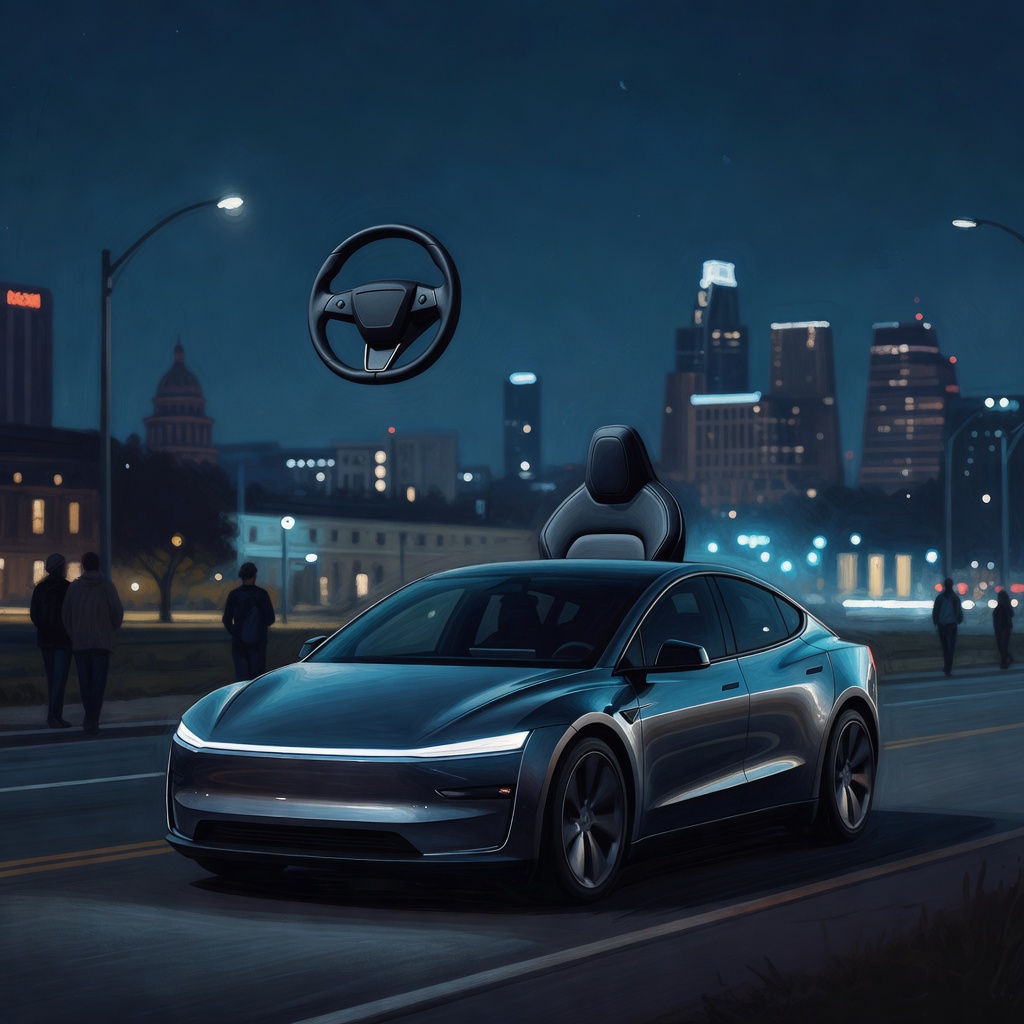
Mark Delaney: You're sitting in the passenger seat of a car in downtown Austin. No one's in the driver's seat because there is no driver's seat. The person next to you — uh, the safety monitor — their job is to watch. That's it. No wheel to grab, no pedal to hit. The car just... drives. That's what's happening on public roads as of June 30th, 2026.
Juniper Vale: That's the Cybercab. Tesla's purpose-built, two-seat, all-electric robotaxi — and 34 of them are running engineering tests in Austin right now.
Mark Delaney: Thirty-four on the road. And then — this is the number that got me — seventy-plus more units staged nearby. Not in a factory. Staged. Like they're ready to flip a switch.
Juniper Vale: You know, that staging detail is the one that actually tells you something about Tesla's confidence here. That's not hedging.
Mark Delaney: No, that's a bet. And honestly? After Elon Musk first showed this thing off in October 2024, I kinda figured it'd be vaporware for five years. It's been eighteen months.
Juniper Vale: Okay but that eighteen-month window — that's actually where the real story is. Because the thing that's genuinely new isn't the car. It's that the rules changed while the car was being built. Like, simultaneously.
Mark Delaney: Wait — the rule change and the road test are happening at the same time?
Juniper Vale: Yes. That's exactly it. Think of it like this — elevators used to have operators. Human beings who ran the controls. And then at some point, we removed them. But we removed them *after* the system was certified end-to-end. After the engineering was settled. The Cybercab flips that sequence. NHTSA is granting federal exemptions and the Texas Department of Transportation is formally signing off on a controlless design — all while Tesla is still running engineering tests. Production started at Gigafactory Texas in February, volume ramp in April, on-road tests June 30th. Concept to streets in under two years.
Mark Delaney: So the certification is being written around the car that's already driving.
Juniper Vale: Right. And that's — I mean, that has no modern precedent. The Texas DOT confirmation isn't just paperwork. It's a formal acknowledgment that a vehicle with zero manual controls is permitted on public roads. That sentence couldn't have been written a few years ago.
Mark Delaney: Huh. No kidding. So the headline is 'Tesla's testing a wild new car' but the actual signal is... the regulatory floor just moved.
Juniper Vale: That's the signal buried under the hype, yeah. A century of U.S. vehicle standards said you need a steering wheel, you need pedals. That requirement — gone, formally, right now, in parallel with the tests. Not after.
Mark Delaney: Okay but here's the take I keep seeing that I just — I don't buy it. Everyone's saying the safety monitor is a safeguard. Like, 'Tesla's being responsible, there's a human in the car.' That's not what's happening.
Juniper Vale: Is that unfair to Tesla, though? Or exactly right?
Mark Delaney: I mean — okay, think about what that monitor can actually do. Nothing mechanical. No wheel, no pedal, remember? The Model Y tests before this, yeah, a safety driver could grab the wheel. The Cybercab? That person is... logging data. Maybe calling someone. They're watching it happen.
Juniper Vale: Right. And that's actually a real distinction worth naming — the monitor's value might be in data collection, not intervention. Those aren't the same thing.
Mark Delaney: Regulatory optics.
Juniper Vale: Maybe. But then the harder question is — what's the actual safety case? Because Waymo has years of commercial robotaxi operations, multiple cities, real performance data. And they use LIDAR — physical 3D mapping of the environment. Tesla's Full Self-Driving is cameras. Only cameras. That comparison isn't settled.
Mark Delaney: And Tesla unveiled the Cybercab October 2024 — we're talking eighteen months ago — and it's still in engineering tests. No firm commercial launch date. So uh, the trust calculus is: cameras, six months of road tests, and a monitor who can't touch anything. Against Waymo's actual track record. That's the gap nobody's naming.
Juniper Vale: And that's the thing I can't resolve — if the Cybercab reaches commercial service before Full Self-Driving has actually proven it can match Waymo's real-world performance record in the same cities, we won't know whether NHTSA and the Texas DOT granted those exemptions because they genuinely believed in the technology, or because... I mean, ambition moved faster than oversight could catch up. Those are two very different stories and we won't be able to tell them apart from the outside.
Mark Delaney: Yeah. And the thing is — Austin already said yes to a driverless car. The Model Y tests happened, people got in. But that car had a wheel. Someone could've grabbed it. The Cybercab has nothing to grab. Whether that's a genuine safety upgrade or just... a leap — uh, I genuinely don't know. I don't think anyone does yet.
Juniper Vale: That's where I'll be watching. Thanks for chewing on this one with me.