Hope Sterling: Okay, I've been bouncing off the walls since I read this press release — like, how was your morning, are you caffeinated, because I need you to be ready.
Juniper Vale: I had one coffee and I'm told that's enough — hit me.
Hope Sterling: Tesla. The company that has spent its entire existence being like, we don't need you, we don't need suppliers, we are the battery people — just posted a global open competition asking strangers to come fix their factory. Literally. That is the episode.
Juniper Vale: The JUNI x Tesla Battery Cell Giga Challenge — July 6, 2026, that's when it dropped.
Hope Sterling: July 6! And the application window closes July 24 — like eighteen days, they gave people eighteen days, through Submittable, to apply to pilot solutions inside Gigafactory Berlin-Brandenburg's live production line. Like, a working factory. Not a test bench, a live line.
Juniper Vale: And it's not just Tesla doing this quietly — it's co-organized with JUNI, which is a startup platform backed by Germany's federal economics ministry and the EXIST program. This is officially official.
Hope Sterling: Which means the German government is basically co-signing on Tesla saying, yeah, we could use some help with these 4680 cells — and like, Elon Musk built this whole identity around not needing anyone's help on core technology, so what — what actually happened that got them here?
Juniper Vale: That's exactly the thing sitting under all of this.
Hope Sterling: Wait, but like — what even is the 4680, because I feel like we jumped to the drama without doing the setup.
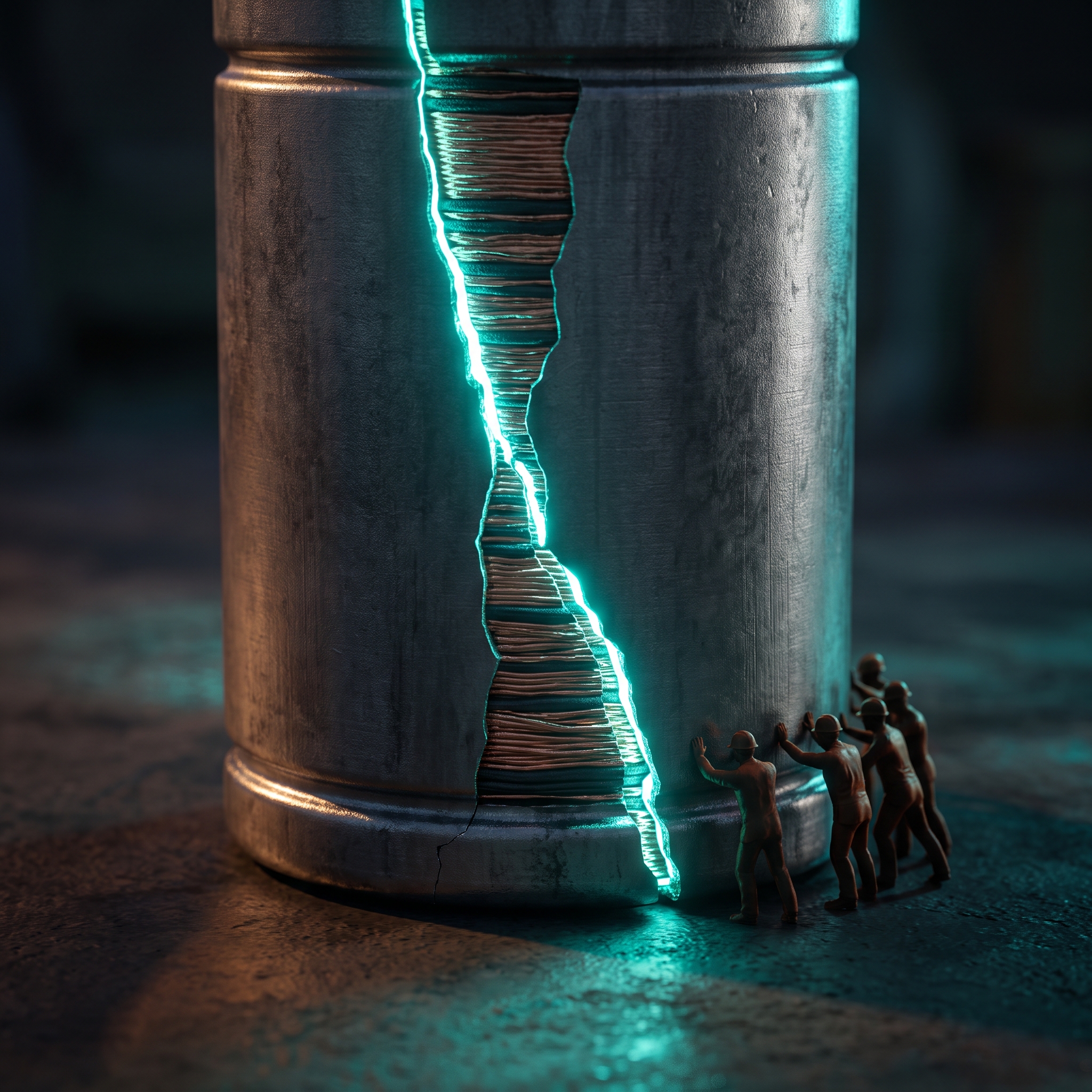
Juniper Vale: Think of it like a contractor who designed a revolutionary new type of concrete. It tests beautifully in the lab — genuinely brilliant chemistry. But when they pour it in your driveway, it cracks. The formula worked. The pour didn't. That's the 4680.
Hope Sterling: The pour didn't — okay, hold on, because Battery Day 2020, Elon Musk is up there promising 5x energy, 6x power, 16% more range. That's not a modest claim, that's like, a manifesto.
Juniper Vale: And a cost promise — up to $5,500 saved per pack. Which is the number that actually mattered for making EVs affordable. So fast forward to now, and Electrek — Fred Lambert specifically — reported that Tesla quietly swapped supplier cells for 4680s in European Model Y vehicles. And owners noticed. Worse energy density, slower charging, reduced range.
Hope Sterling: You paid for an upgrade and got downgraded. That is — I mean, that's not a bug, that's like a betrayal.
Juniper Vale: And the cost savings landed at $2,000 to $3,000 per Model Y pack — not $5,500. Which is still real money, but it's not the number that changes the math on mass-market EVs.
Hope Sterling: Wait, so actual owners are driving around with a worse battery than they would've gotten if Tesla just... kept using the old cells?
Juniper Vale: That's what the reporting shows. And the timeline — I mean, mass production was supposed to hit in 2021, and they only got to small-scale output around mid-2024. Three years late. And the program has burned through roughly $3 billion over five years getting here.
Hope Sterling: Three billion dollars and real people are canceling road trips. That's the actual story.
Juniper Vale: But here's the part people are getting wrong — because I keep seeing this framed as a total failure, and that's not right. Tesla confirmed in their Q4 2025 investor update that both electrodes, anode and cathode, are now being produced with a fully dry-electrode process at Giga Texas. First automaker ever to do that at scale for a production EV battery. That is a real thing that happened.
Hope Sterling: Wait — both? Like, they actually cracked it?
Juniper Vale: Both. And the dry-electrode process matters because you're eliminating the slurry coating steps — the wet chemistry, the massive drying ovens. Smaller factory footprint, way less energy. That's the cost economics unlock everyone was waiting for.
Hope Sterling: Okay but then — wait, this is the part I don't get — if Texas figured it out, why is Berlin still a nightmare? Like, can't they just... copy paste the factory?
Juniper Vale: That's actually the more interesting question than whether the tech works. Proving a process in one facility is — I mean, it's genuinely different from making it repeatable somewhere else. Different workforce, different supply chain, different equipment tolerances. The recipe exists. Running the restaurant in a second city is a separate problem.
Hope Sterling: And Berlin is targeting 18 gigawatt-hours of annual 4680 capacity — that's not a small ask to transfer.
Juniper Vale: Right — and even in Texas, where it worked, the output numbers tell you something. By October 2023, Giga Texas had produced around 20 million cells total. That sounds huge until you realize it's roughly 2,000 Cybertrucks a month. Which was nowhere near the original mass production targets from 2021.
Hope Sterling: So the breakthrough is real but like — limited? It worked, just... slowly, and only there, and that's why the startup challenge exists, and meanwhile Panasonic and CATL are racing on 46-series cells while Tesla's still asking strangers for help — that part, we should come back to that.
Juniper Vale: Yes — that competitive piece changes the whole stakes calculation. But the 'total failure' take skips the actual hard part, which is: confirmed breakthrough at one site, can't transfer it, and no one knows why at scale yet. That's a different problem than failure. It's a harder problem.
Hope Sterling: And that's the thing that keeps me up — like, the gap between 'it works in Texas' and 'we can't get Berlin there' is exactly why Panasonic and CATL scare me in this story. Because those companies, that's all they do. Batteries aren't a side project for them.
Juniper Vale: That's the real watch item. Both Panasonic and CATL are now pursuing 46-series cell production — same form factor as the 4680. And they have decades of scaling muscle that Tesla is literally running a startup contest to acquire.
Hope Sterling: Stop. So Tesla invents the format, spends $3 billion, and Panasonic just — walks in and scales it cleaner?
Juniper Vale: That's the risk. First-mover advantage evaporates if you can't hold the manufacturing lead. And the layoffs made it worse — the 4680 team was hit in Musk's broader cuts, so internally there's less capacity to solve this than there was two years ago.
Hope Sterling: Okay, picture this — it's late 2025, someone's got a Cybertruck, they've got a whole road trip mapped, and somewhere around the second leg they realize the charge is not holding like it should, they have to reroute. And then like two weeks later the startup challenge drops and they just — they laugh. That's the whole relationship with Tesla right now.
Juniper Vale: And that's the question the challenge has to answer, actually. Not 'is dry-electrode possible' — they proved that. It's whether open collaboration can move Berlin toward 18 GWh before CATL or Panasonic makes the head start irrelevant.
Hope Sterling: Two things I'm watching — does a startup actually pilot something at Giga Berlin before the 18 GWh target slips again, and do Panasonic or CATL close the 46-series gap before the challenge even produces results. Either one changes the whole story.
Juniper Vale: Yeah. The vertical integration bet made sense when no one else could do this. The question now is whether anyone can still say that with a straight face.
Hope Sterling: And like — I can't shake this. The JUNI x Tesla Battery Cell Giga Challenge is basically Tesla going public with the bet that open innovation can do what $3 billion of internal R&D couldn't. And if it doesn't work — if no startup pilots anything useful inside Giga Berlin — what does that actually say about the 4680? Not the science. The product.
Juniper Vale: Inventing something and manufacturing it reliably are two different achievements. And Tesla may have genuinely only solved one of them.
Hope Sterling: Yeah. I mean — does that make it revolutionary? Or just... expensively experimental? I don't know. I actually don't know.
Juniper Vale: Neither do I. And I think that's where it honestly sits right now.