Hugo Vance: You seemed distracted when you walked in — what's going on?
Lila Soto: Yeah, I — hm, I've been stuck on something since this morning. I was reading about the Slave Societies Digital Archive, which has over 700,000 digitized images of historical records, and I keep thinking: that's an enormous number. And also completely beside the point.
Hugo Vance: Beside the point how?
Lila Soto: Because 700,000 images of what? Records that were kept by owners, by courts, by churches with legal authority over these people. The surviving record is built on survivorship bias — what's there isn't a portrait of humanity, it's a portrait of power. And a name only makes it into a ledger because of a sale, or a punishment, or a legal transfer.
Hugo Vance: Alexis Wells-Oghoghomeh is very precise about this. Enslaved women appear in those records — present, documented — but 'never speaking.' Their bodies are there. Their labor is there. Their voice is not.
Lila Soto: That phrase — 'never speaking' — I mean, that's not silence. That's something worse than silence, kind of?
Hugo Vance: Saidiya Hartman calls the whole structure the 'violence of the archive.' The document perpetuates the harm even in the act of recording. You see, it's not a neutral ledger. It was never neutral.
Lila Soto: Which is the thing driving everything we're getting into today — if the archive was designed to erase you, what does it even mean to go looking for someone inside it?
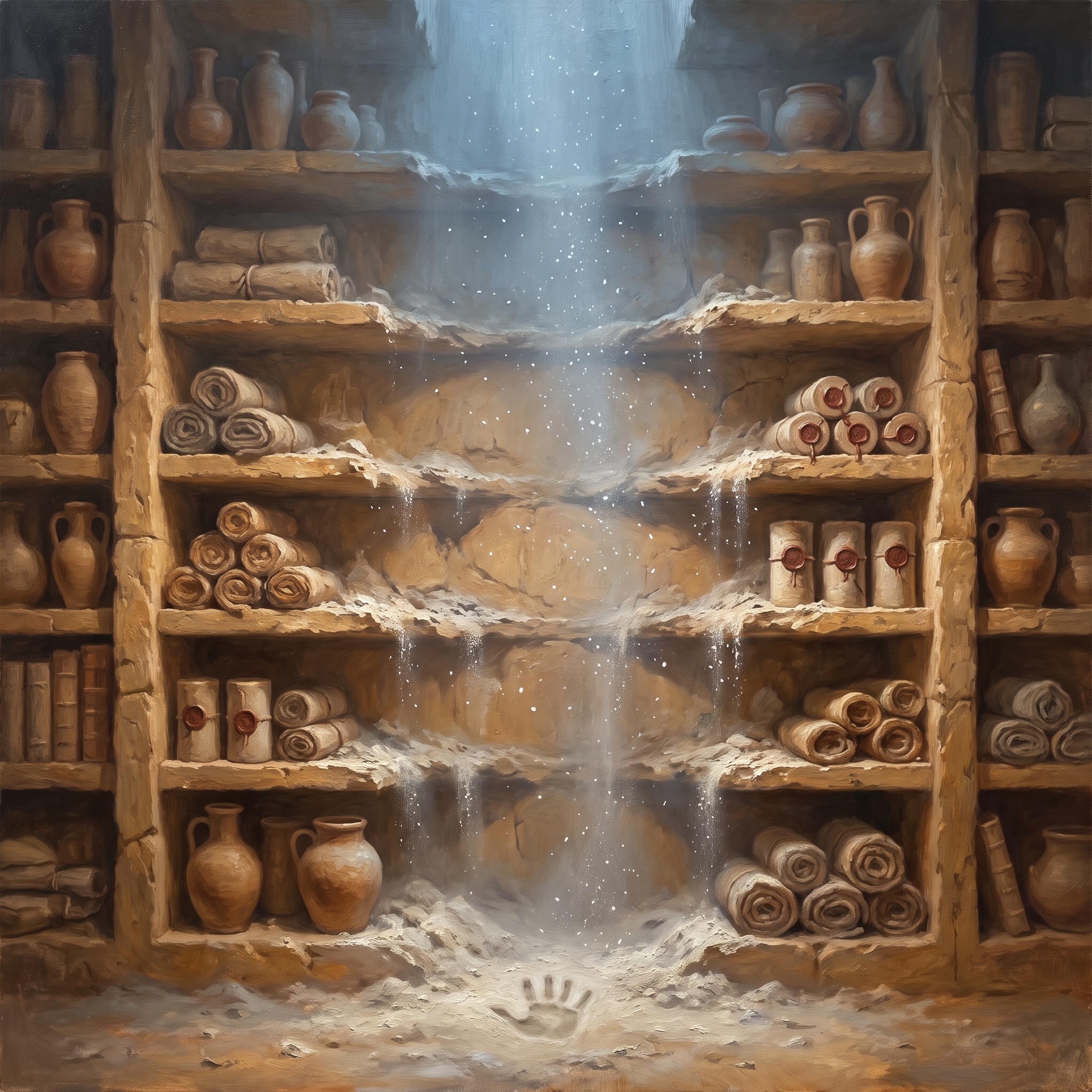
Hugo Vance: Well, and that question — 'what does it mean to go looking' — that's actually where the mechanism becomes visible. Think of it this way. The archive is like a family photo album kept exclusively by the wealthiest relative. What gets into that album is whatever that person thought worth photographing. Not the tenant farmer. Not the woman who ran the household labor. Not the man who was owned. The album isn't incomplete by accident. Someone decided what the camera pointed at.
Lila Soto: Okay but — I mean, wasn't that just kind of inevitable? People who could write, wrote. Clergy wrote. Courts wrote. That's just who held the pen.
Hugo Vance: That's the comfortable version. Literacy was concentrated among clergy, nobility, bureaucrats, merchants — yes. Oral cultures, peasants, the poor left almost no documentation. That part is structural. But some of it goes further than that. It's not passive. It's — you see, it's architectural.
Lila Soto: Architectural how?
Hugo Vance: In pre-abolition Anglo-American law, a married woman could not hold property or sign a contract in her own name. Her name was legally barred from appearing on those documents. So when historians look at property records and find almost no women — that absence doesn't mean women weren't managing estates, negotiating labor, running farms. It means the law made their names disappear from the page. The silence is a legal rule masquerading as an historical fact.
Lila Soto: Wait — the name literally couldn't appear? Not 'wasn't included,' couldn't legally exist on the document?
Hugo Vance: Precisely that. The record is not evidence of her absence. It's evidence of the rule.
Lila Soto: That's — hm, that reframes everything. Because historians look at that gap and might read it as 'women weren't involved' when what they're actually reading is a statute. The document is doing legal work, not historical work.
Hugo Vance: And monasteries, royal courts, colonial administrations — they preserved what they valued. Records of enslaved people, of women, of the poor — left to decay, to fire, to neglect. Archives as non-neutral power structures. Not passive storehouses. Active reflections of who had authority, wealth, empire. That's the core of it.
Lila Soto: But that's where I get stuck — because if the document is doing legal work, not historical work, then the flip side is that someone has to go back in and read it against itself. And that method, that reading against the grain thing — I mean, it's kind of breathtaking but also kind of terrifying?
Hugo Vance: Name the terror precisely.
Lila Soto: Picture a historian — real scenario — sitting with a court transcript from 1820. An enslaved woman is brought before a judge. Her actual words are gone, replaced by the court's summary of her crime. And the historian isn't there for the verdict. She's reading for the texture underneath the paraphrase. The rhythm of speech the clerk couldn't quite flatten out. That's the method. And it's — yeah, it's extraordinary. But what if you're just hearing what you came to hear?
Hugo Vance: Saidiya Hartman confronts this directly. Her argument is that the lives of enslaved people can be — her phrase — 'rescued and reclaimed from the violence of the archive' through exactly that kind of excavation. And I find it genuinely compelling. But I won't pretend the risk isn't real.
Lila Soto: What's the risk in your version of it?
Hugo Vance: That what emerges is discovery — yes — or it's creative interpretation dressed as recovery. You see, Howard Zinn in 1980 with A People's History, that was a landmark — genuinely shifted narrative toward women, workers, African-Americans, Native Americans, the working poor. But it also introduced its own framings, its own omissions. He was reading against one grain and sometimes with another.
Lila Soto: Oh — so the rescuer brings their own distortions.
Hugo Vance: Always. The question isn't whether interpretation is present. It's whether you can show the document constrained you — that something in the transcript actually pushes back against your reading. Cross-referencing legal records with material culture, oral history — that's when scholars of slavery have surfaced how gender shaped both the institution and the route out of it. Evidence the documents never intended to give. That's the discipline. Without it, you're not reading against the grain, you're writing over it.
Lila Soto: And what the Slave Societies Digital Archive can even do with all of that — whether 700,000 images changes the math or just the scale of the same problem — that's the part I think we need to sit with next.
Hugo Vance: The Slave Societies Digital Archive is actually the test case for that exact question. Founded in 2003, over 700,000 digitized images — yes, that is genuinely significant. But here's what the number cannot tell you: how much of the original record it represents. We have no measure of that. None. You can digitize every surviving document and still not know what percentage of what once existed you're even touching.
Lila Soto: So the denominator is just — gone.
Hugo Vance: Irrecoverably. What was never written, or what burned, or what decayed in a parish cellar in Cartagena — no amount of methodological ingenuity retrieves it. The archive addresses bias at the margins. Not at the structural root.
Lila Soto: Mm — okay, but I want to push on margins. Because archaeology, material culture, oral history — those aren't nothing, right? You can sometimes find the person underneath the record through what they built or left behind or what their grandchildren remembered.
Hugo Vance: Supplementary. I mean — genuinely valuable, I'm not dismissing it. But think about what it means when your strongest evidence for someone's interior life is a ceramic pattern or a third-generation memory. That's not recovery. That's reconstruction under severe constraint. It narrows the uncertainty; it doesn't close it.
Lila Soto: And there are people alive right now sitting with that constraint. Like — their grandparent's actual experience, the texture of it, what they thought about their own children — that's not ancient history. That's a broken chain of knowing yourself.
Hugo Vance: That's the part I think gets lost when we talk about 'digital recovery projects.' The loss isn't only scholarly. It's — you see, it's genealogical in the deepest sense. The irreversibility lands differently when the absent record is your grandmother's, not a stranger's from four centuries ago.
Lila Soto: Which means the question of what historians owe those communities — not just what method they use, but what they say when the method runs out — is genuinely hard.
Hugo Vance: What honesty requires, I think — and this is where it lands for me — is that every history lesson, every museum caption, every documentary is already an act of interpretation. Already shaped by whose voice survived to shape it. The honest move is simply to say so.
Lila Soto: Not 'we don't know anything.' Just — we know who got to decide what we'd know.
Hugo Vance: Yes. The archive is both the problem and the only tool available. That's the constraint you can't get around. Saidiya Hartman understood that — you work from inside the violence of the thing because there's nowhere else to stand.
Lila Soto: And an archival silence isn't an absence of people. It's — mm, it's evidence of who controlled the pen. That's what I want to carry out of this.
Hugo Vance: That's the modest version. And it's the right one.
Lila Soto: Thank you for sitting in this with me. I think I needed someone to make it feel — less like a hole and more like a wall with a shape.