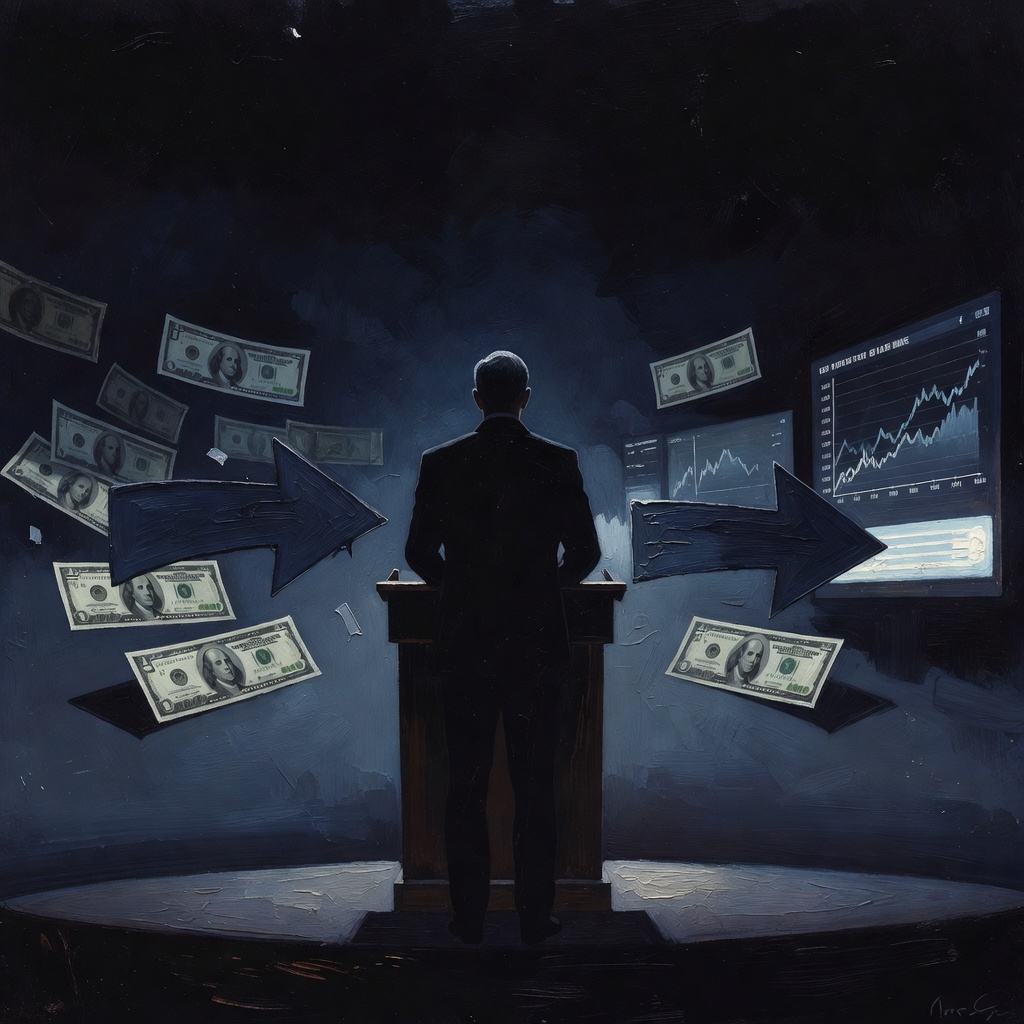
Jordan Hale: The $31 trillion Treasury market is pricing in rate hikes this year, but the president who appointed Kevin Warsh explicitly expects him to cut rates — and one of them has to be wrong.
Alex Mercer: Yeah, and what matters here is that both of those things can't be true at the same time — either the bond market is misreading the economy, or Trump is misreading his own Fed chair.
Jordan Hale: Right, and — I mean, the crazy part is Warsh hasn't even fully settled into the chair yet and he's already walking into this like, impossible situation where his two most important audiences want completely opposite things from him.
Alex Mercer: Basically, yeah — if you look at the data, markets are seeing persistent inflation pressure and building in hikes, but the White House wants cheaper borrowing costs to keep the growth story alive heading into the next election cycle.
Jordan Hale: And Warsh — you know, he's got this reputation as an inflation hawk, which is part of why the bond market might actually trust him, but that's also exactly what makes Trump's expectations so, like, awkward to square.
Alex Mercer: The key point is that whoever he sides with first — the market or the White House — that signals everything about how this chairmanship is going to go, and that's what we're digging into today.
Alex Mercer: Three weeks into the job, Kevin Warsh already can't satisfy both of the people he answers to. Trump wants rate cuts. The bond market is pricing in rate hikes. Those two things are not compatible.
Jordan Hale: And you have to feel the whiplash here, right? Trump swears Warsh in at the White House on May 22nd, big ceremony, says he wants him to be 'totally independent' — and then you look at the two-year Treasury yield sitting at 4.15%, above the Fed's own 3.75% ceiling. The market is basically laughing at that word. Independent.
Alex Mercer: The yield gap is the key thing. When the two-year is above the policy rate, that's the market saying the Fed is already behind. It's not a prediction — it's a bet. Thirty-one trillion dollars in Treasuries is positioned against rate cuts right now.
Jordan Hale: Okay but here's what I keep coming back to — Trump nominated Warsh in January 2026, when the economic case for cuts actually existed. And then everything reversed. Inflation hits 4.2% by May, three-year high. The jobs report adds 172,000 jobs, more than double what forecasters expected. Did Trump just... get unlucky with timing?
Alex Mercer: I think that's partially right, but I'd push back a little. I don't know if Trump ever really understood what he was buying with Warsh. Warsh spent years at the Hoover Institution explicitly criticizing the Fed for running a bloated balance sheet and for over-relying on forward guidance. That's not a man who's itching to cut rates. That's a man who thinks the Fed has been too loose for a decade.
Jordan Hale: Wait, so you're saying Trump misread his own pick?
Alex Mercer: Basically. Or Warsh let him believe what he wanted to believe. Either way, the collision was always coming. You don't put a known inflation hawk in the chair and get rate cuts into 4.2% inflation.
Jordan Hale: And this is where the Paul Volcker comparison haunts me. Volcker built enough credibility over years that when he finally tightened, people accepted the pain. Warsh has zero of that buffer. One Democrat voted for him — John Fetterman, lone wolf — and that's it. Weakest bipartisan confirmation of any modern Fed chair. He starts delegitimized.
Alex Mercer: That confirmation vote matters more than people are treating it. Powell had broad bipartisan support. That gave him cover when Trump attacked him publicly over rates. Warsh doesn't have that. If Trump turns on him, there's no coalition in the Senate saying 'back off, this guy's credible.'
Jordan Hale: Trump doesn't even need to remove him. He just needs to keep calling him a partisan, and Warsh's credibility slowly bleeds out while the market is still trying to figure out which direction he's moving.
Alex Mercer: I'm not totally convinced that's how it plays out, though. The June 16th FOMC meeting is the first real signal. J.P. Morgan strategists are forecasting rates on hold through all of 2026, with three potential cuts in 2027 if inflation cools. If Warsh holds and the press conference language reflects that — drops any easing bias — markets will read it as a hawkish signal regardless of what Trump says publicly.
Jordan Hale: But Trump recently called the inflation numbers 'great.' Like, genuinely tried to spin 4.2% as good news. Are we reading that as him giving Warsh political cover to hold? Or is that just Trump doing Trump?
Alex Mercer: One positive comment doesn't undo sustained pressure. Look at what he did to Jerome Powell — months of public attacks, 'too slow,' 'keeping rates too high,' floated removing him. Powell survived, but it cost the Fed real credibility. Warsh starts with less credibility than Powell had and faces the same dynamic.
Jordan Hale: Right, but there's this — the Iran conflict, the tariff effects driving some of this inflation, those could be temporary. If Warsh frames it as a transitory shock and holds steady rather than hiking, does that actually thread the needle? Trump gets no cuts but no hikes either, and Warsh can point to external factors.
Alex Mercer: Here's the problem with that framing. The bond market is not treating Iran or tariffs as transitory. The two-year yield doesn't move to 4.15% because traders think this is temporary. Investors are positioned for tightening by December 2026. SoFi's FedWatch data has 98% odds on no hike at the June meeting, but analysts expect Warsh to drop easing language entirely. The market has already decided this isn't transient.
Jordan Hale: Okay but — are we sure the market is right? Like, genuinely, do we just defer to thirty-one trillion dollars of positioning and say case closed?
Alex Mercer: No, and that's a fair challenge. The honest answer is nobody knows if the Iran shock is transitory. But here's what Warsh can't do — he can't cut rates into 4.2% inflation and keep the Fed's price-stability mandate intact. That's the statutory floor. Whatever happens with Iran or tariffs, that number is real right now.
Jordan Hale: So he holds. And if he holds and Trump publicly attacks him the way he attacked Powell —
Alex Mercer: Then the question is whether the institution survives the delegitimization faster than the market can price in stability. And I don't think we know the answer to that yet. Warsh's hawkish instincts point one direction. The political circumstances he was handed point somewhere else. June 17th press conference — that's the first real data point on which version of him we actually got.
Jordan Hale: And if Trump decides that Warsh, his pick, is just another Powell in disguise — what's left of Fed independence as a concept, not just as a norm? That's the part I can't shake.
Jordan Hale: Man, okay. I keep coming back to that framing — the inflation hawk was always in the chair. Like, that's the whole thing. Trump went looking for someone who'd do what he wanted and picked someone constitutionally incapable of it.
Alex Mercer: Yeah. And what matters here is that's not a Warsh problem — that's a precedent problem. Every future Fed chair is going to operate in the shadow of how this one ends.
Jordan Hale: June 17th. We'll be watching. Catch you next week.