Finn Brooks: Okay, long week — but I have been stewing on something and I need to just say it out loud to see if it holds.
Juniper Vale: Stewing is a good sign, usually — what is it?
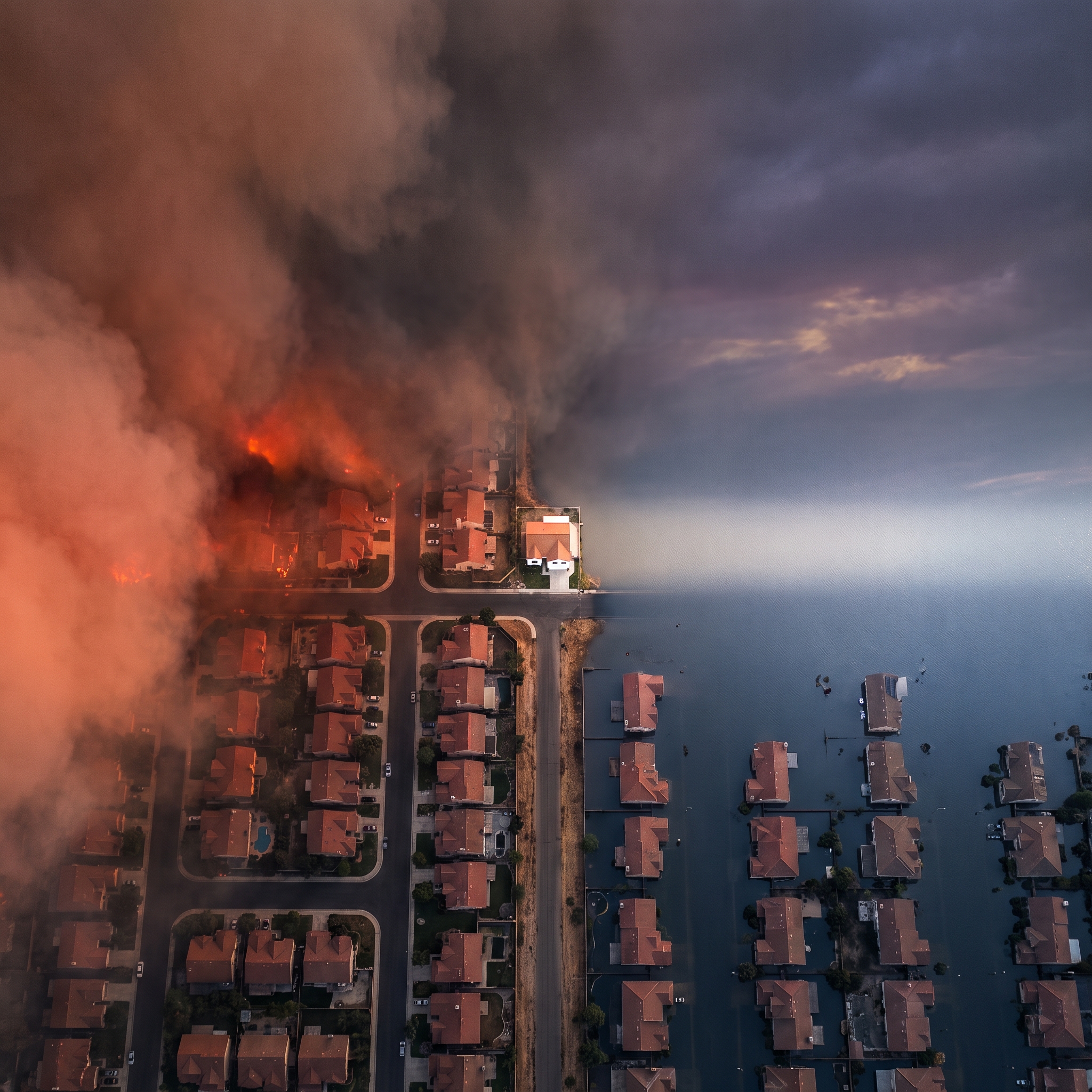
Finn Brooks: Hot take: the Great Climate Insurance Collapse — that's Senator Sheldon Whitehouse's phrase, by the way, not mine — the whole thing where State Farm, Allstate, and Farmers stopped writing new policies in California and Florida? That's not a crisis. That's the market finally getting honest.
Juniper Vale: Hmm — define 'getting honest.'
Finn Brooks: Florida average annual premium is $7,136. Highest in the nation. And Realtor.com just — like July 23rd — published data showing 23.1% of U.S. homes, $11.2 trillion in value, are sitting in severe or extreme climate risk zones. And buyers are still rushing into those exact markets, at stronger rates than nearby lower-risk areas. So like... the information is there. The price signal is screaming. And people are saying, I want that house.
Juniper Vale: That's on them, you're saying.
Finn Brooks: I mean — yeah? And I feel a little cold saying that, but I don't know that it's wrong.
Juniper Vale: Here's where I'd push: when the private market exits and you land in the state's insurer of last resort, that's not just a personal consequence anymore — that risk just got socialized.
Finn Brooks: Right — but is that actually new? Like, risk gets socialized all the time, that's kind of the whole premise of insurance.
Juniper Vale: Think of it like this — insurance is basically a giant communal rain jacket. Everyone pays in, and when one person gets soaked, the jacket-maker covers them. That works as long as only a few people are getting soaked per year. But when a whole neighborhood starts flooding every single year, the jacket-maker doesn't raise prices forever. At some point they just stop selling jackets there. And the neighborhood is left out in the rain with no warning.
Finn Brooks: Okay but — wait, so it's not that individuals made bad choices. The whole architecture just stops functioning for that geography.
Juniper Vale: That's exactly the thing the Senate Budget Committee found. Whitehouse ran the first-ever county-level dataset on non-renewals, all 50 states, 2018 to 2023 — and the non-renewal rates weren't scattered randomly. They were highest and rising fastest in Florida, California, Louisiana, coastal North Carolina. Predictable climate-hazard geography. That's not millions of individual bad decisions. That's a structural pattern.
Finn Brooks: No way — a dozen insurers just left Louisiana after 2020 and 2021? Like, gone?
Juniper Vale: At least a dozen, after those back-to-back hurricane seasons. Which means those homeowners ended up in the state's insurer of last resort — a program never designed to carry that kind of concentrated load. And the Geneva Association flagged this isn't just a Louisiana or Florida problem — they documented availability failures across multiple U.S. states and Canadian provinces. They're calling it a global market dislocation.
Finn Brooks: Global — okay, and Moody's put a number on the long tail of this, right? Like, the physical climate risk toll?
Juniper Vale: $41.4 trillion by the mid-2040s. So when Whitehouse calls this the Great Climate Insurance Collapse, he's not being dramatic — he's describing a mechanism. The private market retreats, the state backstops absorb risk they can't price, and that $41 trillion pressure keeps building underneath all of it.
Finn Brooks: That $41 trillion number sitting under all this — okay, but what keeps nagging at me, because I think the hot take actually survives, just not the way I phrased it. Like, buyers flooding into Fort Lauderdale right now aren't being idiots. I think they're — wait, actually, let me try this differently. They're pricing in a backstop that already exists.
Juniper Vale: The National Flood Insurance Program.
Finn Brooks: The NFIP, exactly — it's already a federal flood backstop, it's not hypothetical. So the expectation that the government absorbs catastrophic loss? That's not delusional. That's just reading what the government already does.
Juniper Vale: Okay, I'll grant you that. But here's what makes it complicated — picture a couple signing closing documents on a beachfront condo in Fort Lauderdale on a Tuesday afternoon. They've already calculated $594 more per month — between the HOA premium and the insurance — and they looked at each other and said the appreciation math still wins.
Finn Brooks: Right — and that $192 a month gap in HOA fees alone, that's 53.6% more than what people in lower-risk areas pay. That's not nothing. The climate tax is already embedded in their monthly budget before a single hurricane shows up.
Juniper Vale: Wait — so they're not ignoring the cost. They're paying it and still saying yes.
Finn Brooks: Which means the real question isn't 'why don't they see the risk' — they see it, they're literally paying it monthly. The question is whether the bet that the government catches them if it all goes wrong is rational or just... catastrophically optimistic.
Juniper Vale: And if enough people are making that bet simultaneously, the NFIP math breaks — the backstop that made the bet rational is the thing the bet destroys. I mean, that's the paradox.
Finn Brooks: Which actually sets up the fix everyone's reaching for — this federal climate reinsurance backstop modeled on TRIA — and I think when we get there, it solves one problem and quietly creates a bigger one.
Juniper Vale: Right — but the TRIA model is where this gets uncomfortable fast, because that's the part nobody's saying out loud yet. TRIA worked for terrorism because terrorism losses were episodic, unpredictable, hard to model. Climate losses are the opposite. They're accelerating, they're geographic, they're basically scheduled at this point. So if you build a federal reinsurance backstop on that architecture, you're not stabilizing the private market — you're handing private insurers a permission slip to stop pricing risk at all.
Finn Brooks: Wait — so the backstop kills the price signal.
Juniper Vale: That's the trap. And state regulators are already inside a smaller version of it — you cap premiums to keep coverage affordable, State Farm and Allstate walk out the door, and you've made the availability crisis worse while trying to fix the affordability one.
Finn Brooks: And then Citizens Property Insurance in Florida or the California FAIR Plan just... absorbs everything the private market dropped. Which means — wait, I mean, these programs were never designed to hold half a state's housing risk. That's not a safety net, that's like a, I don't know, it's a hammock holding a car.
Juniper Vale: And if a major hurricane hits while Citizens is holding that much exposure with insufficient reserves — the federal government intervenes anyway. Not by design. By necessity.
Finn Brooks: The bailout happens either way, just messier.
Juniper Vale: Which is why Jane Kim won California's insurance commissioner primary on a public disaster insurance platform — because voters are already intuiting that the private market isn't coming back. But Amy Bach at United Policyholders basically said, look, a public option sounds good until you price what it actually costs to run at scale. And McCarran-Ferguson is still a 1945 wall blocking any clean federal solution — states own insurance regulation, full stop.
Finn Brooks: So the honest answer is — no one designed this outcome, but Citizens and the FAIR Plan might already be too big to fail, which means we've already socialized the loss. We're just pretending we haven't.
Juniper Vale: That's the calibrated take, I think. Not 'the fix is coming' — the fix may already be happening, badly, by default, and calling it a TRIA-style backstop would just be giving a name to something we're already doing without the accountability.
Finn Brooks: Okay, so — I started this whole thing saying the market was getting honest. And I think what I actually meant was the market is just... running out the clock. Like, it's not correcting anybody's behavior. It's just waiting for one bad hurricane season to hand the bill to whoever's left holding the bag — which, at this point, is the rest of us.
Juniper Vale: And that's the thing Whitehouse keeps saying that I don't think lands the way it should. He didn't call this a pricing problem. He called it a collapse. And — I mean, that word matters. Pricing problems get fixed. Collapses get bailed out. No one votes on it, no one designs the architecture, Congress just has no choice once the first major catastrophe hits a Citizens or a FAIR Plan with nowhere near enough reserves to absorb it. The precedent for socializing those losses gets set regardless of whether anyone intended it.
Finn Brooks: Which is kind of what I was reaching for on Tuesday morning in Fort Lauderdale, right? That couple at the closing table. They weren't wrong about the backstop existing. They were just wrong about who authorized it.
Juniper Vale: Nobody did. That's the whole thing. Anyway — good stew.