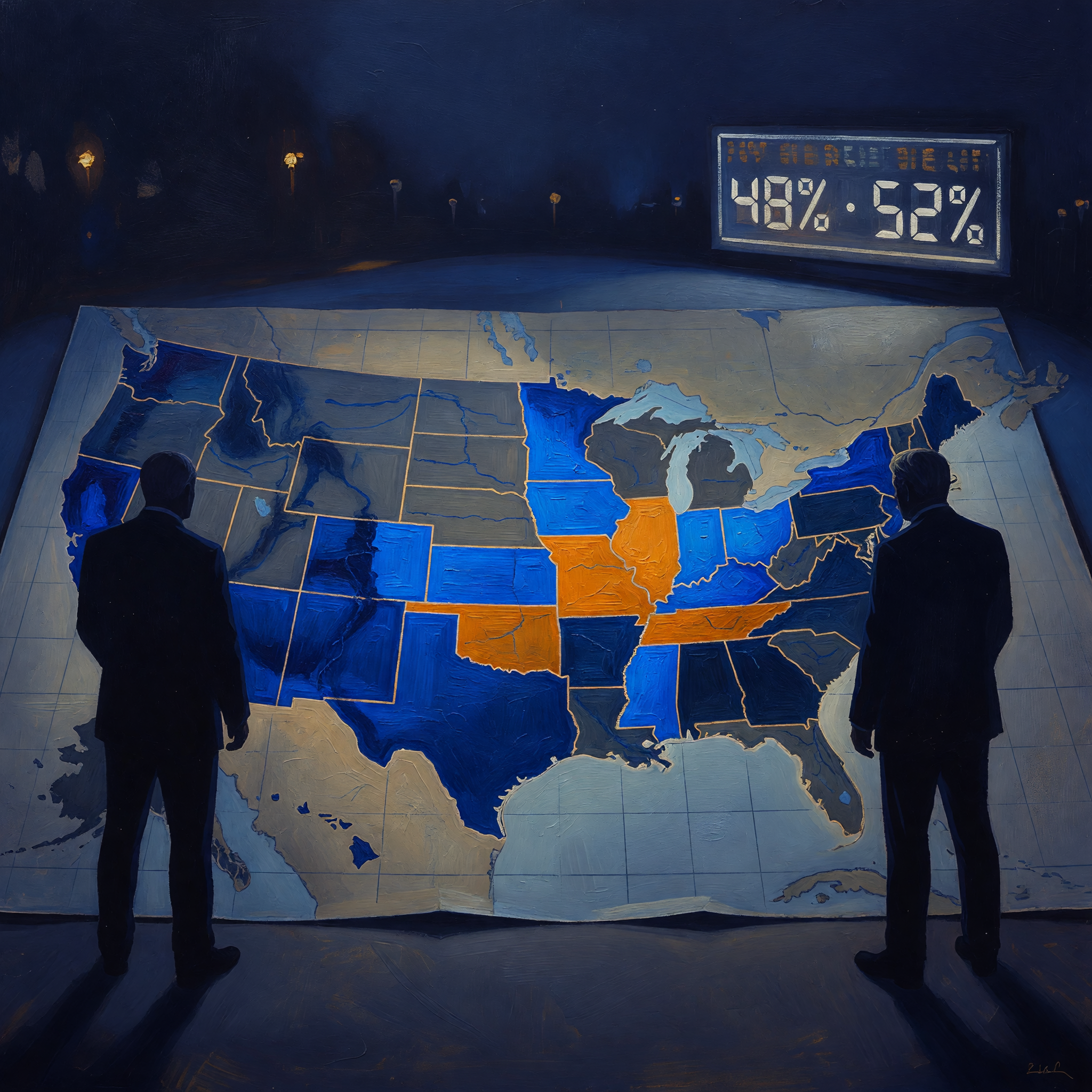
Iris Holm: Hana, good to be back — how was the drive in, did you catch any of the postelection coverage still running?
Hana Field: Oh, I did, and what struck me was — they kept cutting to these really tight state maps, Arizona, Pennsylvania, Georgia, and I kept thinking about all the states that were just... not on the map at all. California. Texas. Not even in the frame.
Iris Holm: That's the thing we're pulling on today. So — the Electoral College. And the actual question is whether the way campaigns respond to it is rational optimization or something closer to a structural failure. Those aren't the same answer.
Hana Field: And the number that — so in 2020, 96% of all presidential campaign visits and advertising happened in just 12 states. Ninety-six percent. I keep saying it because it keeps not feeling real.
Iris Holm: Thirty-eight states and DC, mathematically irrelevant. Not unimportant. Irrelevant — under the rules as written.
Hana Field: And the rule is — winner-take-all, which 48 of 50 states use — means it doesn't matter if you win by one vote or by a million. You get the same number of electoral votes either way. So it's like, you know, a game where the margin is invisible. Only the outcome counts.
Iris Holm: Maine and Nebraska don't do it that way. Two states. Everyone else? Winner takes all.
Hana Field: Which — we should definitely come back to that, because it's a stranger exception than it sounds.
Iris Holm: Stranger than it sounds is right — because the exception actually proves the origin. Winner-take-all wasn't in the Constitution. State legislatures chose it, one by one, starting in the early 1800s, because whichever party controlled a legislature realized: split your electors and you hand the other side leverage. Give them all to your guy and you punch at full weight. It was nakedly tactical.
Hana Field: Wait — so it spread because each state was trying to out-maneuver the next one?
Iris Holm: Exactly that dynamic. No federal mandate. No constitutional requirement. Partisan majorities in state legislatures, calculating their party's influence, adopting a unit rule and locking it in. And then — here's what's strange — 48 states end up doing the same thing, and we treat it like bedrock.
Hana Field: And Maine and Nebraska just... didn't. They allocate by congressional district, and I keep wondering — did the republic collapse? Because it didn't, and Maine actually split its electoral votes in 2016 and again in 2020, and somehow that's not the center of every reform conversation.
Iris Holm: Two states quietly run a different system. The architecture holds. And yet 48 states behave as if the unit rule is — I don't know, gravity. A tactical choice calcified into something that feels constitutional without being constitutional.
Hana Field: So what does it mean that something adopted for partisan self-interest in the 1800s now feels like it was handed down — you know, like it was always the design?
Iris Holm: It means the origin is almost never interrogated. Which is — frankly, that's the whole trap. If voters in California or Texas assume winner-take-all is constitutional architecture, they have no frame for asking why their state gets treated as a safe state foregone conclusion rather than a place campaigns might actually contest.
Hana Field: And the gap between accidental origin and permanent-feeling structure — that's what makes it so hard to undo, isn't it? Not that it's impossible. Just that nobody thinks to ask if it was ever a choice.
Iris Holm: And that choice question is where the data gets genuinely uncomfortable. Because David Strömberg — Stockholm University economist — he didn't argue the system produces bad behavior. He proved it produces *optimal* behavior. Built a probabilistic voting model, fed it each state's electoral vote count, forecasted outcome, forecast uncertainty. Ran it against 2000 and 2004. The correlation between his predicted visits and actual campaign visits was 0.9.
Hana Field: Wait — 0.9? That's almost perfect.
Iris Holm: Nearly perfect. Not a tendency. A mechanism. Campaigns weren't roughly following the incentive — they were executing it with near-mathematical precision.
Hana Field: So what Strömberg actually showed is — and I'm trying to land this right — it's not that campaigns are *choosing* to ignore Oklahoma or California. It's that ignoring them is the correct answer to the equation. A rational campaign has no choice, given winner-take-all.
Iris Holm: Right. Win a state by one vote, win it by a million — same electoral outcome. So near-zero investment in a safe state isn't negligence. It's the correct rational choice. Strömberg's model even centers around the probability of, quote, 'being Florida' — the paradigmatic swing state, so central to the math it literally named a term in a formal economic model.
Hana Field: Florida as a unit of measurement. And then 2024 — you had five states decided by less than 3 percentage points. Five. And California, Texas — combined that's over 80 electoral votes — negligible presidential campaign attention. Because the model says so.
Iris Holm: The system is working perfectly. That's the part that's hard to sit with — it's not broken. Campaigns aren't failing safe-state voters. They're succeeding at optimization.
Hana Field: And the person in Oklahoma checking her inbox the Sunday before the election, nothing there — she's not the victim of a mistake. She's the correct output of a rational system. That's — I don't know, that's a different kind of disturbing.
Iris Holm: Which brings us to something we haven't touched yet — and this is where it compounds. Because which states get ignored rotates. Georgia moves competitive. Ohio doesn't. But the *cost* to the voters left behind? That doesn't rotate. It accumulates.
Hana Field: But rotating neglect — I'm not sure that's actually better for the person living through it. Like, Georgia flipped competitive, Arizona did too, after decades of safe Republican territory. And that's real. But the woman in Oklahoma sealing her mail ballot in November 2024, no campaign ad on her local news all cycle, no one knocked her door — she doesn't experience 'randomness.' She experiences Tuesday. Again.
Iris Holm: And it shows up in the data. Voter turnout is empirically lower in non-competitive states. Not because Oklahoma voters are apathetic — because no one mobilized them.
Hana Field: While a voter in Pennsylvania got seventeen presidential ads that same week.
Iris Holm: Same country. Same election. The fluidity argument — Georgia flipping, Arizona flipping — that's real movement. But it doesn't solve anything. It relocates the neglect. Someone else's state just became the new Oklahoma.
Hana Field: And then there's the popular-vote divergence piece, which is — I mean, you can win the whole thing with fewer total votes nationally. That's not a thought experiment, that's happened.
Iris Holm: The unit rule makes it structurally possible. Win the right thin margins in the right states, lose everywhere else by landslides — you're president. That's the legitimacy problem the American Academy of Arts and Sciences landed on. Their finding: winner-take-all systems are, quote, 'clearly not advisable' in deeply divided societies. Strong scholarly consensus. Exacerbates polarization.
Hana Field: So the National Popular Vote Interstate Compact — the NPVIC — that's the workaround, right? States agree to give their electoral votes to whoever wins the national popular vote, no constitutional amendment needed, once you hit 270 committed electoral votes.
Iris Holm: That's the proposal. But critics push back — and it's not a weak objection — that you'd just shift concentration toward high-population urban centers instead. You haven't eliminated distortion. You've reoriented it.
Hana Field: So the fix might move the Oklahoma problem rather than end it. And she's still sealing that envelope either way, still wondering if it bends anything at all.
Iris Holm: And that's the trap that actually has no exit inside the system. Campaigns are rationally correct to concentrate on swing states. Safe-state voters have no electoral leverage to punish that. So who forces change?
Hana Field: That's the thing I keep sitting with. And I don't have an answer. Because organizing in a safe state — it matters locally, it matters for school boards and state legislatures — but as a mechanism to pressure a presidential campaign? You're outside the equation. The equation doesn't have a variable for you.
Iris Holm: The early-nineteenth-century legislators who spread winner-take-all — they were also just being rational. Partisan self-interest, state by state. And that's exactly how the trap got built.
Hana Field: Rational actors, all the way down. Then and now.
Iris Holm: Which is — I don't know. That's not a comfort. That's the whole problem.
Hana Field: The woman sealing her ballot in Oklahoma — she's not wrong to vote. But she's also not wrong to feel like the thing she's participating in wasn't really built with her in mind. Both of those are true at once. And I think that's where I land. Not with an answer. Just with that.