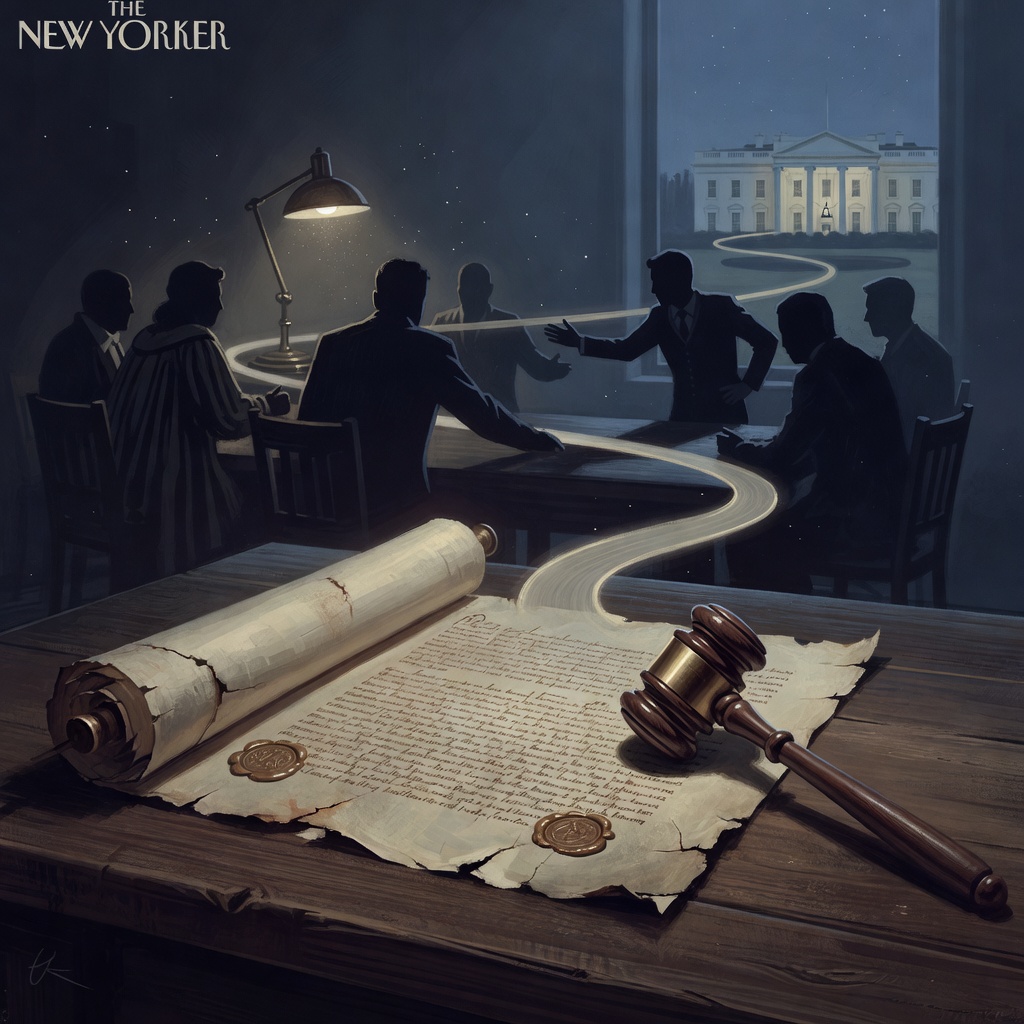
Jonathan Ingles: Forty barons. That's who Magna Carta protected. Forty rebels who'd taken London and needed King John to stop taxing them arbitrarily. June 15, 1215, Runnymede. Archbishop Stephen Langton in the middle brokering it. And the White House just described that document as — I want to read this exactly — 'eternal principles of equal justice, liberty, and the rule of law.'
Jonathan Ingles: That's it? Huh?
Maya Chen: No, I — I'm sitting with it. Because the thing is, the document almost didn't exist at all. Pope Innocent III annulled it within weeks. King John never meant to honor it. And somehow that's now America's founding story, filed under America 250.
Jonathan Ingles: Which is either a scandal or proof that myths beat facts every time. I genuinely don't know which the White House is counting on.
Maya Chen: Maybe both. Maybe that's not even a contradiction.
Maya Chen: Edward Coke. This is a 17th-century lawyer who looked at a 400-year-old document and decided, no, this is constitutional scripture. Historians call it a construction, not a discovery. He didn't find the meaning, he built it. And then Jefferson — drawing on Coke's reading, not the 1215 text — drafts the Declaration. American liberty doctrine is Coke's invention, essentially.
Jonathan Ingles: Right, but — that's my point. That's not a defense of the White House, that's the indictment.
Maya Chen: No, wait — I think it's actually the opposite. If Coke constructed it, and Jefferson built on Coke, and real people used that construction to resist real power — I mean, Jenks called it a myth in 1904, Helmholz called it mythologized, Chesterman says almost everything we think we know is inaccurate. And none of that stopped it from functioning. The myth did actual work.
Jonathan Ingles: A myth doing work is not the same thing as a myth being true.
Maya Chen: But does that distinction — I wonder if it holds when we're talking about how democratic values actually get made. They're all constructed retroactively. Messily. By people who needed them to be real.
Jonathan Ingles: The White House isn't saying 'here's a useful myth.' They're saying eternal principles. Bedrock. That's not acknowledging construction — that's hiding it. And the Rule of Law the White House traces to Magna Carta? Originally protected forty barons from arbitrary taxation. That's the bedrock.
Maya Chen: But FDR said it. 1941 inaugural. 'The democratic aspiration is no mere recent phase in human history — it was written in Magna Carta.' That's not the White House in 2026. That's a wartime president reaching for it when democracy was actually under threat.
Jonathan Ingles: Which proves my point. Every administration in a crisis reaches for the same armor.
Maya Chen: Or — wait, actually — or it proves the constructed thing had real weight. Due Process. That's not mythology. That's directly traceable to Magna Carta's clauses in U.S. law. Unlawful imprisonment, arbitrary justice — those specific clauses. That's a real legal inheritance, Jonathan.
Jonathan Ingles: No, I don't buy that.
Maya Chen: You don't buy Due Process?
Jonathan Ingles: I buy Due Process. I don't buy — look, Maitland was already pulling this apart in 1899. Reissued, revised, rewritten multiple times after 1215. Even Schama — who takes the document seriously — calls it a death certificate, not a birth certificate. Death of arbitrary feudal power. That's narrower than 'eternal principles.' And filing it under America 250, right now, during active democratic contestation? That's not a history lesson.
Maya Chen: I hear you. But the narrower version still did real damage to real power. For real people.
Maya Chen: And I think — I mean, that's actually the thing I can't get past. If Coke's construction, four centuries after Runnymede, was powerful enough to put Due Process into the Constitution — to give ordinary people a legal language to resist the state — then maybe the construction being the point isn't a problem. Maybe that's just how legitimacy gets made. Retroactively. Out of need.
Jonathan Ingles: Or we've just confirmed that whoever controls the narrative controls what counts as law.