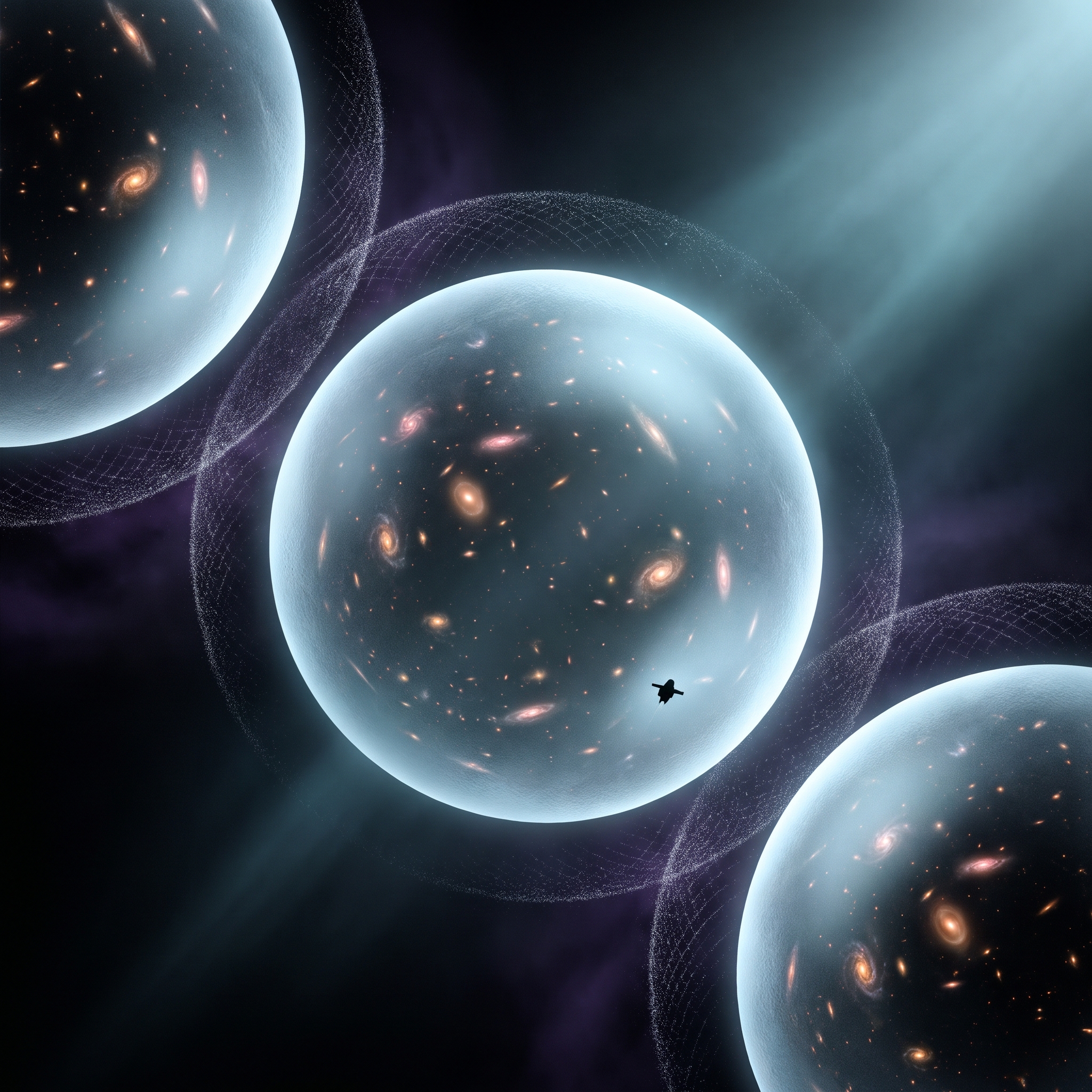
Miles Ashworth: You sent me that paper at eleven-thirty at night with no context whatsoever — just a link and a question mark.
Megan Skiendel: Because honestly, I didn't know what to say. A Yale astrophysicist named Michael Keim publishes in The Astrophysical Journal — he's found a third galaxy with almost no dark matter inside it. Third one. Same cluster.
Miles Ashworth: NGC 1052-DF9 — that's the new one.
Megan Skiendel: That's the new one. And look — the way to understand what's strange here is not through the equations. It's through what Keim was actually watching at Keck Observatory: stellar velocities. Stars inside DF9 are moving too slowly. Way too slowly. In a normal galaxy, there's so much dark matter surrounding it, that invisible halo, that stars get flung around at high speed. DF9's stars are basically drifting.
Miles Ashworth: What's the analogy here — give me the plain version.
Megan Skiendel: A soap bubble. Same size as a basketball, almost no mass. DF9 has the physical dimensions of a galaxy — it's what astronomers call an ultra-diffuse galaxy, big footprint, almost no light — but it weighs almost nothing, because the dark matter that should dominate its mass budget isn't there.
Miles Ashworth: And DF2 was 2018, DF4 was 2019, also Yale — Pieter van Dokkum's group — and now DF9 drops and they're all sitting 65 to 67 million light-years out in the same galactic group.
Megan Skiendel: All three. Which is the part that stopped me cold — not the third galaxy, but where it lives.
Miles Ashworth: And that's the number, isn't it — three. Because one galaxy without a dark matter halo is a measurement headache. Two is uncomfortable. Three, all neighbours, all sitting in the same NGC 1052 group — that's a pattern. That demands a different kind of answer.
Megan Skiendel: But what does ΛCDM actually say should be there? Because I want to make sure we're precise about what's missing.
Miles Ashworth: Every galaxy — every single one, in the standard model — forms inside a dark matter halo. Invisible, non-baryonic, extending far beyond the visible disk. It's the gravitational scaffolding. Without it, the galaxy, frankly, shouldn't hold together at the scales we're observing.
Megan Skiendel: And the stellar dynamical mass measurements on DF9 — the ones Keim's team actually ran — show total mass close to ordinary matter alone. The halo isn't small. It's basically absent.
Miles Ashworth: Which ΛCDM says cannot happen. Right — but what actually bothers me: van Dokkum's team finds DF4 around 2019, same group, same profile. At that point you'd think the field convulses. It doesn't. Not really.
Megan Skiendel: Two is still deniable. Two you can explain away. DF9 is what forces the reckoning — Keim publishes it in The Astrophysical Journal alongside DF2 and DF4 as a deliberate trio, and suddenly the question isn't 'is the measurement wrong,' it's 'why are they neighbours.'
Miles Ashworth: Three clustered outliers. That's not scatter — that's environment doing something the model didn't predict.
Megan Skiendel: And Keim's answer is a violent collision event — something that separated ordinary matter from dark matter when these three formed. Honestly, it's elegant. But nobody's found the debris from that event yet, which means we're currently explaining the absence of one invisible thing by invoking the behaviour of another.
Miles Ashworth: Yes, and — look — that's where I find the clustering genuinely revealing rather than reassuring. If the collision model is right, it predicts something locatable. Gas, residue, something. The neighbourhood should be a crime scene. And right now it's immaculate.
Megan Skiendel: And that's exactly what makes this hard to wave away. Picture someone — let's say a postdoc running collision simulations, two monitors, one showing DF9's rotation curve data, the other showing the region of space where the residual gas from the impact should still be drifting. It isn't there yet. That's not a minor gap. That's the entire evidentiary load-bearing wall of the hypothesis, and it's missing.
Miles Ashworth: But isn't that — look, isn't proposing a testable mechanism exactly what good science looks like? Keim says: violent event, matter separated, find the gas and you've confirmed it. That's falsifiable.
Megan Skiendel: It is. And — honestly, that's what makes this genuinely hard to dismiss rather than easy to attack. Keim's collision hypothesis, the idea that all three formed together in a violent high-energy event that physically separated ordinary matter from dark matter, that's real physics. It generates a prediction. I'm just not sure the field is being honest about how long they're willing to wait for the gas to show up before quietly retiring the question.
Miles Ashworth: And dark matter itself has never been directly detected. Not in a lab. Not once.
Megan Skiendel: Five decades of null results. Its entire evidential basis is gravitational and indirect — we infer it from what moves, not from what we see. So when DF9's stellar dynamical mass measurements come back showing total mass close to ordinary matter alone, you're not just finding an anomaly. You're finding an anomaly in a model that is itself built entirely on inference.
Miles Ashworth: And the clustering makes it worse for the standard picture. Three galaxies, same group, all dark-matter-deficient — that's not scatter, that's ΛCDM failing to predict an environment.
Megan Skiendel: Which is why the shared formation history argument matters — because if they all formed together in one violent event, the clustering is a feature, not a bug. But you still need the wreckage. The collision can't just be the explanation. It has to eventually be the confirmed sequence of events.
Miles Ashworth: No, I don't buy that the alternatives are cleaner, though.
Megan Skiendel: They're not — and that's actually where this gets worse, not better. ΛCDM is under real stress, but the alternatives, including Milgrom's MOND framework from 1983, don't escape cleanly either. We'll get to exactly why in a minute.
Miles Ashworth: Right — but the part that doesn't fit is that you'd think MOND picks up the slack here. Mordehai Milgrom, 1983, modifies the gravitational laws at low accelerations. No dark matter required. So three galaxies without a dark matter halo — surely that's a win for MOND?
Megan Skiendel: It's actually the opposite. MOND predicts enhanced gravity in weak-field regimes — it's supposed to mimic what dark matter does, not erase it. A galaxy with near-zero dark matter content is just as awkward for Milgrom's framework as it is for ΛCDM.
Miles Ashworth: Wait, so MOND needs the mimicry to work.
Megan Skiendel: Exactly — remove the effect entirely and MOND has nothing to substitute. DF2, DF4, DF9 aren't vindicating the alternative models. They're stress-testing everything simultaneously.
Miles Ashworth: And then there's — well, this is the number that actually stopped me. A 2026 paper in Monthly Notices of the Royal Astronomical Society, claiming an alternative model reproduces rotation curves for all 175 galaxies in the SPARC database. Without dark matter. 175. That's not three anomalies, that's a — I mean, that's a portfolio.
Megan Skiendel: 175 is what breaks the 'extraordinary exceptions' framing — which is Keim's own language, by the way. His paper calls DF2, DF4, and DF9 extraordinary exceptions to be explained within ΛCDM. But if 175 galaxies separately fit without dark matter, the exception is doing a lot of heavy lifting.
Miles Ashworth: Although — no, actually, we should be careful. That 2026 paper and Keim's trio aren't directly linked. Nobody's established the connection between the SPARC database findings and the NGC 1052 group specifically.
Megan Skiendel: No, they're not. And that's the uncomfortable position everyone's sitting in right now — ΛCDM is stressed by the clustering, MOND is undermined by the near-zero dark matter result, and the SPARC paper is floating without a clear theoretical home. Nobody wins.
Miles Ashworth: And that is, frankly, the most interesting place for a field to be.
Megan Skiendel: And that's actually what comes up with the residual gas. If Keim's collision hypothesis holds — if someone eventually points a telescope at the space between DF2, DF4, and DF9 and finds that wreckage drifting there — dark matter doesn't go away as a problem. It gets stranger. Because what you've now shown is that dark matter can be physically peeled away from ordinary matter. Separated. Which ΛCDM doesn't really have a clean account of. The model survives, but the question of what dark matter actually is gets sharper, not softer.
Miles Ashworth: Three galaxies. Same neighbourhood. That stopped being a coincidence a while ago.
Megan Skiendel: And you sent me that link at eleven-thirty at night and you got a question mark back — which, honestly, was the right answer. I didn't have one then. I'm not sure I have one now. Whether NGC 1052-DF2, DF4, and DF9 become a solved puzzle or an open wound in the field — that's entirely down to what the next observation finds. Or doesn't find.