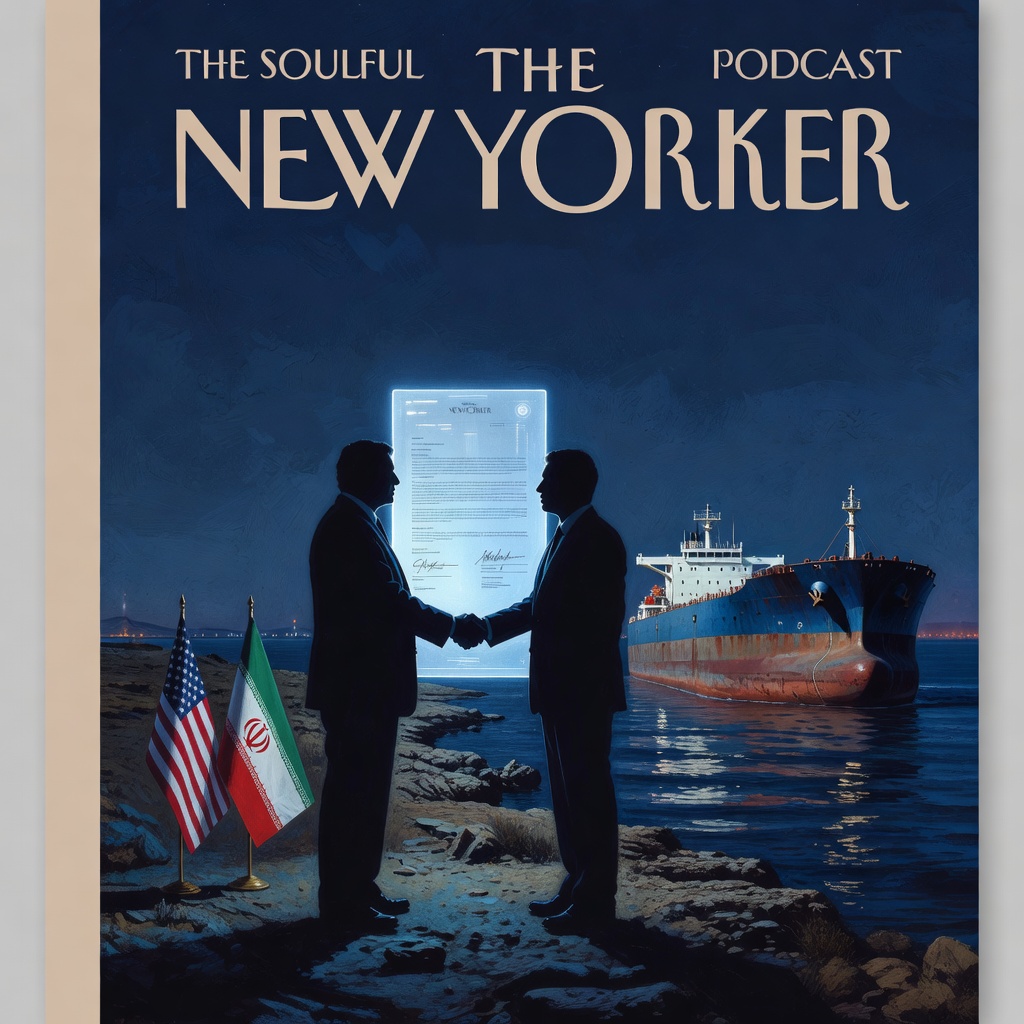
Jonathan Ingles: Quick question before we get into this. When Shehbaz Sharif — the Pakistani Prime Minister — is the person announcing a U.S.-Iran ceasefire to the world, what does that tell you?
Maya Chen: Hmm. That the U.S. couldn't be the one to say it?
Jonathan Ingles: That's the start of it, yeah. June 14th — Trump and Iranian leadership sign the MOU electronically, JD Vance is on it, Kazem Gharibabadi confirms for Tehran — and Sharif is the one who walks to a podium and declares 'immediate and permanent termination of military operations on all fronts, including Lebanon.' Not Washington. Islamabad.
Maya Chen: Okay — but hold on, is that — I mean, is that necessarily damning? Mediators announce things.
Jonathan Ingles: Sure. Except — no, look — the IRGC then announces Iran gets half of the $24 billion in frozen assets before any final negotiations. A U.S. official says the opposite. Zero. Not until compliance. They announced contradictory financial terms on the enforcement mechanism of their own deal. That's not a mediator announcing things. That's two sides describing different agreements to their domestic audiences and nobody — nobody — trying to square it before the press conference.
Maya Chen: That's — yeah, that's a real problem.
Jonathan Ingles: It's the whole problem. Trump posts 'Ships of the World, start your engines' on Truth Social and the press treats it like a peace deal. It isn't. It's two parties who both needed to announce a win. The question of what they actually agreed to — that's still completely open.
Maya Chen: Okay but — wait — are we holding an MOU to the standard of a final treaty? Because that's not what it is. It's a preliminary framework. Non-binding. The whole point is that permanent settlement details — nuclear questions, all of it — those are expected to take up to a year to negotiate. The 60-day window is the window.
Jonathan Ingles: I know what an MOU is.
Maya Chen: Then — I mean, does ambiguous face-saving language in early diplomacy actually prove bad faith? Or is it just... what the first document looks like? Abbas Araghchi was warning that U.S. regional bases were legitimate targets two weeks ago. That clock stopped on June 14th. That's real.
Jonathan Ingles: The clock paused. There's a difference.
Maya Chen: Fine — paused. But think about what that pause means for an actual person. A shipping manager in Singapore right now can reroute tankers through the Strait of Hormuz instead of around Africa. That's 12 days off delivery. Twenty percent of globally traded oil moves through that waterway, and it's been closed since February 28th — nearly four months. That's not abstract. That's her Tuesday.
Jonathan Ingles: And she books three shipments or she waits — because she knows it could collapse in 45 days. That's my point. The relief is real and fragile at the same time.
Jonathan Ingles: Fragile is the right word. And here's where — no, wait, I'll actually concede this — the hot take holds. Israel publicly stated it is not bound by the Lebanon terms. Not implied. Stated. The MOU says 'all fronts, including Lebanon.' Hezbollah is active on that front. So you've declared a permanent termination of hostilities on a battlefield where a signatory just opted out.
Maya Chen: That's — yeah, that's not interpretive. That's just a hole.
Jonathan Ingles: It's a factual hole. Not a framing disagreement.
Maya Chen: But what does that mean for a Lebanese civilian who heard Shehbaz Sharif say 'permanent termination' — who actually believed that word?
Jonathan Ingles: It means the document lied to them. And — look, this connects to Pakistan. Vance flew to Islamabad in April, met Sharif directly, Islamabad hosts both delegations. Egypt and Turkey participate. Qatar's mediators are literally in Tehran on June 10th trying to close gaps while Trump is ordering new strikes. That's not a diplomatic architecture that's functioning. That's a proof that the U.S. couldn't close this directly with Iran.
Maya Chen: Mm. Though — I mean, does the routing matter if the Strait reopens?
Jonathan Ingles: It matters because when Switzerland hosts the formal signing on June 19th and nuclear talks actually start, Pakistan is the credibility bridge — not Washington. That's not a win. American leverage in this region hit a floor, and Pakistan brokering a U.S.-Iran framework is what a floor looks like.
Maya Chen: And — I mean, Friday. June 19th. Switzerland. That ceremony is four days away. The 60-day clock is already running on a document that has contradictory frozen funds terms, an unresolved Lebanon front, and nuclear talks that previously took years. Those aren't unknowns waiting to be filled in. They're the whole thing.
Jonathan Ingles: Yeah. And they're signing it in Switzerland anyway.
Maya Chen: Maya Chen: Which is — that Singapore shipping manager stands out to me. She's not waiting for Switzerland. She booked those three shipments. And maybe that's the real answer to whether an incoherent deal is better than no deal. The Strait is open. The IRGC and a U.S. official disagree on $24 billion. Israel's still doing whatever Israel's doing in Lebanon. But the oil is moving. The question isn't whether this holds — it's whether the act of signing it, even this messily, already changed the thing it was supposed to change.