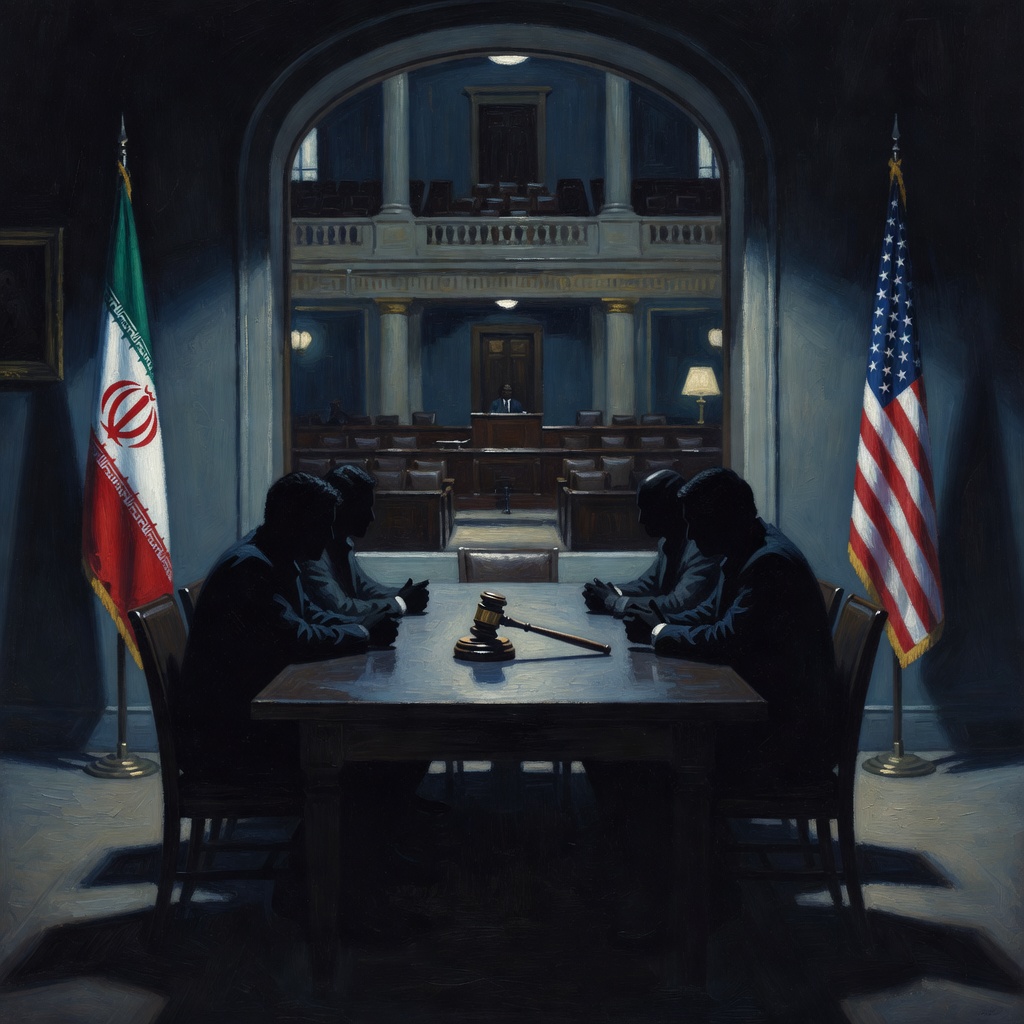
Miles Ashworth: Megan. Good to have you back.
Megan Skiendel: You saw the Truth Social post.
Miles Ashworth: I did. June 15th, Trump's 80th birthday — 'The Deal with the Islamic Republic of Iran is now complete.' Just — complete. Done. The Strait of Hormuz, reopened. The naval blockade, lifted. All on Truth Social. And I mean — look, the audacity alone is almost admirable.
Megan Skiendel: Except Abbas Araghchi went on state television and said it hadn't been signed yet.
Miles Ashworth: The Iranian Foreign Minister. Publicly contradicting the American president's birthday announcement. And yet — wait, here's the part that actually interests me more than any of that. The Associated Press got hold of the White House talking points. The ones circulated to Republican lawmakers. And these talking points claim Iran agreed — quote — never to develop a nuclear weapon. Never. This is a 60-day negotiating framework, Megan. An MOU. Not a concluded agreement.
Megan Skiendel: Signed electronically. Trump, Vance, and Ghalibaf.
Miles Ashworth: Right, and Congress — Congress wasn't negotiated with. It was managed. There is a difference, and I think that distinction is the entire story.
Megan Skiendel: Hold on, though — managed is one way to read it. But the institutional machinery is actually moving. That's what I want to push back on.
Miles Ashworth: Is it, though?
Megan Skiendel: It is. Look — the MOU-versus-treaty framing, that's a real workaround executives use. An MOU doesn't need Senate ratification, full stop. But INARA is specifically designed to puncture that. The 2015 law says any agreement relating to Iran's nuclear program gets submitted to Congress for review before sanctions relief can take effect. That's not a treaty clause. That's a statutory carve-out Congress built precisely because they knew presidents would try to sidestep ratification.
Miles Ashworth: Wait — so calling it an MOU doesn't actually buy the White House anything on the sanctions question?
Megan Skiendel: Not on sanctions, no. And I mean — here's the tell. John Thune. Senate Majority Leader, Republican, told reporters he expected the deal sent to Congress. And Semafor reported on June 16th that there's a bipartisan consensus forming — actual Republican-Democrat agreement — that any final nuclear agreement needs a congressional vote. Then Trump himself said the same day he was willing to send the interim deal for review. That's not a dead institution, Miles. That's slow, hypocritical machinery that is — actually grinding.
Miles Ashworth: Right, but — and I'll grant you Thune, genuinely — the war started February 28th without a single notification to Congress. Not a word. No appropriation, no permission. So INARA is the one lever they actually have left, is that what you're saying?
Megan Skiendel: INARA is exactly the lever. And look — the 47-48 vote is where it gets genuinely interesting. Four Republicans broke. Collins, Cassidy, Murkowski, Rand Paul. That's not base politics. That's the Senate actually — I mean, it almost held.
Miles Ashworth: One vote. Fetterman on the wrong side and it's 47-48.
Megan Skiendel: Which is where you get your partial win, actually. Because — wait, here's what that vote proves. INARA was weaponized against Obama in 2015 by Republicans who suddenly discovered constitutional principle. And now those same Republicans are in the position of applying it to their guy or quietly burying it. The 47-48 split is the answer. Most of them buried it.
Miles Ashworth: That's — yes. That's precisely the hypocrisy I'd have bet money no one would say out loud.
Megan Skiendel: But the pattern still matters even when the actors are cynical. Mehr News Agency published a 14-point draft MOU — an immediate halt to the war, the naval blockade lifted, Strait of Hormuz reopened, 60-day nuclear negotiation window. That's not a framework. That's — I mean, there's real substance there. Rubio and Hegseth ran this whole thing without Congress in the room, and yet the Mehr draft is specific enough that INARA has something to actually bite on.
Miles Ashworth: Right, and that's the concession I'll make. The 47 isn't nothing. It's — well, it's one vote from a blocking majority. On a Trump foreign policy vote. That's frankly closer than this White House should be comfortable with.
Miles Ashworth: Fine. 47 votes. You win on math. But — and this is, frankly, the part that should keep everyone up at night — if the MOU-versus-framework distinction *holds*. If Congress accepts it. Then every future president, of either party, has a clean template. You don't submit to INARA, you just call it an interim agreement, get the electronic signatures — Trump, Vance, Ghalibaf in this case — and Congress gets... managed. That's not a Trump problem. That's a next-twenty-years problem.
Megan Skiendel: I mean — no, that's actually right. And the 47-48 makes it *worse*, not better, because they nearly had it. One vote short is worse than never trying. It signals the bypass is viable.
Miles Ashworth: The precedent is the deal.