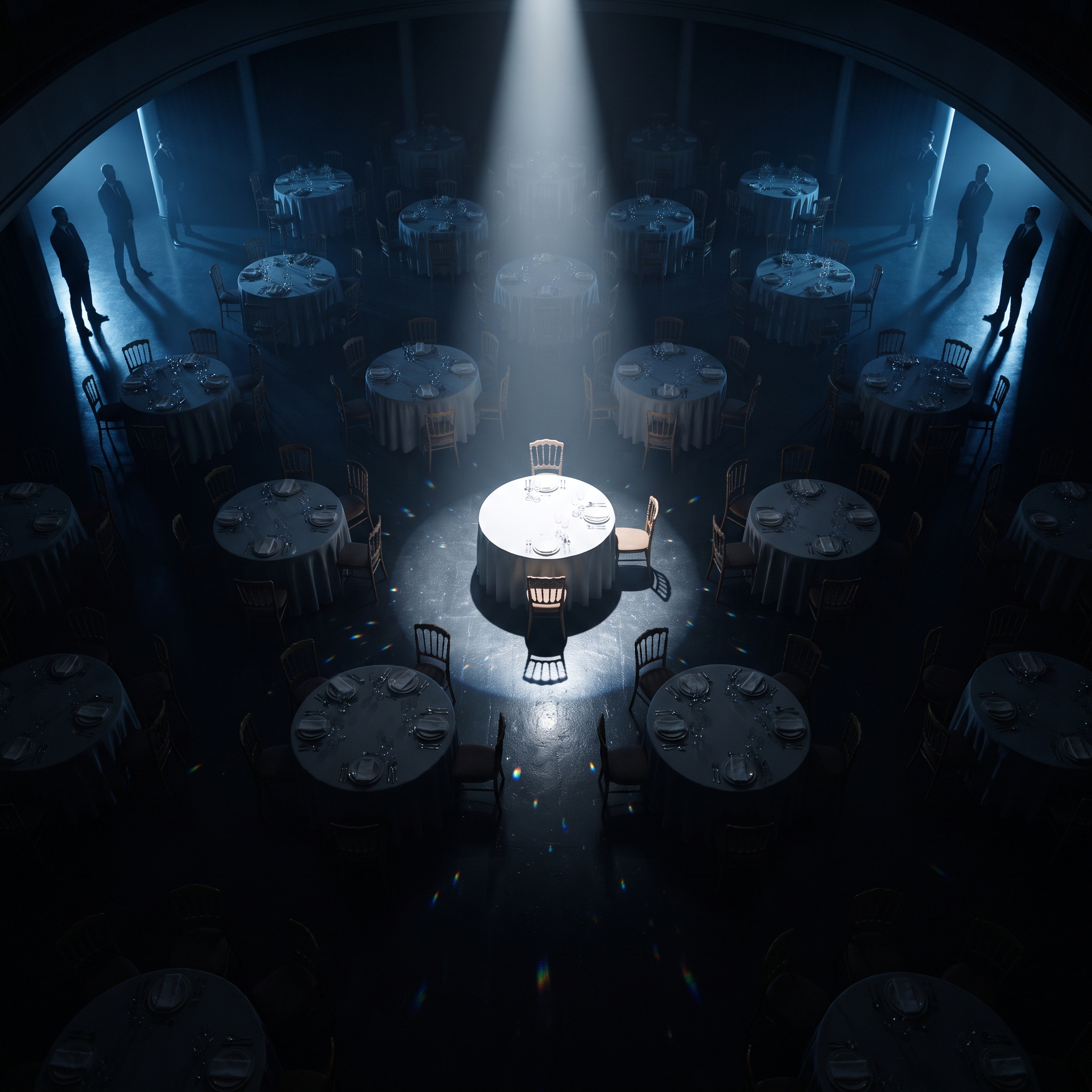
Lila Soto: Hugo, I spent the commute in trying to figure out how I'd feel if I were a journalist in that room on July 24th — like, sitting at the Waldorf Astoria, formerly the Trump International Hotel, watching the president deliver remarks his own press secretary called 'unifying yet vicious,' knowing that the day before, his lawyers had been trying to force three of your New York Times colleagues to name their sources in open court.
Hugo Vance: And could you land on a feeling?
Lila Soto: I could not. Which is kind of the whole episode.
Hugo Vance: Indeed. Because the dinner is functioning as two things at once — a pressure valve, which it has been for decades, and now also a performance of dominance. Trump boycotted this dinner for his entire first term, 2017 through 2021. He shows up April 2026 for the first time as president, that dinner ends in a shooting, and three months later he's back. That pattern is not incidental.
Lila Soto: Wait — so the question is whether the WHCA even had a real choice about hosting him.
Hugo Vance: That, and whether the subpoena withdrawal — one day before the dinner, after a federal judge called the government's legal work sloppy — is genuine retreat or just a pause until the lawyers sharpen their paperwork.
Lila Soto: Mm, and he gets to stand at a podium in his own building either way.
Hugo Vance: Precisely. The press has moved its press-freedom ritual into the President's house. That is where we begin.
Lila Soto: Which means the shooting is where I want to actually start — like, what happened that night, because I think people have a rough sense but not the specific picture.
Hugo Vance: April 25th, 2026. Think of it like a neighborhood block party that's been running for sixty years — same street, same neighbors, same ritual. Then someone walks up to the gate with a shotgun, a handgun, and multiple knives. That is Cole Tomas Allen, 31 years old, rushing the Secret Service checkpoint at the Washington Hilton. Gunfire. An officer struck in the protective vest — non-critical, but struck. And Trump, Melania Trump, JD Vance, Cabinet members — all evacuated. The first time Trump had ever attended this dinner as president, and that is how it ends.
Lila Soto: His first time there ever.
Hugo Vance: First time. And Allen pleaded not guilty to attempted assassination charges in May 2026. So the question — the one the WHCA had to answer — isn't just logistical. It's: who controls what the party means when it comes back? Cancel, and Allen decides. Reschedule, and you're making a claim about institutional nerve. Weijia Jiang, WHCA president, opened the July 24th dinner saying exactly that — 'we will not be intimidated,' 'we refuse to let an act of violence have the final word.'
Lila Soto: That's — yeah, that's the defiance framing. But wait, actually — Weijia Jiang also thanked Trump for attending that same night. How do you hold both of those things at once?
Hugo Vance: You hold them uneasily. I mean — the defiance is real, I don't dismiss it. But Trump had posted in June, vowing to reschedule and deliver remarks, framing his return as defiance too. So both sides are performing resolve, in the same room, and one of them owns the building.
Lila Soto: Oh, that's the thing that won't leave me alone — the Waldorf Astoria is the former Trump International Hotel. So Weijia Jiang says 'we will not be intimidated' and she's saying it inside his property.
Hugo Vance: Which is what makes the dinner a test now rather than a ritual. A ritual has a stable meaning. A test has a result you don't know yet.
Lila Soto: And we're still waiting on that result.
Hugo Vance: And while we're waiting — the press pool is operating without the Associated Press. The AP, barred from the White House briefing room. That's not suspended access, that's expulsion. So an AP journalist on July 24th watches the WHCA welcome in the president who banned her outlet, into a dinner that's supposed to be about press freedom.
Lila Soto: That's — I mean, that specific image is the whole argument. She can't get into the briefing room, but the dinner rolls on.
Hugo Vance: And it's not isolated. FCC regulatory pressure on networks deemed hostile. Pentagon access restrictions on individual reporters. A threat to revoke TV licenses over networks that didn't air a prime-time speech — a speech that contradicted a U.S. intelligence assessment, by the way. That's not general hostility toward press, that's a coordinated instrument.
Lila Soto: Wait — revoke licenses? That actually happened?
Hugo Vance: Threatened, yes. And Karoline Leavitt's phrase — 'unifying yet vicious' — that's not a communications slip. That's the dual track made explicit in four words. The dinner is the 'unifying' half. The subpoenas, the FCC, the AP ban — that's the 'vicious' half running concurrently.
Lila Soto: Okay but — actually, no, here's what I keep getting stuck on. The NYT subpoenas get dropped one day before the dinner, after a federal judge says the legal work was sloppy. Not because the administration changed its position — because the paperwork was bad. So does Trump walk into that room having shown he can do this, just not neatly enough yet?
Hugo Vance: That is precisely where I'd be cautious about calling it a retreat. You see, a tactical pause and a principled reversal look identical on day one. The three Times reporters aren't subpoenaed today — but the question is whether the next subpoena arrives with sharper legal work.
Lila Soto: Which means the dinner actually lowers the temperature just enough to — mm — reset the clock.
Lila Soto: And there's a layer underneath this we haven't touched yet — the venue itself, the press freedom coalition's letter, what it means that the 'show must go on' framing might serve Trump's story more than the WHCA's. That's where I think this gets genuinely uncomfortable.
Hugo Vance: The venue is the argument. The WHCA has held this dinner at the Washington Hilton since 1962 — sixty-four years of institutional geography. One shooting forces a change, and the building they land in is the Waldorf Astoria, formerly Trump International Hotel. That's not a neutral logistical fix. That's the press-freedom ritual physically relocated into the president's house.
Lila Soto: And a coalition of press freedom groups — hundreds of former journalists — sent a letter before the dinner demanding the WHCA confront Trump forcefully. Not gently push back. Confront.
Hugo Vance: Yes. And what did they get? Weijia Jiang thanked him for attending. Which — I don't fault her exactly, the courtesy is structural, but the letter asked for something and the room produced its opposite.
Lila Soto: That's the trap, isn't it.
Hugo Vance: That is precisely the trap. Challenge him — risk losing access entirely, the AP model. Absorb his presence as normal — and you've validated a model where federal subpoenas against your colleagues and a dinner invitation coexist without contradiction. Both exits serve his narrative.
Lila Soto: So the 'show must go on' framing — I mean, it felt like resilience when Weijia Jiang said it, but actually — wait — it hands Trump a room full of journalists applauding their own survival while his administration is still in court against them.
Hugo Vance: The ritual continuing is not the same as the ritual meaning what it used to mean. You see, in 1962 the Hilton wasn't anyone's property. The Waldorf is. That sixty-four-year gap is not a footnote.
Lila Soto: Yeah — and that's the thing I think I actually needed you to name. The 'show must go on' produces a winner. It's just not obviously the press.
Hugo Vance: And the smaller, more heavily secured dinner at the Waldorf may simply become the new model — which means the institution adapts, yes, but it adapts on his terms, in his building, with a diminished guest list. Whether that counts as survival or surrender depends entirely on what comes next.
Lila Soto: And then Stephen Miller was in that room. Like — the administration didn't just send a president, it sent an audience. Someone to watch how the press behaves when the president is standing right there.
Hugo Vance: Yes. And Trump has now vowed — publicly, June 2nd, social media — that this is an annual tradition from here on. So the WHCA has to sit with that. Next July, Karoline Leavitt announces he's coming back. What do they do?
Lila Soto: I mean — I genuinely don't know. And I'm not sure they do either. That's the question I'm left holding. The dinner survived a shooting. It survived a venue that used to have his name on it. It survived Miller in the audience watching. Each time it survives, does it get a little harder to refuse the next one?
Hugo Vance: I don't have an answer to that.
Lila Soto: Yeah. Good conversation — genuinely. Unsettling, but good.