Finn Brooks: Hey, you make it in okay? I know the Tube was doing something weird this morning.
Juniper Vale: Yeah, yeah, eventually — I'm here, I'm caffeinated, what have you got.
Finn Brooks: Okay I'm handing you a number and I need your honest first reaction: five million.
Juniper Vale: Five million what?
Finn Brooks: Five million people in flats in the UK who, until literally August 27th of this year, had zero — like, legally zero — viable route to put solar on their homes. And then one piece of legislation, SI 2026/848, passes on July 16th, and suddenly that changes. All of it.
Juniper Vale: Wait, just — one statutory instrument and it's done?
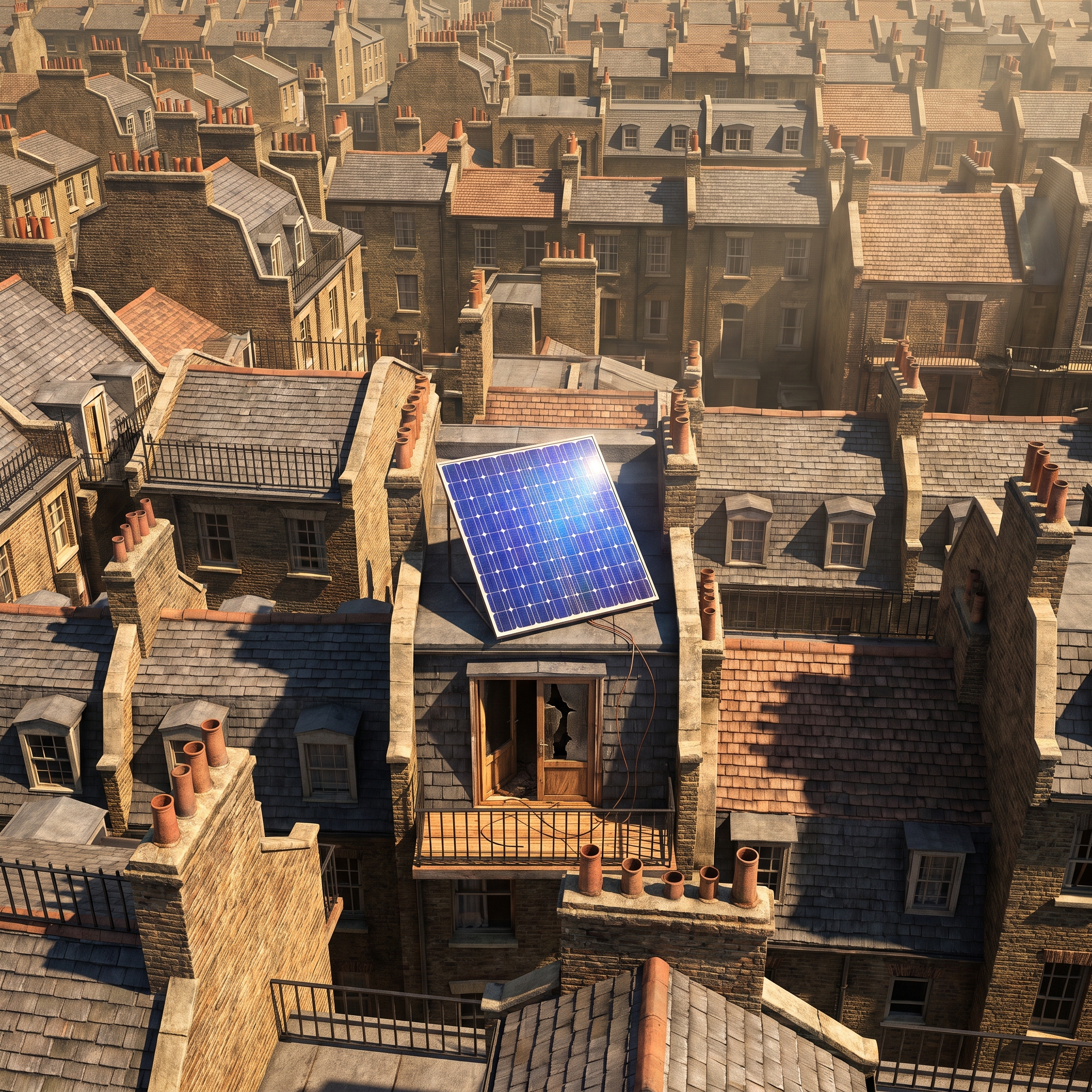
Finn Brooks: One statutory instrument. And so today — I mean, this is what we're really trying to figure out — what does that actually look like the first morning it's legal? Like, picture a third-floor flat in Manchester, a Saturday in late August, someone's just come home from Lidl with a box under their arm that cost about £400—
Juniper Vale: Lidl. A solar panel from Lidl.
Finn Brooks: Right, but that's the thing — before they even open the box, before they get anywhere near the balcony railing, they had to text their landlord.
Juniper Vale: Because permitted development rights — what SI 2026/848 actually does — they remove the planning permission barrier. Full stop, done. But they don't touch the tenancy contract. Like, not at all.
Finn Brooks: Wait. So the law says yes and the landlord can still say no?
Juniper Vale: The landlord can absolutely still say no. The planning system and your lease are two completely separate things. One doesn't override the other.
Finn Brooks: Okay that is — I mean, that's not what I assumed when I read 'no planning permission needed.' I genuinely read that as 'you can just do it.' That's how it lands.
Juniper Vale: That's how millions of people are reading it right now. And Katie White — the Climate Minister — she said back in April 2026 that renters should be permitted to install plug-in solar panels. Should. And if landlord refusals became a, quote, 'friction point,' she'd consider further legal changes. Consider. That word is doing an enormous amount of work for five million people in flats.
Finn Brooks: So the group this policy was most built for — renters — they're still behind a gate that policy hasn't actually opened.
Juniper Vale: Yeah, and the demand is already running ahead of the clarity — Google searches for plug-in solar panels are up 30% since the start of summer 2026. People are looking, they're excited, they think the door is open. I'm not sure most of them know there's a second door.
Finn Brooks: So back in that Manchester flat — that person with the Lidl box — it comes down to whether their landlord happened to text back yes.
Juniper Vale: And that's actually the thing that keeps nagging at me — because this isn't experimental technology waiting on a landlord's generosity. Germany's been doing this for years. The Balkonkraftwerk — balcony power plant — it's a normal retail item there, and in Spain. The UK just existed in this legal grey area while the rest of Europe moved on.
Finn Brooks: Wait, like — years? Not months?
Juniper Vale: Years. Proven, normalised, sold at the equivalent of Lidl. And what SI 2026/848 actually did — I mean, this is the mechanism — it amended two existing regulations: the Plugs and Sockets etc. Safety Regulations from 1994, and the Electricity Safety, Quality and Continuity Regulations from 2002. It created a whole new legal category. Plug-in microgenerators. That category did not exist in UK law before July 16th.
Finn Brooks: So the Department for Energy Security and Net Zero — DESNZ — they ran the consultation in June, legislation passed in July, goes live August 27th. That's fast.
Juniper Vale: It is fast. And you have to ask — what finally made urgency win? I think it's the Energy and Climate Intelligence Unit number. They found that typical households paid £4,800 more in dual-fuel costs over the five years since the 2021 gas crisis. Eighty-seven percent higher. That's the pressure that moved this.
Finn Brooks: Eighty-seven percent — okay, that's — no, that reframes everything. That's not a bill going up a bit, that's a completely different relationship with energy costs.
Juniper Vale: Right, and so the policy response makes sense in that context. But here's where I'd push — the landlord gap means the people absorbing most of that £4,800 hit, the renters in flats, they're exactly the ones who still need a yes from someone else. The ECIU number created urgency, DESNZ built a framework, but the framework has a hole right at the centre.
Finn Brooks: I mean — imagine someone on a fixed income, they've been hit hardest by that 87%, they scrape together £400 for a Lidl kit because Lidl's actually stocking this thing, and their landlord just... doesn't reply to the text.
Juniper Vale: And we haven't even touched the part that makes all of this thornier — that £4,800 crisis number sitting right next to a product nobody has actually quantified the annual saving for. When Lidl starts selling solar panels like kitchen knives, someone has to tell buyers the payback period. But that's the missing piece.
Finn Brooks: Right — but the quantification gap is actually worse than 'nobody said it.' Like, the £4,800 number comes from the Energy and Climate Intelligence Unit — that's a real analysis, five years of dual-fuel costs, it's devastating context. And then the product lands at £400 at Lidl, B&Q, Screwfix, Aldi, Amazon — all of them confirmed — and there is just... no matching number. Government messaging never states what an 800W system saves per year in a UK climate. The payback period is not stated. Anywhere.
Juniper Vale: So people are being handed a solution without the data to evaluate it?
Finn Brooks: That's exactly it. And when a Next Energy specialist — publicly, at the point the legislation passed — urges consumers to carefully compare plug-in solar against traditional rooftop systems before buying... like, that's a renewable energy company saying pump the brakes. That is not a throwaway quote.
Juniper Vale: Okay, but I want to sit with that for a second — because safe and financially sensible aren't the same thing. The Plug-in Solar Device Interim Product Specification means anything on those shelves has cleared a safety bar. That part's covered.
Finn Brooks: Totally, yeah — the spec exists, the safety standard is real. But there's no specialist at the B&Q checkout.
Finn Brooks: Like — picture someone, Sunday afternoon, they've just seen a Lidl ad, they've absorbed this ECIU number somehow, maybe through a headline, maybe just vibes, they know bills went up a catastrophic amount, and they're standing in the aisle holding a £400 kit thinking 'this pays for itself, obviously.' The number that convinced them — £4,800 — has nothing to do with what that box actually delivers.
Juniper Vale: That's the detail that crystallises it, I think. The loudest number in the whole policy narrative is the one that's measuring the wound, not the cure.
Finn Brooks: And nobody — not DESNZ, not the retailers, not the framing around August 27th — nobody closed that loop. The crisis is quantified. The product isn't.
Juniper Vale: The Manchester flat keeps coming back to me. Like — the panel's propped on the railing, it's plugged in, the electricity is actually flowing. That part is real. August 27 is a real date and for that person, if their landlord said yes, something genuinely changed.
Finn Brooks: And for the millions who are still waiting on that text back — it hasn't changed yet. Not even a little.
Juniper Vale: Yeah. That's — I mean, that's where we actually are. A real legal change, a real panel on a real railing, and a question mark the size of five million flats.