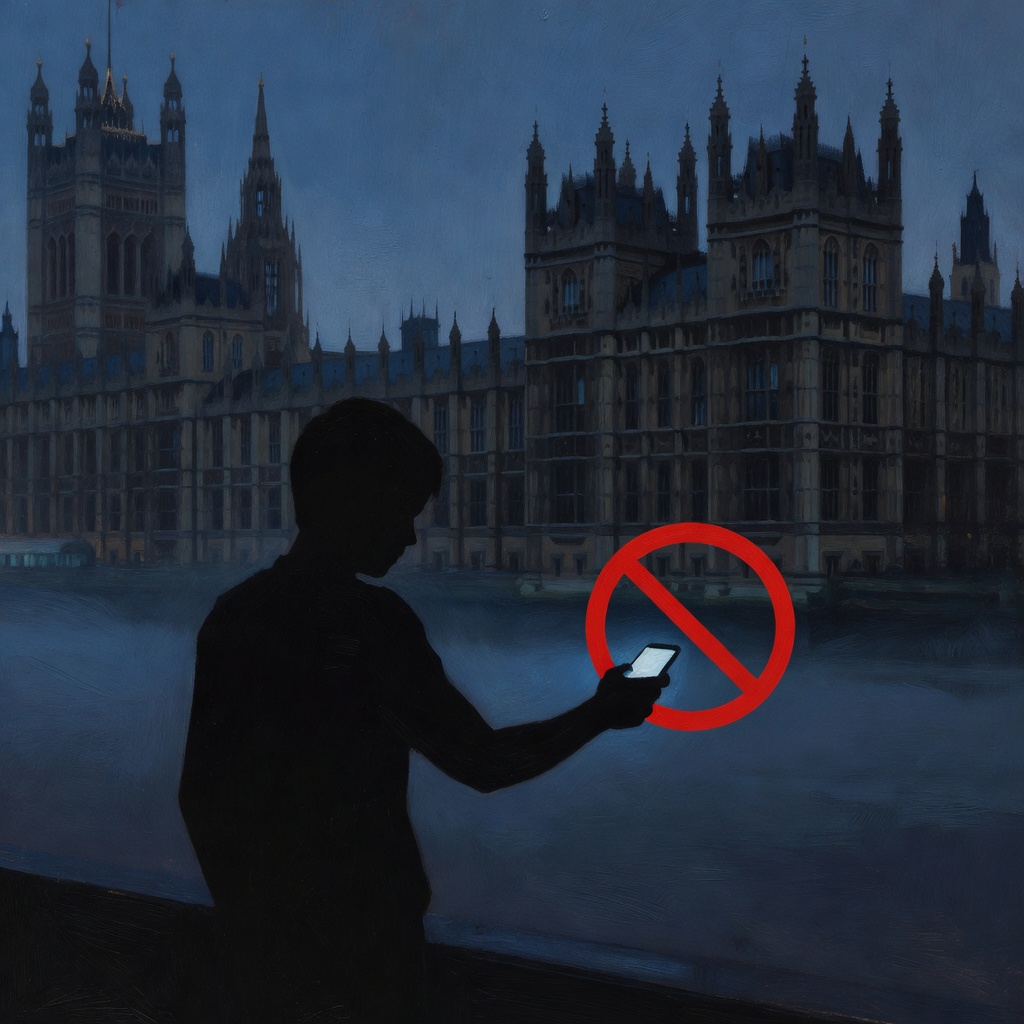
Megan Skiendel: You look like you've already done the maths on this one and you don't like the answer.
David Sterling: Well. I have, and I don't.
Megan Skiendel: Australia's social media ban for under-16s, which went live in December 2025, had 70% of blocked children back on the platforms within six months — yet here's Starmer announcing a stricter version of the same policy, for a larger country, before anyone's published a peer-reviewed word on whether the Australian one actually worked.
David Sterling: Right. Seventy percent. That's not a compliance gap, that's a compliance collapse — and the UK is now legislating as though that number doesn't exist.
Megan Skiendel: Honestly, when I was at — look, I've sat in rooms where policy people are borrowing from a jurisdiction that's six months ahead of them and calling it evidence, and this has exactly that shape to it.
David Sterling: Here's the point — the structural problem isn't whether teenagers are clever enough to use a VPN, which they are, it's that the UK is now politically committed to an enforcement mechanism that the only live test case has already falsified.
David Sterling: Seventy percent. That's the number nobody in the UK framing is touching. Australia's ban went live December 2025. By March 2026 — six months — seventy percent of blocked under-16s were back on the restricted platforms. And Starmer announces an 'Australia plus' model three months later. I need someone to explain the logic there.
Megan Skiendel: Here's the thing — no UK government source has publicly addressed that number. Not once. Liz Kendall leads with the 90% parental approval stat, Starmer says 'we're giving children their childhoods back,' and Australia's eSafety Commission findings just... don't appear in the press conference.
David Sterling: Because 90% parental support is doing different work than evidence of efficacy. Those are not the same claim.
Megan Skiendel: Look, I don't fully buy that framing. The consultation drew 116,000 responses. That's the largest since the same-sex marriage proposal in 2012. That's not availability heuristic noise — that's a genuine cultural signal that something shifted in how parents feel about this. I watched the same-sex marriage consultation become actual durable policy. The volume matters.
David Sterling: The volume measures the anxiety. Not the solution. Parents wanted action — I accept that. What I'm asking is whether a ban is the action that actually addresses it. Because Australia tested that premise and got 70% circumvention.
Megan Skiendel: And that's where Starmer's 'Australia plus' language is doing real work — or trying to. The UK version adds restrictions on livestreaming, disappearing messages, communication with adult strangers. Overnight curfews for under-18s. The argument is that Australia's ban was too shallow.
David Sterling: But none of those restrictions trigger if kids are circumventing the age gate itself. If a 15-year-old defeats the age check, the feature-level controls are irrelevant. You can't build a second floor on a foundation that's already cracked.
Megan Skiendel: That's fair — but the counterargument is the ultimatum Starmer issued to Apple and Google at London Tech Week. Device-level blocking, or face government enforcement. Prison time for executives was explicitly on the table. That changes the compliance calculus significantly.
David Sterling: Does it? Apple and Google have faced regulatory ultimatums before. The question is whether the enforcement architecture actually exists by Spring 2027. Nine months. No age-verification infrastructure at scale. No public statement on who pays for it — platforms or taxpayers. That's not a deadline, that's a placeholder.
Megan Skiendel: Honestly, I've watched tech companies move fast when executive liability is personal and specific. Not institutional fines — personal. But here's what nobody's naming: Signal. Signal put out a public statement calling the device-level scanning mechanism 'dangerous' and 'dystopian.' They said it will not keep children safe and could be repurposed for state surveillance of everyone's communications. That's not a tech company lobbying against regulation — that's a specific architectural warning.
David Sterling: Wait — Signal is excluded from the ban entirely.
Megan Skiendel: Exactly. Signal and WhatsApp both carved out. Messaging services, full stop — excluded. So Signal isn't objecting to being covered. They're objecting to the infrastructure being built to cover TikTok and Instagram, because that same scanning mechanism sits on the device. It doesn't distinguish.
David Sterling: Right — and WhatsApp has two billion users. If you're building age-verification to stop predatory adult contact with children, why does that same contact remain completely legal on WhatsApp?
Megan Skiendel: Because No. 10 knew they couldn't win a fight on encryption. They tried it during the Online Safety Act battles and got battered. The WhatsApp carve-out is a deliberate political choice, not an oversight. They drew the line where the resistance was lowest.
David Sterling: Which makes the safety calculus incoherent. TikTok is banned, Reddit is banned, YouTube is banned — but the platform where a predator can message a child directly, one-to-one, encrypted, is fine.
Megan Skiendel: And Makerfield is June 18th. The announcement was June 15th. Three days before a by-election where Labour needed a reset. The Independent called it 'the act of a desperate PM.' I'm not saying child safety isn't real — Ian Russell, Molly Russell's father, has been one of the most credible voices on this for years, and even he called Starmer's rush 'deplorable.' That's not a critic from the right. That's the movement's own advocate saying slow down.
David Sterling: That's the tell for me. The government already has the powers under Part 3 of the Children's Wellbeing and Schools Act — no new legislation required. So the announcement is the policy. There's no bill to scrutinize. Just a deadline that predates any working infrastructure.
Megan Skiendel: Man, okay. Here's where I keep landing — the ban will probably fail on its own terms, and that's almost beside the point now. The infrastructure doesn't get decommissioned when a policy fails. It just waits.
David Sterling: Right. And that's the thing nobody's pricing in. Failed policies leave working pipes. The question is who turns the tap next.
Megan Skiendel: And for what. Catch you next week.