Zara Reyes: Leon Rose built a championship roster with one drafted player and I think we should just — sit with how insane that is for a second.
Megan Skiendel: Mitchell Robinson.
Zara Reyes: Mitchell Robinson. Everyone else — bought, traded, poached. Josh Hart at the deadline in 2023, OG Anunoby six months later. The San Antonio Spurs just lost the NBA Finals to a team assembled like a fantasy auction.
Megan Skiendel: I mean — is that the story, or is the story Brunson dropping forty-five in a must-win Game 5?
Zara Reyes: Both, but — no, here's what's actually happening. The Brunson game becomes the myth. The forty-five points, the comeback from sixteen down, ninety-four ninety — that's the clip that lives forever. But the roster construction is the thing that changes behavior. Like, every front office with an owner who has capital is looking at this and asking why they spent three years being bad on purpose.
Megan Skiendel: That's the part I want to interrogate.
Zara Reyes: Good. Because the draft orthodoxy — the whole post-Moneyball mythology of patient asset accumulation — Leon Rose just torched it and won a ring doing it. That's not a small thing.
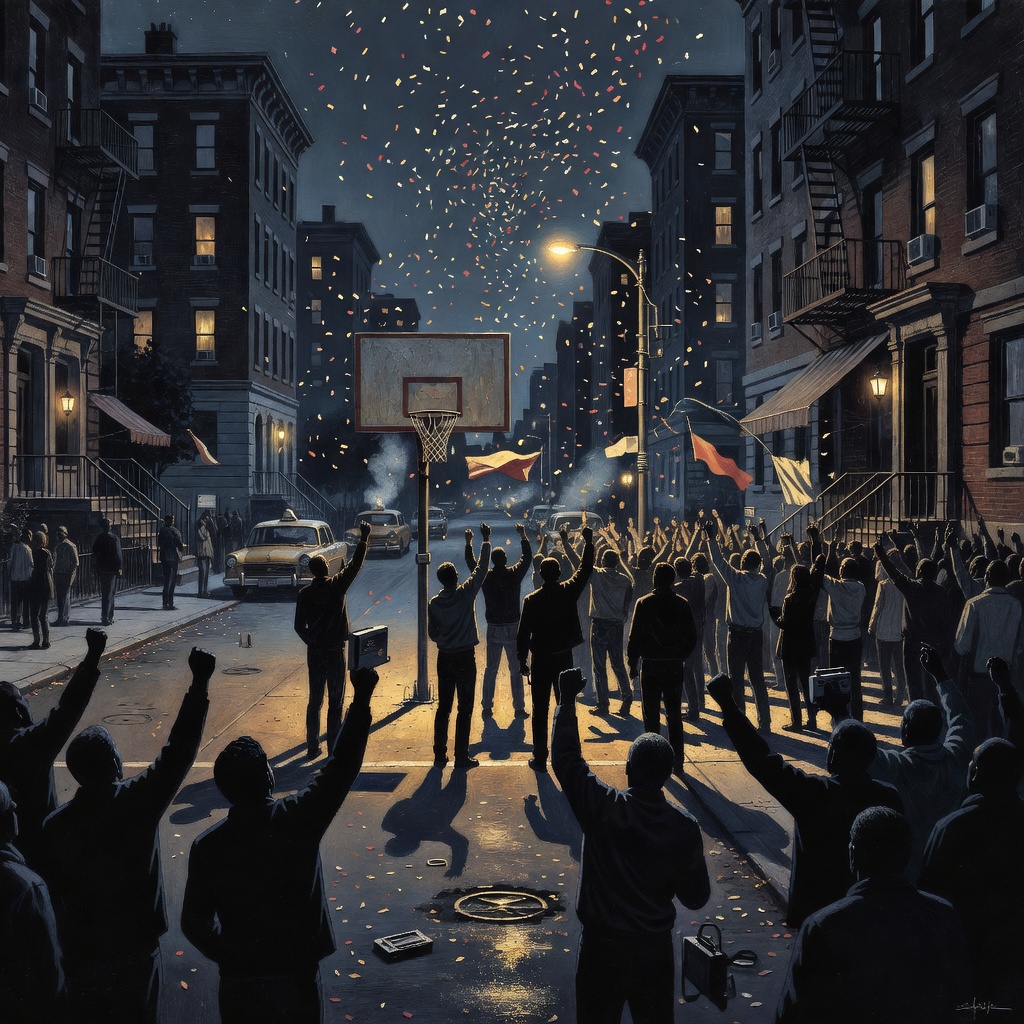
Megan Skiendel: Okay but — before we build the franchise gospel here — the same night Mamdani announced the ticker-tape parade, there were gunshots in Times Square. Like, actual gunshots. ABC News called it 'mayhem.' That's not a footnote.
Zara Reyes: Wait — simultaneous?
Megan Skiendel: Simultaneous. Crowds at Madison Square Garden, Wollman Rink, all five boroughs — and violence running concurrent with all of it. And I've watched the coverage, and honestly — everyone split it into two separate stories. The transcendent civic moment over here, the mayhem over there. Nobody held both at once.
Zara Reyes: No but — a deli owner in Ditmas Park literally compared this to the moon landing. That's real sentiment.
Megan Skiendel: That's exactly my point. 'Moon landing' and 'mayhem' — those are the same night. And the civic sports moment framing, the championship-as-shared-urban-experience idea — it assumes the city synchronized. I don't think it did. I think it fractured, and the celebration just made the fractures visible.
Zara Reyes: That's — yeah. That actually reframes the whole thing. Like, did the Knicks unify New York, or did they just — reveal what was already there?
Zara Reyes: But wait — that's actually where Brunson becomes the answer. Like, not to the fracture, but to why it still *lands*. The chip-on-his-shoulder thing, the gritty determination narrative — multiple outlets framed him as genuinely embodying New York's working-class ethos. And that maps onto the fracture perfectly. He's not the guy who heals the city. He's the guy who — I mean, he looks like the city. Forty-five points doesn't read as celebrity. It reads as grinding.
Megan Skiendel: That's fair. And honestly — Walt Frazier turning eighty this year and publicly passing the torch before the Eastern Conference Finals? That's the living connective tissue you need for that narrative to stick.
Zara Reyes: Right! And Frazier doing that makes the fifty-three years *present*. It's not just a stat. It's — actually, no, this is the Cubs 2016, Red Sox 2004 thing. The Sporting News literally drew that comp. 'Team of Destiny' framing. The drought is so long it becomes the origin story.
Megan Skiendel: Spike Lee was courtside in 1999. He's courtside in 2026. Same person. Nearly three decades.
Zara Reyes: Wait — that's not continuity though, right?
Megan Skiendel: That's a cultural fossil. The 1999 Finals had JFK Jr. in celebrity row. That world is *gone*. The city changed completely around Spike Lee, and he's still there. Willis Reed's 1973 team had Phil Jackson, Earl Monroe, Bradley — all homegrown identity. Now it's transactions. Everything flipped. And Spike Lee watched both versions from the same seat.
Megan Skiendel: And that's — look, that's the question going into year two, isn't it. The drought is gone. The origin story is spent. The Knicks swept Cleveland four-zero, blew them out a hundred-thirty to ninety-three in Game Four, looked completely inevitable — and then won on a sixteen-point comeback in Game Five. Both of those things happened in the same playoff run. So what's the fuel now? Leon Rose doesn't get to run the trade-first model on narrative fumes forever.
Zara Reyes: Fine — fine, okay. Every championship city retrofits a grit story onto whoever won. That's just how the mythology machine works. But nobody — I mean, you cannot retrofit a forty-five point Finals MVP performance. That happened. Brunson did that.
Megan Skiendel: No, you're right. The performance is real. But year two — no drought, no Walt Frazier passing any torch, no fifty-three years of pressure building underneath it — that's when we find out if Leon Rose built a dynasty or just the world's most expensive pressure-release valve.