Malcolm Reeves: There's a post on X — 48,000 likes — from a Japanese fan named @kaorukazama, just thanking people for noticing. And when I read that I thought, this is the fourth time.
Cole Brennan: Fourth — wait, what do you mean fourth?
Malcolm Reeves: 1998. 2018. 2022. Now 2026. Same story, same global shock. But that's actually Cole's — you have a thing about the Winston clip specifically.
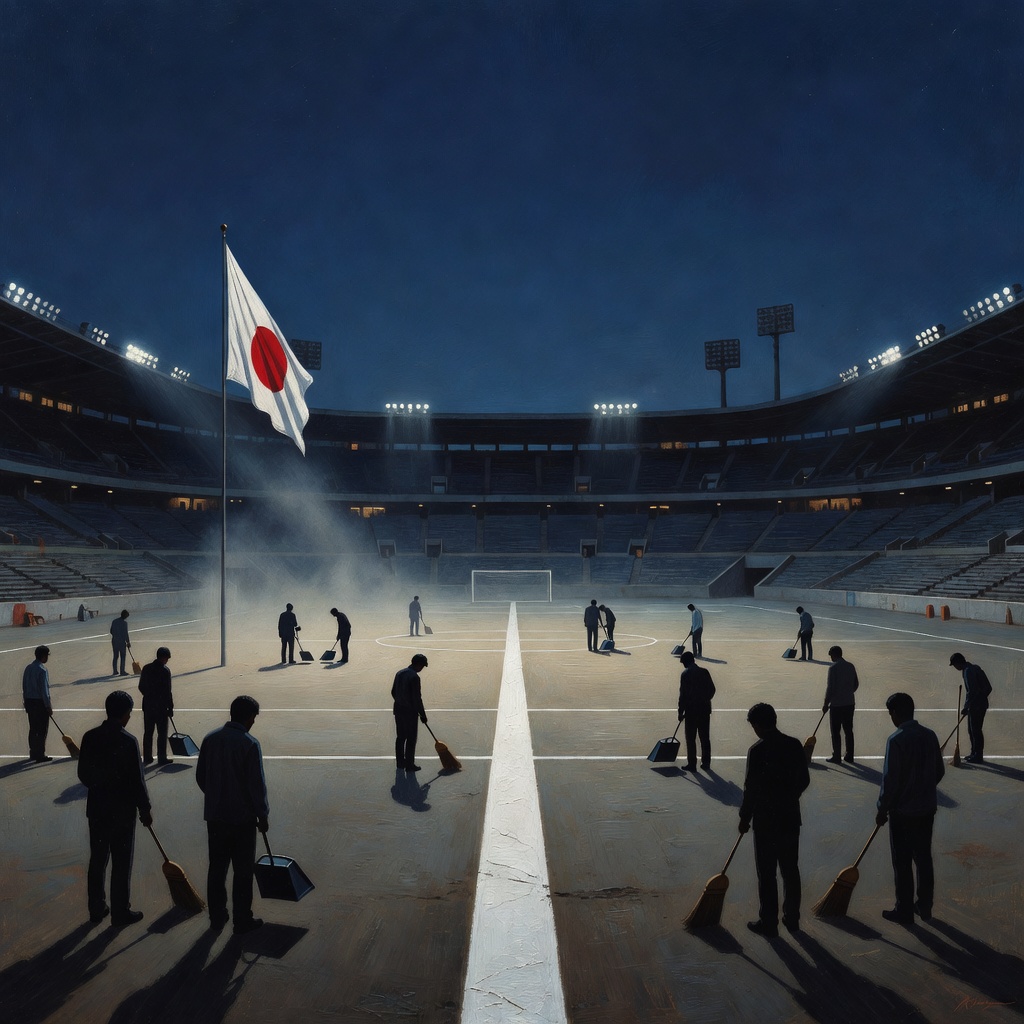
Cole Brennan: Yeah because — okay here's what I cannot get past. The Japanese supporters clean AT&T Stadium on June 14th after a 2-2 draw with the Netherlands. Blue bags, the whole apparatus. The players clean their own locker room too. All of that is documented, all of it spreads. But Jameis Winston — New York Giants QB, Fox Sports World Cup correspondent — he walks over and joins them and that one Fox4 Dallas clip crosses a million Facebook views inside twenty-four hours and outperforms the entire original story. I mean — what does it say that we needed him to do it before it fully landed?
Malcolm Reeves: But hold on — 1998, Cole. France. That clip exists before Facebook, before X, before any of this infrastructure. And it still traveled. So the Winston inversion is real, I'm not dismissing it, but it doesn't explain the origin point.
Cole Brennan: Huh. Yeah, okay.
Malcolm Reeves: The 1998 shock happened with none of the machinery. Then 2018 Russia, 2022 Qatar — Khalifa International Stadium, after the Germany match — same story, same global moment. Four tournaments. What that tells me is the practice itself is load-bearing, not the platform. And there's actually a name for what's underneath it — o-soji. Japanese schoolchildren clean their own classrooms, their own hallways, communal spaces. Scott North at Osaka University has documented this directly — it's not spontaneous, it's institutional. Embedded from childhood.
Cole Brennan: Wait — so the blue bags aren't random.
Malcolm Reeves: No. Moriyasu, the head coach, he articulated the leave-it-cleaner-than-you-found-it ethic in real time. In 2026. Meaning the practice and its explanation arrived together. He was narrating it for global consumption as it went viral. We don't actually know which came first.
Cole Brennan: That's — wait, that reframes the whole thing. Because then by the time @dann0bann0 is calling it 'very right wing coded' that week on X, the story being amplified isn't even the raw footage anymore. It's already been packaged.
Cole Brennan: And that's — yeah, that's where I think the hot take actually lands. Because the four-tournament repetition, 1998 through 2026, same shock every time — that's not the algorithm being innocent. That's the Western media cycle *needing* Japan to surprise us. Like we require this story periodically.
Malcolm Reeves: Positive othering. That's the actual term.
Malcolm Reeves: The practice is real, o-soji is real, Scott North's documentation is real — but the framing around it positions Japanese fans as admirably exotic. Implicitly. Which means the same footage that gets @kaorukazama 48,000 likes as a thank-you post is simultaneously available to @dann0bann0 as nationalist signaling. Identical clip. Opposite readings.
Cole Brennan: Wait — and there's apparently an internal Japanese tension about this that we completely skip over. @Aceface4ever flagged that Japanese feminists and left-wing voices were attacking the viral spread for projecting a sanitized national image. That's — I mean, that existed and Western coverage just... didn't.
Malcolm Reeves: Largely ignored, yes.
Cole Brennan: So the algorithm didn't invent the distortion — I'll grant that, four tournaments proves that — but it industrialized it. Now the same footage is doing opposite political work *simultaneously*. That's the infrastructure change. That's actually new.
Malcolm Reeves: And that's — that's the tell for 2030, really. If Japanese fans clean the next stadium, and the response splits along the exact same political lines despite nothing — nothing — changing in the practice itself, then the infrastructure was always doing the actual work. The culture just showed up.
Cole Brennan: We're gonna need Jameis Winston at every tournament to explain o-soji to us.
Malcolm Reeves: Fox Sports has a four-year contract window to figure that out.