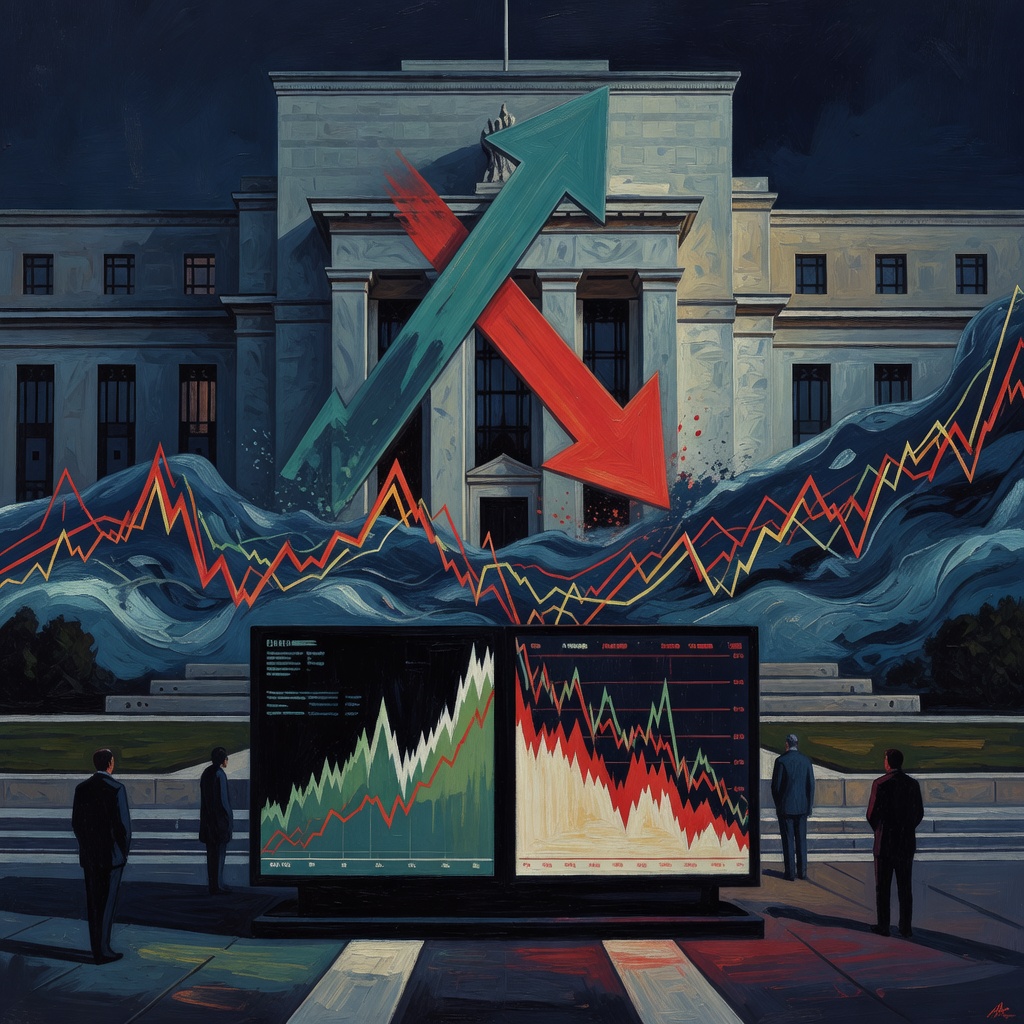
David Sterling: In May 2026, inflation hit 4.2%—the first time since April 2023—and Wall Street's response was instantaneous: every major bank abandoned its rate-cut forecast for the year. Every one. Gone in about a trading session.
Megan Skiendel: Right, and — okay, here's the thing — I was on the phone with someone at Goldman the morning that number dropped, and the word she used was 'paralyzed.' Not surprised. Paralyzed.
David Sterling: Well, that's the structural problem. Energy drove almost all of the spike — we're talking Brent crude doing something it hasn't done in eighteen months — and the Fed's models know that. But the Fed can't cut into a 4.2% print without it reading as capitulation, regardless of what's causing it.
Megan Skiendel: Mm. And that's — honestly that's the part that's almost unfair to Powell, because this is an oil-market story that got dressed up as a monetary policy story, and now he's the one holding the bag.
David Sterling: This is, frankly, 1998 all over again — external commodity shock, Fed caught between optics and mechanics, and the market pricing in maximum uncertainty because it can't read the institution's intent. The fact is, that uncertainty has a beneficiary, and it's CME Group.
Megan Skiendel: Yeah — look, when traders can't agree on what the Fed does next, they hedge, and when they hedge, CME collects. I mean, that's the whole episode right there: confusion is a revenue model if you own the exchange.
David Sterling: The Bureau of Labor Statistics dropped the May CPI number on June 10th. 4.2% year-over-year. Highest since April 2023. Third consecutive month of acceleration. That's the headline. But here's what I keep coming back to: energy was over 60% of the May increase. Gasoline up 40.5% annually. Fuel oil up 58.9%. The Iran conflict broke the oil market, and we're calling it inflation.
Megan Skiendel: And yet the Fed can't say that out loud. You cannot stand at a press conference and tell Americans that the inflation they're feeling at the pump isn't the 'real' inflation. That's politically incoherent.
David Sterling: Well, but that's exactly what core CPI is for. Strip out food and energy — the number is 2.9%. Elevated above the 2% target, yes. But not a runaway. That's the number the Fed is actually supposed to anchor policy to.
Megan Skiendel: Look, I hear you. But here's what I saw happen in 2022 — business owners don't separate core from headline. They see gas at whatever it is per gallon, they see their input costs up, and they raise prices. By the time you've isolated the 'clean' number, the expectation has already moved. Core doesn't exist in a vacuum.
David Sterling: That's directionally fair. Core did tick up — 2.8% in April to 2.9% in May. Shelter holding at 3.4%, food jumping to 3.1%. The broadening is real. It's just not the dominant story yet.
Megan Skiendel: Yet. That word is doing a lot of work.
David Sterling: It is. And here's the credibility problem. The Fed cut rates in late 2025 on an explicit disinflation thesis. That thesis is now empirically broken. April came in at 3.8%. May at 4.2%. Three straight months of acceleration. The Fed has to answer whether it made a policy error, or whether this is genuinely exogenous. It cannot defend both positions simultaneously.
Megan Skiendel: Honestly, the word I keep hearing from people I know inside that debate is 'paralysis.' Not caution. Paralysis. Because the Reuters poll out June 9th — strong majority of economists now expect the Fed to hold for the rest of 2026. That's the first such consensus this cycle. And the people I know are saying the real risk isn't the median outcome. It's the tail.
David Sterling: The Reuters consensus is structurally rational given the bind. The dual mandate cuts both ways here. 172,000 nonfarm payrolls added in May. Unemployment at 4.3%. The labor market is not giving the Fed any recession cover. Normally you cut because the economy is softening. There is no softening.
Megan Skiendel: Which is exactly why I'd push back on reading that Reuters poll as a structural forecast. Wall Street economist surveys chase the consensus. They always have. The median doesn't capture what Wells Fargo's trading desk is actually hedging against right now.
David Sterling: Which brings us directly to CME Group.
Megan Skiendel: Right. And this is the part that I find genuinely strange. CME's interest rate futures and options volumes are surging — because nobody can price what the Fed does next. That's good for CME. That's their business model working exactly as designed. But —
David Sterling: — look, I'd frame that differently. CME supplies the venue. Uncertainty generates hedging demand. That's value-neutral. The exchange isn't creating the volatility.
Megan Skiendel: I know that's the clean version. But an institution whose revenue is literally indexed to the Fed's inability to give clear guidance — at some point you have to ask whether that shapes how they market uncertainty to clients. CME profits most when nobody knows what the Fed will do. That's not neutral. That's an incentive structure.
David Sterling: The load-bearing assumption in your argument is that CME has a channel through which it influences Fed communication. I'm not sure that exists.
Megan Skiendel: It doesn't have to be direct. It's ambient. When every major hedging instrument prices in maximum ambiguity, that ambiguity becomes self-reinforcing. Traders position for uncertainty, volatility stays elevated, the Fed reads the market signal and feels even less able to move cleanly.
David Sterling: Mm. That's harder to dismiss than I'd like.
Megan Skiendel: The scenario I actually want you to model is the one where the Iran conflict doesn't resolve in six months. Oil stays elevated. The energy index keeps printing 3.8%, 3.9% monthly — which is what it did in March, April, and May. What does the Fed do then? Because holding while inflation sits above 4% with a strong labor market — that starts to look less like caution and more like a chair who's afraid to move.
David Sterling: Then the Fed has a genuine choice between mandate priorities. And frankly, that's 1973 territory, not 2023. Supply shock sustained by geopolitics, labor market intact, central bank caught between inflation and a hard place. The historical analog is not comfortable.
Megan Skiendel: Man, okay. So here's where I land on this. The Fed can survive being wrong about the data. They've done it before. What they cannot survive is being wrong about the story — and right now the story is slipping.
David Sterling: Right. The data will eventually vindicate or indict the hold. That's just arithmetic. The question is whether the Fed still controls the narrative by the time the data arrives. And frankly, central bank credibility is not a lagging indicator.
Megan Skiendel: Which means the real test isn't July CPI. It's whether the next shock — whatever it is — finds a chair who's already spent the credibility defending this one. That's the question I don't have an answer to. We'll be back.