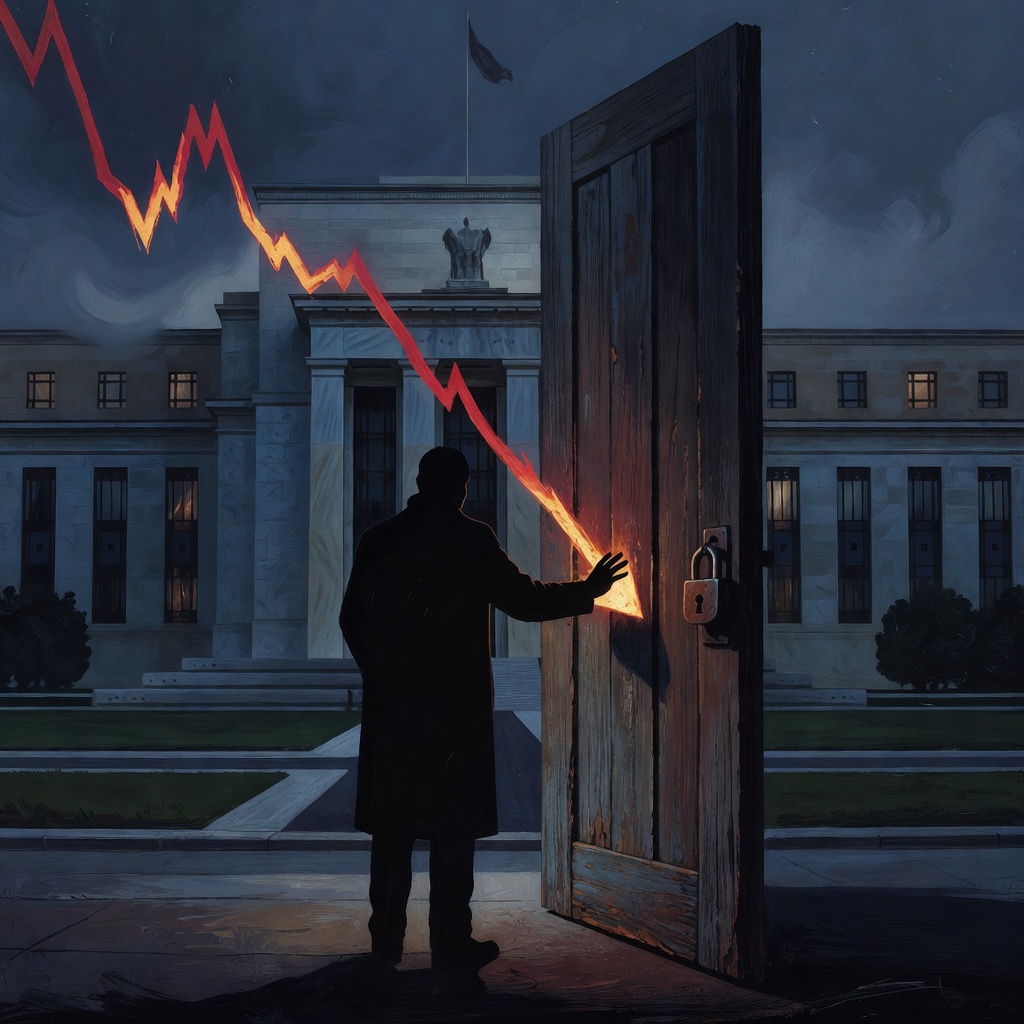
Malcolm Reeves: May 13, 2026. The Senate confirms Kevin Warsh as Fed Chair by 54 votes to 45. Most divisive confirmation in Federal Reserve history. Now — most people filed that and moved on.
Cole Brennan: And then June hits.
Malcolm Reeves: June 17th. First FOMC meeting. Rates unchanged — fine, expected. But the policy statement drops from 341 words to 132. All forward guidance: removed.
Cole Brennan: No — wait, actually — that's the part I keep getting stuck on. Forward guidance is how markets price everything. Like, mortgages, bonds, retirement accounts — all of it assumes the Fed is sending signals about where rates go next. Warsh just... pulled the signal.
Malcolm Reeves: And announced five task forces in the same press conference. Communications, balance sheet, economic data gathering, AI's impact on productivity and jobs, inflation frameworks. That is not a man tinkering. That is a man dismantling.
Cole Brennan: Huh. So the question I can't shake — those 209 deleted words. What were they actually telling us? And what does it mean that they're just... not there anymore?
Malcolm Reeves: Now, to understand what's actually new — you have to go back. Alan Greenspan ran the Fed in near-total opacity. Markets guessed. Then Bernanke comes in and declares monetary policy is, and I'm quoting him directly here, '98% talk and only 2% action.' He introduces press conferences, he builds the dot plot — the Summary of Economic Projections, every policymaker's rate forecast laid out. That's a thirty-year arc toward transparency. Warsh just broke it.
Cole Brennan: Wait — Warsh was *there* for part of that.
Malcolm Reeves: He was. 2008. Bear Stearns sale to JPMorgan, Lehman's bankruptcy, the AIG bailout — Warsh is in the room for all of it, as Fed Governor, helping build exactly the crisis-era communication infrastructure he's now pulling apart.
Cole Brennan: So this isn't some outsider saying you guys talk too much. He's — I mean, he helped wire the house and now he's cutting wires.
Malcolm Reeves: And then he resigns in March 2011 over QE2 — Bernanke's $600 billion Treasury purchase program — leaves, goes to Stanford Graduate School of Business, and spends years developing the critique from inside out.
Cole Brennan: That's the piece that, like — actually, no, the part I want to understand is the transcript thing. He thinks *publishing* FOMC transcripts chills debate? That people speak less candidly because there's a record? That feels... backwards to me.
Malcolm Reeves: It does. And I don't think we can resolve it cleanly — because the evidence cuts both ways and his 'skinny Fed' task force hasn't delivered findings yet.
Malcolm Reeves: Now, there's a take circulating — on X, among traders — that markets will self-correct. That without the Fed's hand-holding, price discovery actually gets healthier. @MacroAlphaHQ basically declared the era of central bank hand-holding is officially dead, framing Warsh's move as a correction. And I want to name that take directly: it's wrong.
Cole Brennan: Hold on — wrong how, specifically?
Malcolm Reeves: Mark Zandi, chief economist of Moody's Analytics, goes on CNBC and says he is — quote — 'not a fan.' His actual warning: reduced communication widens the term premium on longer-dated bonds. That's not philosophy. That's mortgage rates. That's retirement accounts.
Cole Brennan: Right, and — wait, I want to make that concrete. A bond trader on a Tuesday afternoon, the statement drops, 132 words where 341 used to be, no forward guidance, and now they're pricing 10-to-30 year duration risk with — nothing. @nickgiva1, ex-JPMorgan, actually said the term premium came in a lot after Warsh's hawkish tone. But then added: 'volatility works both ways.' That second half is the part people keep skipping.
Malcolm Reeves: Malcolm Reeves: The split is genuine — because Zandi also said he was encouraged by Warsh's hawkish tone specifically, as a signal the Fed stays independent. So he's separating two things most people are collapsing into one.
Cole Brennan: So the real gap isn't the philosophy — it's the five task forces haven't reported yet and markets have to price right now. That's the actual problem.
Cole Brennan: And that gap is — I mean, it's not abstract. The five task forces are reviewing communications, balance sheet, inflation frameworks, all of it — none of them have reported. And bond traders are pricing 10-to-30 year duration right now. Today. Without a roadmap. So either markets find a floor on their own inside twelve months, or the term premium keeps widening and the Federal Reserve has to walk this back before Warsh's own reviews are even finished.
Malcolm Reeves: And if they don't have to walk it back — if volatility actually settles — every other central bank is watching. The ECB, the Bank of England. Warsh becomes the model.
Cole Brennan: Which is — yeah, that's the whole thing, right? Nobody knows. Warsh doesn't know. The task forces don't know. Is that the point, or is that the problem?