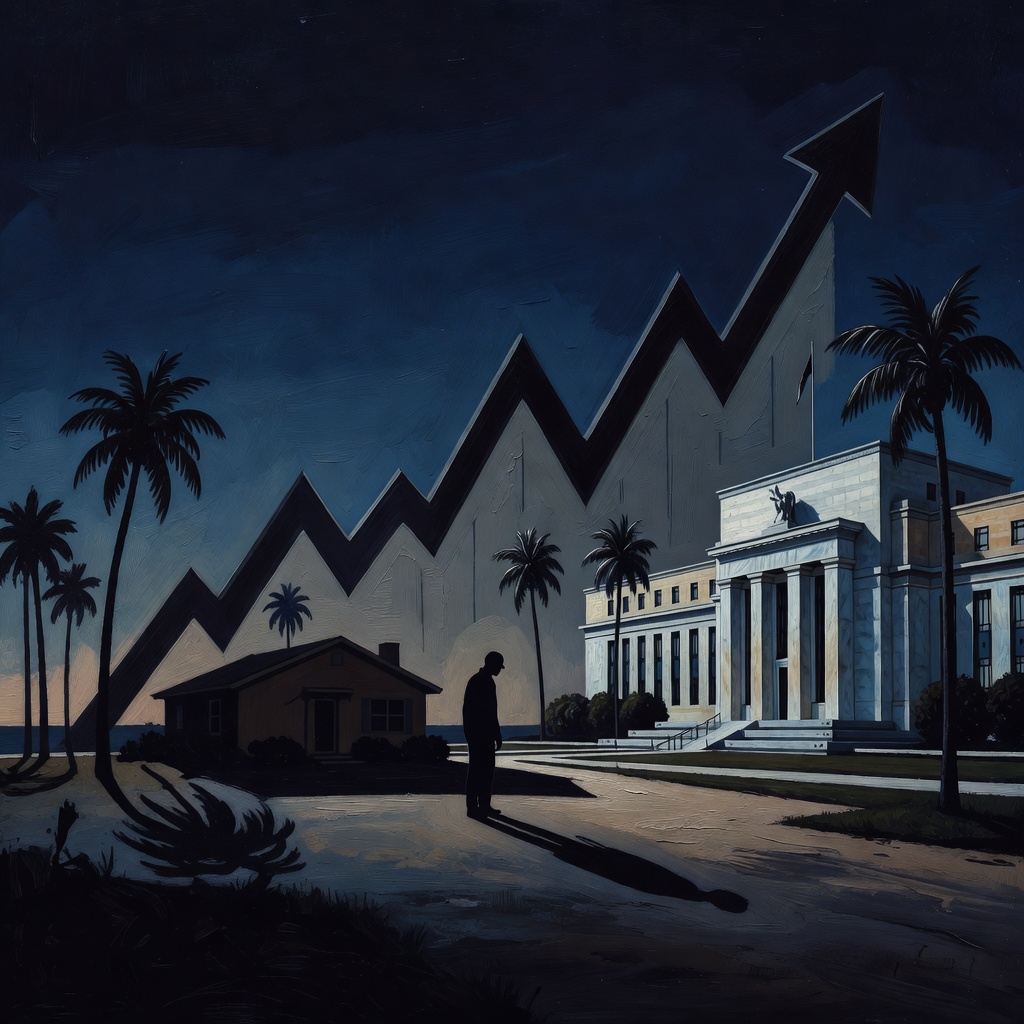
Clara Bennett: You sent me a voice memo at 11 PM about a dot plot — I'm going to need you to explain yourself.
Finn Brooks: Ha — no, okay, but it's warranted, I promise. Because Kevin Warsh just chaired his first Federal Open Market Committee meeting and did something genuinely historic and nobody's leading with the right detail.
Finn Brooks: He held rates at 3.50 to 3.75 — mid-June 2026, first meeting — and then the post-meeting statement comes out and it's 131 words. Powell's April statement was 341. And Warsh didn't submit his personal dot in the Summary of Economic Projections. His forecast is just... not there. No Fed chair has ever skipped their own dot. It's like the new boss wrote to the whole staff — he actually wrote to the Fed's 20,000-plus employees about his philosophy right after taking over — and then showed up to the first meeting and said, I'm not telling you what I think rates should be. Figure it out.
Clara Bennett: Mm. Now that's — I mean that's a very specific kind of power move. The analogy that lands for me is: your manager stops sending the weekly team update. Completely. And you realize the absence of the email is itself the message.
Finn Brooks: Yes! That's exactly it — the blank space is the communication. And bond markets had to sit with that.
Clara Bennett: And then the June SEP lands. The median PCE inflation forecast gets revised up to 3.6%, and the committee flips — not easing bias anymore, tightening bias. Markets start pricing in a possible 0.25 point rate hike. Not cuts. A hike.
Finn Brooks: Wait — from multiple cuts expected to a possible hike? That's a complete reversal.
Clara Bennett: In one meeting, yes. And the thing that matters here — the mechanism — is that without Warsh's dot anchoring anything, every single data release becomes load-bearing. Gennadiy Goldberg at TD Securities said it publicly: jobs report days and inflation releases now carry substantially greater market-moving weight than before. That's not just analysis, that's a structural warning.
Finn Brooks: Citadel Securities said something too, right? Like, they flagged this specifically—
Clara Bennett: Issued a public warning. Called it a 'shifting landscape.' Flagged increased volatility risk. These aren't small shops being dramatic — this is what the risk premium actually looks like when it materializes.
Finn Brooks: Okay and here's where it stops being abstract for me. There's a 34-year-old right now who's supposed to close on a house. Freddie Mac's 30-year rate is at 6.49% as of June 29th. And instead of having some rough sense of where rates are headed, they're — I'm not even joking — refreshing the BLS website the night before the jobs report like it's a Beyoncé album drop, because Warsh's silence just made their entire $400K mortgage decision hinge on one unemployment number.
Clara Bennett: And the CNN Fear and Greed Index is sitting at 24.8. Extreme fear. Now, 6.49% isn't catastrophically high on its own — the number isn't the whole story. The uncertainty premium embedded underneath it is. That's the bewilderment tax, and it's in someone's mortgage payment.
Clara Bennett: Now step back from the mortgage for a second. Because there's a political layer here that I think actually compounds everything we just described. Trump appointed Warsh — part of the pressure was, get rates down. That was the stated direction. And Warsh shows up hawkish. Signals possible hikes. And Trump's response is — and this is a direct quote — 'fantastic,' and 'I want him to do whatever he wants.'
Finn Brooks: Wait — he said *fantastic*? After the hawkish debut?
Clara Bennett: Verbatim. Which is — I mean, either Trump genuinely reversed on rates, or he's endorsing Warsh's *independence* as a political signal, and those are two very different things. The mechanism underneath them points in opposite directions.
Finn Brooks: Okay but then — no, wait, this is the part that doesn't compute for me — simultaneously, Lisa Cook gets targeted. First U.S. central banker a president has ever tried to fire. So on one hand, 'I want him to do whatever he wants,' and on the other hand, the administration is moving against a sitting Fed governor? Those two things are — they're not the same policy.
Clara Bennett: That's exactly the compounding problem. And then Scott Bessent stands up at the Economic Club of New York — June 23rd — and publicly affirms Warsh's independence. Says he'll 'optimize the path for inflation and economic growth.' So the Treasury Secretary is reinforcing Fed independence while the president is targeting a Fed governor.
Finn Brooks: The signals are as contradictory as the market signals. That's — yeah, that's the same problem twice.
Clara Bennett: Right. Warsh's silence was supposed to reduce noise. Instead — political noise from the White House, uncertainty about Cook's fate, Bessent saying one thing, Trump saying another — Wall Street analysts haven't even reached rate hike consensus. HousingWire, Investopedia, they're both quoting the same thing: markets are just genuinely uncertain. That uncertainty is what's sitting inside that 6.49% rate. Not a policy. A question mark.
Finn Brooks: There's a jobs report coming in a few weeks. June numbers. And under Powell, everyone — bond traders, mortgage brokers, that 34-year-old refreshing BLS — everyone had some rough sense of how the Fed would read it. Like, okay, if unemployment ticks up, they ease. If it stays hot, they hold. Now? Under Warsh and the FOMC's new silence... nobody actually knows the reaction function anymore. The number drops and then it's just — wait, what does that mean for rates? Is that a hike signal? Is it nothing? Mortgage rates could spike or drop sharply on that one release.
Clara Bennett: The Freddie Mac rate is 6.49% today. But the number that matters most right now isn't published yet.
Finn Brooks: Yeah. Just... a lot of people waiting for it.
Clara Bennett: You sent that voice memo about a dot plot at 11 PM. Turns out the missing dot was the whole story.