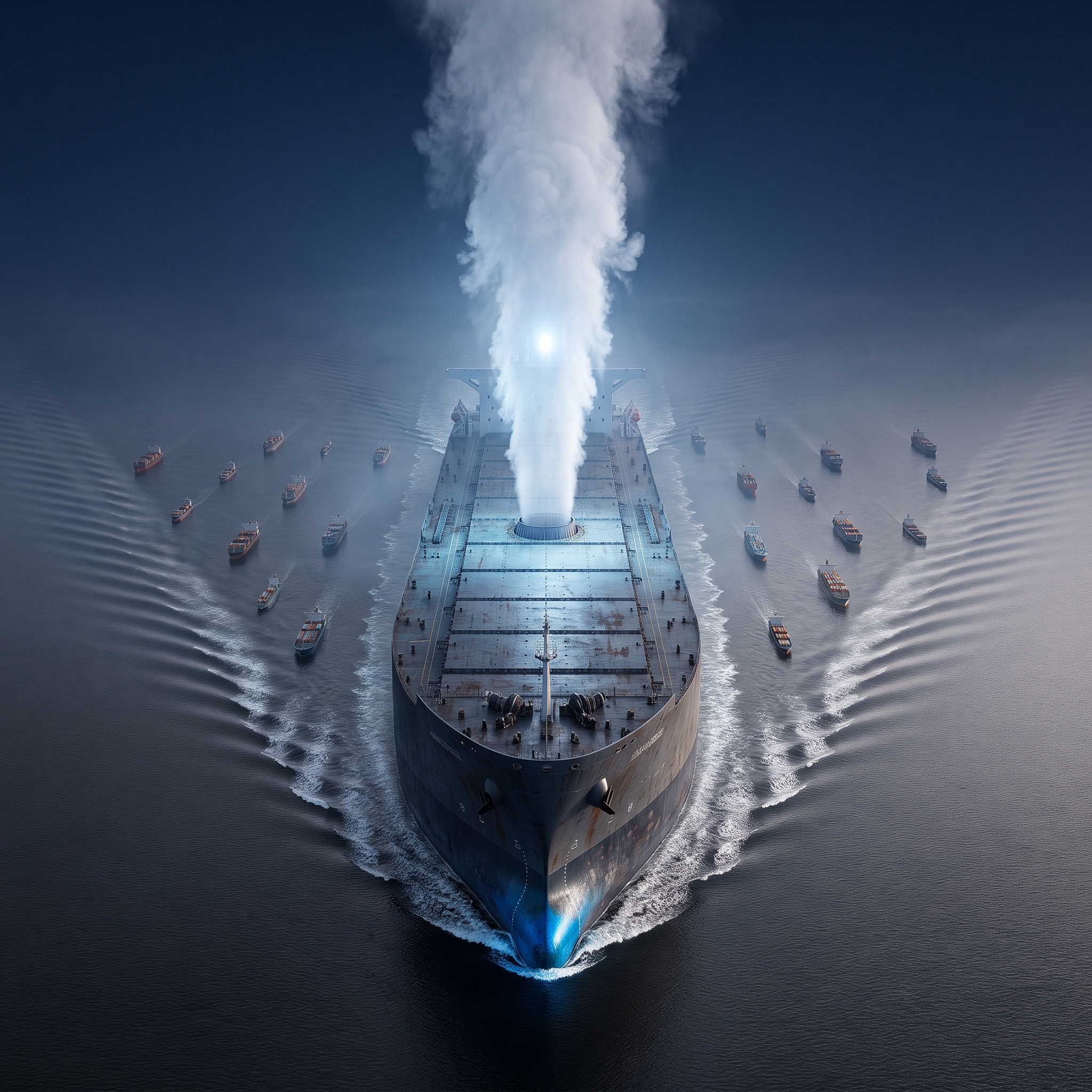
Jordan Hale: Ryan, good — you're here, I need to think through something out loud because it's been messing with me. You know how America used to build the world's cargo ships the way it built the world's cars? Like, that was just a thing we did?
Ryan Castillo: Used to. What's the current number?
Jordan Hale: 0.11% of global commercial shipbuilding. That's the U.S. share in 2024. And then 2025 — basically zero. China is at 53%.
Ryan Castillo: Hold on — 53% is the CSIS figure for China's share of global output?
Jordan Hale: Yeah, and they grew from under 5% in 2000. So in roughly twenty-five years, they went from a footnote to more than half the world's commercial shipping tonnage. And the U.S. went from... a real number to a rounding error. The core question for today — I mean the thing I genuinely don't know — is whether the nuclear initiative MARAD just announced is an actual strategy to change that, or whether it's, you know, a very expensive press release.
Ryan Castillo: The August 24th agreement with Core Power. Preliminary, non-binding — no ships, no budget, no timeline. That framing matters. Let's figure out what it actually is.
Jordan Hale: But even calling it non-binding undersells how far we are from needing to worry about the fine print. Like, China State Shipbuilding Corporation — CSSC — produced more commercial tonnage in 2024 alone than the entire U.S. shipbuilding industry has produced since World War II. That's not a gap. That's... I mean, what do you even call that?
Ryan Castillo: A crater. And the Pascagoula scenario is what makes it concrete — imagine a shipyard manager there in late 2025 getting a call asking to bid on ten container ships. She has to decline. Not on price. There is no domestic capacity to build them. At all.
Jordan Hale: Wait — not even competitive, just... absent?
Ryan Castillo: No floor to stand on. And here's what makes the allied-cooperation argument complicated — South Korea and Japan combined fell from 58% to 38% global share over the last decade. China is displacing them in high-value segments now. LNG carriers, not just bulk freighters. So the backup plan is also shrinking.
Jordan Hale: Which is — okay, that one actually surprised me. Because I always assumed the answer was just, you know, ally with Seoul and Tokyo. But if CSSC is eating their lunch in LNG too, that's a different problem entirely. The USTR Section 301 investigation basically said the same thing formally, right? That this isn't just market competition, it displaces firms, shrinks the field — it's been designated a national security burden, not a trade dispute.
Ryan Castillo: That's the legal grounding that lets the government treat it differently from, say, steel tariffs. But what the Section 301 finding doesn't answer — what nothing so far answers — is whether SMRs close a gap this structural. And that's the darker part: what nuclear propulsion is actually trying to do and why the USS Savannah is a warning rather than a precedent.
Jordan Hale: Yeah — and I don't think we've been honest yet about which problem we're even trying to solve.
Ryan Castillo: Stephen Carmel — MARAD Administrator — he didn't say 'catch up to China.' He said 'change the terms of the competition.' That's a very specific word choice, and I don't think it's accidental.
Jordan Hale: What does that actually mean, though? Like, change them how?
Ryan Castillo: SMRs — small modular reactors — don't need to refuel across an ocean. Extended range, no fuel port dependency. If you're moving logistics in a contested Pacific corridor, that's operationally different from anything CSSC builds. Cost-per-ton comparisons don't capture that.
Jordan Hale: Okay but — wait, no — we have a data point on exactly this. The USS Savannah. 1962. First civilian nuclear-powered merchant ship. Perfect safety record. And it became a museum.
Ryan Castillo: Not because the reactor failed. Insurance companies wouldn't touch it. Ports wouldn't accept it. Crew certification costs were prohibitive. The technology worked — the ecosystem killed it.
Jordan Hale: And the MARAD–Core Power partnership — that August 24th agreement — it's literally focused on regulatory frameworks, insurance structures, port-access rules. Before a single ship is authorized. They're trying to solve the Savannah problem first, sixty-four years later.
Ryan Castillo: Which is either disciplined or alarming depending on your priors. Hunter Stires argues national-security logic overrides cost inefficiency. Scott Lincicome at Cato says the U.S. risks replicating China's own subsidy failure mode. And that tension — nobody's resolved it.
Jordan Hale: And meanwhile CSSC is building PLA Navy warships on the same production lines as container ships. So commercial dominance isn't separate from military capacity — it is military capacity. That's the part I don't think the Savannah conversation captures at all.
Ryan Castillo: The honest version is — we have a preliminary agreement and a named port. Corpus Christi. That's the full inventory of concrete things. No budget line, no ships authorized. And capital without political will doesn't move. I just can't move past that.
Jordan Hale: And the thing I keep sitting with — the Savannah flew the flag in 1962. The reactor worked. We just... didn't follow through. And I genuinely don't know what's different now. Like, I want there to be an answer. I don't have one.
Ryan Castillo: Neither do I. Good talk.