Ben Okonkwo: Okay, I've been sitting with something all week — and I think it's actually the sharpest version of what we're getting into today, so I want to hand it to you cold.
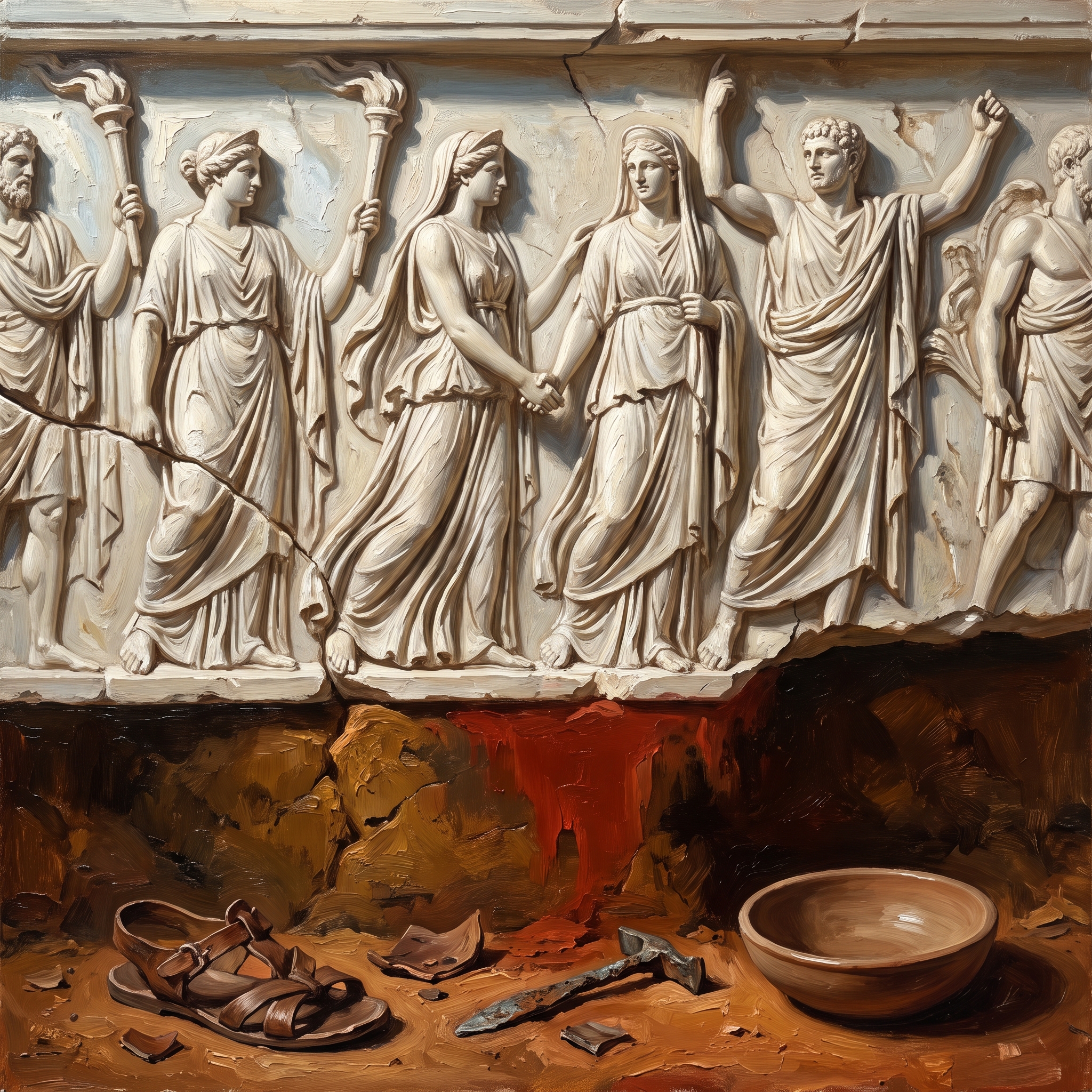
Ben Okonkwo: A parent in Austin opens her kid's newly revised Texas history textbook — reads a compressed, heroic paragraph about her county's founding. No mention of the Native American land seizure her grandfather described to her. And she doesn't flag it. She doesn't think 'something's missing.' She just... absorbs it as history.
Marcus Vale: And the grandfather's version fades.
Ben Okonkwo: Right — and here's what I can't quite resolve. Maurice Halbwachs argued that remembering isn't retrieval, it's reconstruction inside a social group. So in principle, both accounts are reconstructions. But one has the school behind it. And schools are the major institutional site where collective memory gets built for entire populations — specifically during the years when you're most susceptible to that framing.
Marcus Vale: So it's not that the textbook is more true. It's that it has more infrastructure.
Ben Okonkwo: And textbook revision — in Texas, in a lot of states — is frequently driven by politically motivated actors, not historians. Which means the stories communities tell themselves about their own past are being shaped by whoever controls the room when the curriculum vote happens.
Marcus Vale: Frankly, that reframes the whole question. It's not ignorance producing the gap between what communities remember and what evidence supports. It's design. And then the question is simple — who benefits from keeping the design exactly this way?
Ben Okonkwo: But wait — design implies intent. And I'm not sure that's always the right frame. Because Halbwachs's point is that reconstruction happens even without a political actor in the room. The social group does it automatically. So... what's the mechanism underneath?
Marcus Vale: Think of it this way. Family story versus court record. Your uncle retells Thanksgiving 1987 to make the family feel like a family — not to document what actually happened on that Tuesday. A court record of the same day checks for what provably occurred. They're not competing versions. They're doing completely different jobs.
Ben Okonkwo: Different jobs serving different masters.
Marcus Vale: Exactly that. And that's Halbwachs's actual claim — memory isn't retrieval, it's reconstruction inside a social frame. The group needs cohesion today, so the past gets shaped to deliver it. Not maliciously. Structurally. Then Pierre Nora sharpens it further: collective memory denies the historicity of events — treats them as continuously present, still alive, still relevant to you right now. Scholarship does the opposite. It foregrounds pastness. It insists the event is over and we're looking back at something finished.
Ben Okonkwo: Hold on — when Halbwachs says reconstruction, he means the group is actively shaping what gets remembered? Not distorting it, like accidentally — but shaping it because that's the only way remembering works socially?
Marcus Vale: That's exactly it. And mémoire collective — Halbwachs coins that phrase in the late nineteenth century as a recognized intellectual category, not a metaphor. It's the formal claim that group-level remembering is its own phenomenon. James Wertsch later puts it cleanly: collective memory stays loyal to a meaningful narrative. Peter Novick says historical analysis requires consciousness of historicity — awareness that the past is past. Those two orientations point in opposite directions. That's not a gap you close by getting better evidence.
Ben Okonkwo: So — to be precise — the gap isn't a knowledge deficit. It's a structural feature because they answer to incompatible masters.
Marcus Vale: Permanent structural feature. Not a correctable error. Memory serves social cohesion — criticism of a national narrative feels like an attack on the group itself, because it is an attack on the mechanism holding the group together. Scholarship serves accuracy and — I mean, here's the uncomfortable part — embraces uncertainty as a feature. Those two things cannot converge. One of them has to break first.
Ben Okonkwo: Which means every reform effort — every Texas TEKS rewrite, every textbook battle — isn't fixing the gap. It's just deciding who controls which reconstruction.
Marcus Vale: But here's what that actually means in practice. The compression isn't a bug communities tolerate. It's load-bearing. Founding myths, heroic defeats, golden ages — those aren't decorative. They're the architecture. Take a heroic defeat — think how many national identities are anchored to a noble loss that the community retells as proof of character. You strip the nobility out, replace it with ambiguous actors and uncertain causation, and you haven't given the community better history. You've removed the thing that made them a community.
Ben Okonkwo: Hm — so narrative selectivity isn't laziness. It's functional.
Marcus Vale: Completely functional. Wertsch's line — loyal to a meaningful narrative — that's not a criticism. That's a description of how it works. The group needs a usable story. Archives opening, new voices entering the record — that's great for scholarship, it does nothing to the underlying need.
Ben Okonkwo: Okay but here's where I get stuck. If compression is genuinely necessary — I mean, what's the actual cost? Because you could argue communities function fine on simplified narratives for centuries.
Marcus Vale: Pattern-match it to early-stage startups. Every founding team has a myth — the garage, the overnight insight. You need it. The team moves on that story. But the moment founders start making actual resource allocation decisions from myth instead of unit economics — that's the break point. Communities do the identical thing. The compressed narrative stops being background cohesion and starts being the decision frame. What you stop seeing is — I mean, that's when it gets expensive.
Ben Okonkwo: Right — but there's a social cost dimension underneath that. When new evidence arrives and complicates the compressed version, it doesn't just feel inconvenient. Challenging a founding myth gets experienced as an attack on the group itself. Not on a claim — on the group. That's the social cohesion function of memory being triggered as a defense mechanism.
Marcus Vale: Which is why the evidence doesn't land. The archive opens, scholars bring in previously excluded voices, and the community's response isn't 'interesting, let me update.' It's closer to threat detection.
Ben Okonkwo: Picture a regimental association — veterans gathered around a specific battle's memory. Someone publishes archival findings showing the engagement was tactically chaotic, command decisions were poor. Factually rigorous. And the room just... rejects it. Not because they've evaluated the evidence. Because that battle is the thing that makes them a group with a reason to gather.
Marcus Vale: And here's the part that gets worse — the same plasticity that makes this functional is exactly what makes it a target. It's genuinely uncomfortable, and we'll get into it.
Ben Okonkwo: Right — but the part that doesn't fit is: who's doing the editing? Because you said plasticity is the attack surface. And I think that's the piece I want to actually pull on.
Marcus Vale: Here's the deal. You don't need to fabricate from scratch. Communities already hold a compressed version. So the move is just — edit the compression. Trim what the community already simplified. Nobody notices because there's no original to compare against anymore.
Ben Okonkwo: How does the community not notice?
Marcus Vale: Because the same mechanism that makes collective memory resist scholarly revision also makes it resist recognizing deliberate editing. It's identical machinery. Wertsch's loyal-to-a-meaningful-narrative thing — that loyalty doesn't distinguish between 'this narrative emerged from us' and 'this narrative was placed here.' Both feel like memory. Both feel like ours.
Ben Okonkwo: That's — actually unsettling. Because it means bottom-up and top-down coexist without friction.
Marcus Vale: No seam. Politically Instrumentalization of Memory works precisely because communities experience their narratives as authentically theirs — even when the inputs were curated. And — wait, this is actually the extreme end of it — when the framing community doesn't just get edited but collapses entirely? The memory doesn't get revised. It vanishes. Pre-WWII Jewish community life in Eastern Europe — I mean, the archival record saved fragments, but the lived reconstruction? Gone. Because the communities that held it were destroyed. That's not political revision. That's erasure by disintegration.
Ben Okonkwo: The Fragility of Collective Memory isn't just about getting the story wrong — it's that the story stops existing at all.
Marcus Vale: And the Austin parent doesn't need that extreme. She just needs a textbook, a curriculum vote she wasn't in the room for, and the normal human assumption that the school is a neutral institution. The political actor never has to show up.
Ben Okonkwo: So the experiment that would settle it — what signal would even tell a community they'd been edited rather than just... remembered?
Marcus Vale: Probably no clean signal. That's the uncomfortable answer. Because the mechanism that makes collective memory absorb new scholarship — generational renegotiation, each generation integrating or resisting what scholars find — that same process runs whether the inputs are archival discoveries or political edits. And which ones get absorbed depends on whether they serve the community's identity or threaten it. Not whether they're true.
Ben Okonkwo: So absorption is selective, not cumulative. Nora, Halbwachs, Wertsch — they're all describing the same filter. And the filter doesn't have a 'check source' step.
Marcus Vale: The gap doesn't close. That's — I mean, memory and scholarship are mutually influencing, sure, scholarship slowly reshapes communal narratives over time, but the structural gap stays. What actually changes is who's standing at the compression point deciding what fits the story.
Ben Okonkwo: Not whether communities will close it — they won't — but whether noticing who's doing the deciding is even possible from inside the memory. I'm genuinely not sure it is.
Marcus Vale: Honestly? Neither am I. Good place to sit with it.