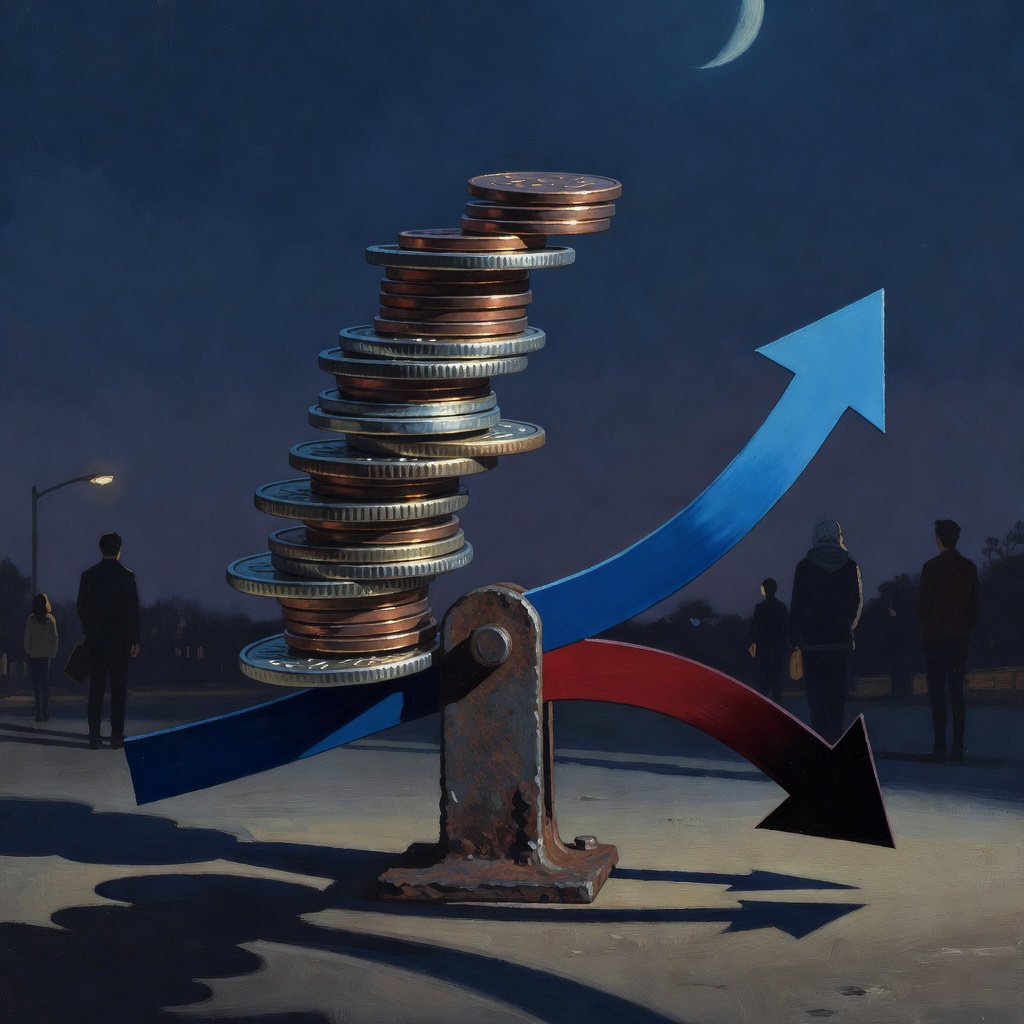
Eleanor Crane: Imagine someone comes to you and says: every single day, without fail, one out of every twenty-eight people in this building loses everything and is quietly removed. Not because of a disaster. That's just... how the building works. That's BitMEX. That's the daily forced liquidation rate on long leveraged positions — 3.51%, every day, routine.
Ben Okonkwo: Hm. And the people left in the building are all holding sixty times leverage on average.
Eleanor Crane: Which is the part I keep returning to. Because leverage — and I want to just say this plainly before we go anywhere complicated — leverage is borrowing money to control more of an asset than you actually own. The gain or loss on your real money moves at a multiple of whatever the asset does.
Ben Okonkwo: Right — so a ten percent asset move, on a 2:1 position, lands as twenty percent on your equity. The math is perfectly symmetric. What isn't symmetric is the timing of when you get removed from the trade.
Eleanor Crane: That's exactly it.
Ben Okonkwo: At 60x, you don't get a phone call. There's no conversation. The forced liquidation executes — automatically, at market prices — and the question this episode wants to sit with is whether that daily 3.51% is a system failing or a system succeeding at the wrong thing.
Ben Okonkwo: Now, the surface explanation — the one most people land on and stay with — is that leverage amplifies symmetrically. You put in a thousand dollars, you borrow another thousand, asset moves ten percent up, you've made two hundred instead of one hundred. Twenty percent return on your equity. Clean. And if it moves ten percent down, you lose two hundred. Also twenty percent. The math is... it genuinely is elegant.
Eleanor Crane: And there's a protective version of that story — that you can't lose more than what you put in.
Ben Okonkwo: Right. The 100% equity cap. Technically — and I mean technically in the truest sense — losses on a long leveraged position are capped at your own equity. The asset can go to zero, you can't go below zero. Which sounds like a protection.
Eleanor Crane: But that floor is never actually what stops the fall.
Ben Okonkwo: No, it isn't, and that's — okay, actually, this is where the clean story breaks. The operative constraint isn't that theoretical floor. It's the margin call. Which arrives mid-fall, well before you hit zero. Your broker demands more capital or demands you reduce the position. You don't meet it — and most people in a sudden drop can't, or don't even know in time — and forced liquidation executes. At market prices. Whatever those are at that exact moment. Which is... think about the Wednesday 2:47 p.m. scenario: a tech earnings miss hits, a trader's in a meeting, liquidation runs automatically, and he finds a notification in his email afterward. The decision was never his.
Eleanor Crane: So the 100% cap is technically true and functionally beside the point.
Ben Okonkwo: And here's what I didn't expect — the gap between what the floor actually should be and what exchanges set it at. Academic work on BitMEX perpetual futures recommends raising margin requirements from 1% to 33% for long Bitcoin positions. That's not a rounding error. That's a thirty-fold chasm.
Eleanor Crane: One percent versus thirty-three.
Ben Okonkwo: One percent actual. Thirty-three recommended for longs, twenty for shorts. And the reason that gap exists — this is the part that really interests me — is that the Value at Risk framework, the VaR margin model that clearing corporations actually use to set these numbers, it assumes returns are normally distributed. And crypto returns... they aren't.
Eleanor Crane: The tails are fatter than the model expects.
Ben Okonkwo: Much fatter. Extreme moves happen more often than a normal distribution predicts — so the regulatory tool is miscalibrated not by accident, by assumption. The architecture is built on a model of the world that Bitcoin empirically violates.
Eleanor Crane: Which raises something for me — the National Financial Capability Study found margin loan users are seventeen percentage points more likely to hold cryptocurrency. And I'd been reading that as: risk-tolerant people cluster together. But if the margin tool itself is inflating prices and undercounting tail risk, maybe the causality runs the other way.
Ben Okonkwo: Yeah — that's actually what I want to test. What if leverage doesn't just attract risk-seekers? What if it creates them? The experimental asset market research shows margin purchases significantly inflate prices even under active oversight — SEBI has been grappling with exactly this since India's retail surge post-2020. The regulatory tool may be inadequate not because it's broken. Because it's working as designed.
Eleanor Crane: And I keep returning to that accountant in Sacramento. Not as a metaphor — as the actual mechanism. He's in a meeting at 2:47 p.m. on a Wednesday. The liquidation has already run. The notification is already in his email. And the thing that stays with me is that on an automated platform, the milliseconds between the margin call triggering and the forced liquidation executing — that gap is gone. There's no phone call. There's no version of this where the decision is his.
Ben Okonkwo: Right. And the system — I mean, the system isn't malfunctioning. It's protecting the broker at exactly the moment when offloading is most damaging to the trader. That's what the 3.51% daily liquidation rate on BitMEX actually describes. Not chaos. Not error. A design running correctly.
Eleanor Crane: Which is the part I can't quite set down. That the notification arrives after. Not during — after. The question of whether leverage created that person's appetite for the risk, or just found it... I don't think the data settles that. And I'm not sure I want it to.