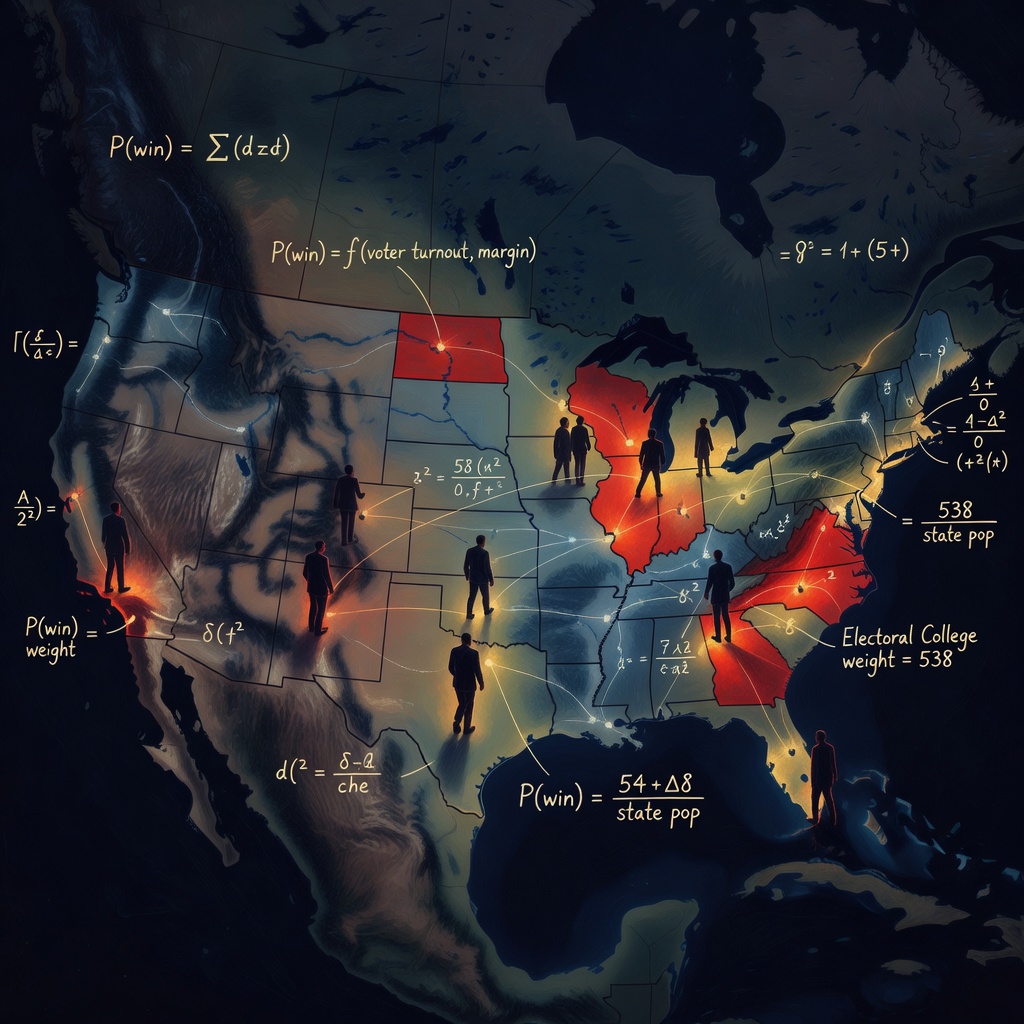
Ryan Castillo: Ninety-four percent. That's the number. In 2024, ninety-four percent of general-election campaign events happened in seven states.
Jordan Hale: Seven states.
Ryan Castillo: Seven. And those seven states represent less than twenty percent of the U.S. population. The other forty-three states — combined — got sixteen campaign visits. Not sixteen each. Sixteen. Total.
Jordan Hale: Wait, that's — sixteen? Like, I assumed it was lopsided but that's not lopsided, that's just... erasure.
Ryan Castillo: That's the right word for it. And this episode is about why — specifically, why the Electoral College's winner-take-all rule makes that math completely rational. A campaign ignoring California isn't being lazy. It's being efficient.
Jordan Hale: Because under winner-take-all, you win California by one vote, you get all fifty-four electors. Win it by three million votes — same fifty-four. The margin is just... noise.
Jordan Hale: And that's the thing everyone leads with, right? Like, the defense you always hear is — the Electoral College protects small states. Wyoming doesn't get steamrolled by California. That's the pitch. That's the bumper sticker. But then you actually look at which states get ignored and it's... wait, it's Wyoming *and* California. Both of them. Together.
Ryan Castillo: Right, but — it's not size. It's predictability.
Ryan Castillo: The electoral vote allocation formula gives every state two senators plus House seats — so Wyoming gets three electors total, which is a per-capita bonus over, say, Texas. That sounds protective. On paper. But the small-state Senate floor advantage only matters if those electors are *contested*. Wyoming is safe Republican. Zero marginal value to a Democrat. You don't go there. The protection the formula supposedly offers just... evaporates the moment the state stops being competitive.
Jordan Hale: And David Strömberg — the Stockholm University economist — actually finds this has gotten *worse* over time. Not stabilized. Worse. Because better polling locks states in earlier, polarization makes them stickier, and campaigns just... I mean, they get smarter at targeting and accidentally make more Americans invisible.
Ryan Castillo: George C. Edwards III makes the point even harder — he argues the whole interest-protection justification is faulty from the start because states don't actually embody coherent unified interests. 'Wyoming' isn't a unified interest. It's ranchers and teachers and retirees. The federalist protection claim, his word, rests on faulty premises.
Jordan Hale: Wait, but what keeps nagging at me — winner-take-all isn't even in the Constitution. Like, states just... chose this. Maine and Nebraska didn't. They use a district allocation system — one elector per congressional district, two go to the statewide winner. They can split. So why hasn't any safe state just... flipped?
Ryan Castillo: That's the trap. If California switches to districts, suddenly Republicans compete for a handful of LA-adjacent seats. Democrats lose leverage. The party in power in a safe state has zero incentive to dilute its own guaranteed pile.
Jordan Hale: Both parties are defending the geography of neglect.
Ryan Castillo: Exactly. Now — October 2024. Phoenix voter. Three campaign texts before nine a.m., direct mail on abortion, targeted ads. That's what swing-state residency feels like. A voter in a locked state? None of that.
Jordan Hale: And then — I mean, this is the irony that kind of breaks my brain — Trump wins 312 electoral votes in 2024 and *also* wins the popular vote, forty-nine-point-seven percent. So the structural problem is just... invisible now. Nobody's screaming about minority rule.
Ryan Castillo: Right, but 2016 — popular vote loser wins, seven faithless electors vote off-script. The system showed every crack. The Wesleyan Media Project and AdImpact data both show the ad concentration was extreme *both* cycles. The 2024 alignment doesn't fix the incentive structure.
Jordan Hale: So the National Popular Vote compact just... removes the targeting algorithm entirely. Though whether any safe state legislature actually moves on it — I honestly don't know. The parties defending the current map have every reason not to.
Ryan Castillo: The thing Strömberg's research keeps pointing at — and I don't think we've fully sat with this — is that the shrinkage doesn't stop. Seven states now. What's the number when polarization locks in two more cycles? Five? Three? At some point the federalist defense... I mean, the founders designed a system to aggregate state interests across a diverse union. But if the competitive map collapses to three states, you're not aggregating anything. You're just — it's a targeting algorithm. Campaigns allocating finite attention to the highest-return voter markets. That's it.
Jordan Hale: And the thing is — right now, nobody's being forced to reckon with that. Because 2024 gave us the popular vote and the Electoral College pointing the same direction. The structural problem got quieter, not smaller.
Ryan Castillo: Yeah. The map keeps shrinking. The system keeps working exactly as designed.