Mark Delaney: Michael, I have been genuinely bothered by something since I went down this rabbit hole, and I need you to either confirm it or tell me I'm reading it wrong.
Michael C. Vincent: Go on.
Mark Delaney: The first thing humans ever wrote down — like, in all of recorded history, the actual first thing — was an inventory list. Grain and livestock at a temple in Uruk, around 3400 BCE. That's it. That's the debut of writing.
Michael C. Vincent: That is exactly right.
Mark Delaney: So here's what bothers me — we treat writing as maybe the defining human achievement, right? The thing that flips the switch from prehistory to history. And the technology that does all that starts because a temple in Sumer needs to track rations. That feels like it should change something about how we think about what writing even is.
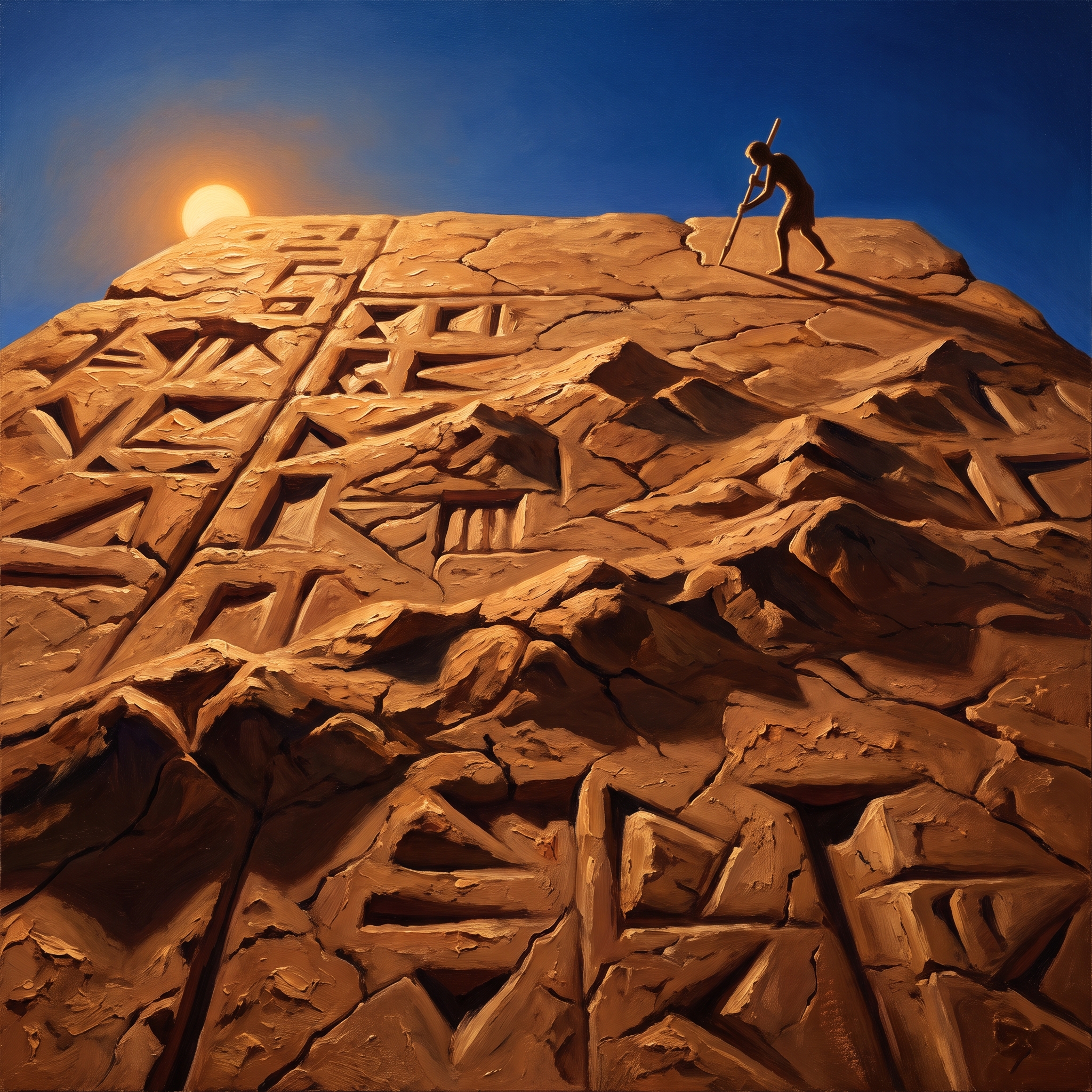
Michael C. Vincent: Well, you see, it does. Cuneiform — those wedge marks pressed into clay with a reed stylus — it was not invented to capture ideas. It was invented to scale a bureaucracy. And the Epic of Gilgamesh, the oldest major literary text we have, that arrives roughly a thousand years later. So literature is almost an afterthought.
Mark Delaney: A thousand years. Huh, no kidding — so what were they writing about for a thousand years before anyone told a story?
Michael C. Vincent: Grain. Livestock. Land. Labor. The administrative needs of temples and palaces in Mesopotamia. That is the full picture for a very long time — and the answer to why gets stranger the further you pull.
Mark Delaney: Wait, so — if the city just keeps getting bigger, at what point does memory actually break? Like, what's the moment where someone goes, uh, we can't do this in our heads anymore?
Michael C. Vincent: Think of it this way. A temple in Uruk is now tracking not one flock of sheep but dozens, across multiple harvests, owed to multiple creditors. No single scribe's memory holds that. Writing is just — it's a filing cabinet the city grew into needing.
Mark Delaney: A filing cabinet. Yeah, no, that's exactly it.
Michael C. Vincent: And now here is where Denise Schmandt-Besserat's work lands like a hammer. She traced that filing cabinet all the way back to the 8th millennium BCE — four thousand years before Uruk. Clay tokens, different shapes, each representing a different commodity. A cone for grain, a sphere for something else. People were pressing them into clay envelopes to record what tokens were inside. You see what that is? That IS the accounting. The wedge marks on a tablet — cuneiform — that's just what happened when someone realized you could press the token's shape directly into the clay surface and skip the token entirely.
Mark Delaney: Hold on. So the marks on the clay were — they were impressions of the physical tokens they already had?
Michael C. Vincent: That is exactly it. Five thousand years of a physical system, working well, before it collapses into a notation. Writing didn't get invented once by a genius. It crept up on people.
Mark Delaney: That — okay, that genuinely reframes it for me. Because I had this picture in my head of some scribe sitting down and going, I'm gonna invent writing now. But it's more like the city just kept adding another floor to the building until someone had to draw a map of it.
Michael C. Vincent: And Egypt hits the same wall around 3100 BCE. Hieroglyphs appear — and the first uses are administrative, economic. Not prayers. Not royal proclamations. Invoices, essentially. The temples and palaces drive it, the same institutional pressure as Uruk.
Mark Delaney: So it's not even a cultural leap — it's a management problem. Across two different civilizations, centuries apart, they hit the same ceiling and solve it the same way.
Michael C. Vincent: Same ceiling, same solution — and that pattern gets genuinely strange when you pull back far enough. Because Egypt and Mesopotamia are one thing. They're neighbors, essentially, with active trade routes already running between them. But China hits the same wall around 1200 BCE, and they get there completely alone. And what they write first isn't grain receipts. It's questions for the gods.
Mark Delaney: Wait — questions for the gods?
Michael C. Vincent: Oracle bones. You take an animal bone — sometimes a turtle shell — you apply heat until it cracks, and then a scribe reads the pattern and writes the divine answer directly onto the bone. Yes or no. Will the harvest fail. Is the king's campaign favored. The writing isn't administrative. It's a transcript of a conversation with the divine.
Mark Delaney: Huh, no kidding. So same basic move — put knowledge outside your head so it survives — but the reason is totally different. It's not a filing cabinet, it's a... record of what heaven said.
Michael C. Vincent: Which is why scholars since the 1980s have landed hard on independent invention. Four sites — Mesopotamia, Egypt, China, Mesoamerica. The old idea was one Sumerian origin and cultural spread. That's gone now. And what replaces it is almost more unsettling: writing looks like a near-inevitable response to social complexity. Whenever a society scales past what oral memory can hold, it reaches for some version of this.
Mark Delaney: Okay but — and I'll just say it — Egypt and Mesopotamia are, what, a hundred years apart? That's nothing. And they're not exactly isolated. Doesn't that complicate the whole 'independent' claim?
Michael C. Vincent: It does, and I'd be careful anyone who tells you it doesn't. We can't prove diffusion. We also can't rule it out. Those Mediterranean trade routes were already active. A century apart, neighboring economies — the independence argument is genuinely contested for Egypt specifically. China and Mesoamerica, though, those hold. Thousands of miles, thousands of years removed. That's convergence, not copying.
Mark Delaney: So Egypt is the uh — it's the wobbly case in the lineup.
Michael C. Vincent: Egypt is where honest historians get quieter. And what comes next in this story makes the stakes of that question much harder to ignore — because once writing exists, whoever controls it controls the state, and the Inca built a continent-spanning empire without any of it, which does something uncomfortable to the entire framework we use to call anything 'history' at all.
Mark Delaney: Okay but — the Inca thing you just dropped. Before we get there, I want to sit on the scribes for a second. Because if writing is just a filing cabinet, why do the guys running the filing cabinet end up being, like, the second most powerful people in the kingdom?
Michael C. Vincent: Because the filing cabinet is the kingdom. Tax records, property boundaries, legal codes — whoever holds the clay tablets holds the truth of who owns what. A governor in the field cannot contradict a written record in the temple. That is power.
Mark Delaney: Wait — so a scribe could just... not write something down and it doesn't exist?
Michael C. Vincent: Or write it differently than it happened. Picture a land dispute in Uruk, 3rd millennium BCE. Two families, one field. The scribe who recorded the original boundary — his version of those wedge marks is the verdict. There is no appeal to another document. He is, in a very real sense, the court.
Mark Delaney: That's — yeah. That's not a clerk, that's a judge who doesn't have to show up to the trial. And this is, uh — this is where the Babylonian astronomical records come in, right? Like, the knowledge that accumulates is also gatekept the same way.
Michael C. Vincent: Exactly so. Babylonian astronomers log planetary movements across centuries — patterns no single human lifespan could detect without written records. Egyptian physicians catalogue cases, symptoms, treatments. Chinese agricultural techniques compound across generations. The cognitive offloading isn't just convenient. It is generational leverage. But it accrues entirely to the people inside the literate institution. Everyone outside is still running on memory.
Mark Delaney: Which brings the Inca crashing into all of this. Because they — I mean, no script, right? Two million square kilometers, millions of people, and they're doing all of it with knotted strings.
Michael C. Vincent: Quipus. Different knot types, different lengths, different colors — encoding census data, tribute owed, military logistics. An empire run on string. And here is the thing worth sitting with: if the Inca administered all of that without writing as we define it, then 'history begins with writing' isn't a fact about human civilization. It is a choice about which evidence we've decided to count.
Mark Delaney: So prehistory isn't actually a category of time — it's a category of who left records we recognize. That's a pretty uncomfortable place to land.
Michael C. Vincent: That's what I think about. And it connects all the way back to Uruk — that temple scribe pressing wedge marks into clay to count grain. He wasn't recording history. He was deciding what counted.
Mark Delaney: And we're still doing that. I mean — every database, every algorithm deciding what gets logged. It's the same question the Sumerians answered in 3200 BCE, just, uh, different clay.
Michael C. Vincent: Who holds the pen. Who controls the record. The scribal hierarchy just changed clothes.
Mark Delaney: And what gets left out stays invisible. Same as the quipus.
Michael C. Vincent: Same as the quipus. That's not nothing to sit with.