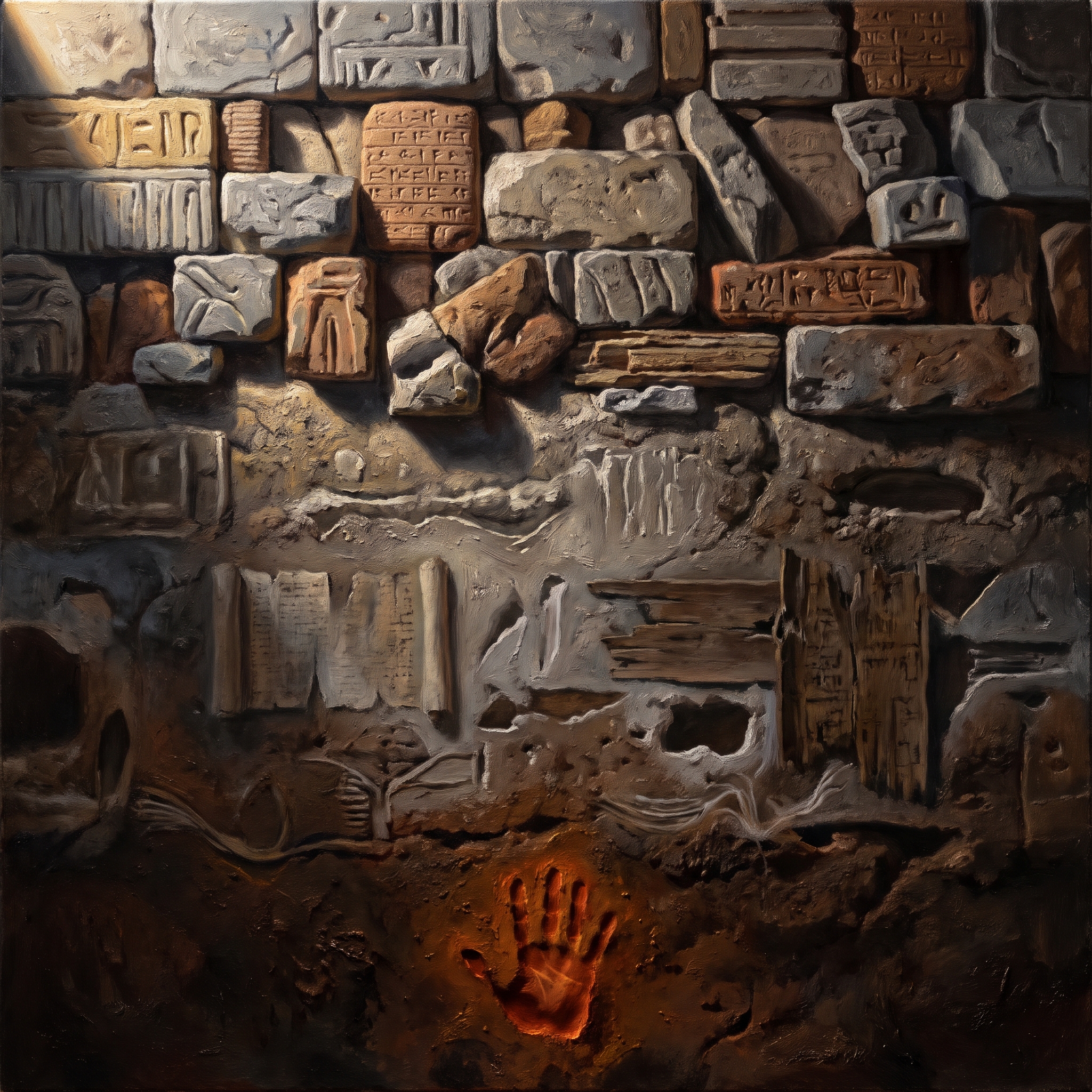
Marcus Kline: Ben — there is a man, upper Egypt, 1945, who went out to dig for fertilizer and came back with one of the most significant document caches in the history of religion. And I cannot stop thinking about him.
Ben Okonkwo: Okay — the Nag Hammadi farmer.
Marcus Kline: He was looking for sabakh — nitrogen-rich soil — to put on his crops. And he turned over a sealed ceramic jar, and inside were thirteen leather-bound papyrus codices that had been sitting there for roughly sixteen centuries. The Nag Hammadi codices. And the probability that he even preserved them all is not certain — he may have burned some for fuel.
Ben Okonkwo: Hm — which is not unusual behavior if you don't know what you're holding. But yes. Documents that reframed the entire diversity of early Christianity, and some may have gone into a cooking fire.
Marcus Kline: Now — the Dead Sea Scrolls, 1947. Bedouin shepherds near Qumran, throwing rocks into a cave. One rock breaks something inside. They climb in, find clay jars, find scrolls. An ancient Jewish library. Same story — accident, not scholarship.
Ben Okonkwo: And neither of those caches would exist — in our possession — if the clay held, if the shepherd had better aim, if the Egyptian soil had been less arid. The survival mechanism is completely orthogonal to the historical importance of the content.
Marcus Kline: Which is — when I actually let that land — that's not just an interesting provenance story. That's a structural argument about what the historical record actually is.
Ben Okonkwo: It's not a record. It's a residue. Right — but a residue filtered by material, by climate, by who had resources to commission documents in the first place. And what I want to get into is exactly how those filters stack. Because it's not one bias. It's compounding mechanisms.
Marcus Kline: Wait — so you're saying we're not just missing data. We're missing it in a patterned, structured way.
Ben Okonkwo: Systematically, yeah. And the surviving data creates a false consensus about what — and who — mattered. That's the actual problem.
Marcus Kline: So patterned erasure — that's the frame. And what I want to know is where it starts. Like, before power, before institutions, before anyone decides what to keep — what's the first filter?
Ben Okonkwo: Material. That's it. That's the whole answer before anything else. The first filter on the historical record is just — what did you write on.
Ben Okonkwo: Okay, think about two neighbors — both kept diaries their whole lives, same neighborhood, same number of years. One wrote in permanent marker on ceramic tiles. One wrote in ballpoint on paper towels. A century later, you open the attic. You'd think the tile-writer was more prolific, more methodical, more complex. You'd be wrong. You'd just be reading whoever used the more durable material.
Marcus Kline: That's — yeah. That's exactly it.
Ben Okonkwo: And that's the Sumerian-Egyptian problem in miniature. Sumerians wrote on clay tablets. Fired clay is chemically stable — it survives millennia even without deliberate preservation. So we have Sumerian grocery lists, land transactions, administrative minutiae. Egyptians wrote daily on papyrus, which is organic, it degrades, it burns, it absorbs moisture. So Egypt's daily writing is — most of it is just gone.
Marcus Kline: But wait — Egypt built in stone. The pyramids are still standing. Doesn't that compensate somehow? If the architecture survived —
Ben Okonkwo: Right — okay, so this is the thing that trips people. Survival of architecture and survival of text are independent variables. Completely separate. Egypt's monuments are still there, yes. But a pyramid tells you almost nothing about what an Egyptian merchant wrote in a letter to his brother. Those are two different categories of evidence and they don't substitute for each other.
Marcus Kline: So Egypt left us stone and silence.
Ben Okonkwo: For daily life, essentially — yeah. And Sumer left us clay and conversation. Now, the really uncomfortable part is that our historiography reflects that asymmetry as though it's meaningful. Like, the textual richness of the Sumerian record gets interpreted as evidence of administrative sophistication. And it might be — I'm not ruling that out. But it might also just be that fired clay is nearly indestructible and papyrus isn't.
Marcus Kline: So entire comparative histories — centuries of scholarship — built on a foundation that is actually just 'who chose the more durable writing surface.'
Ben Okonkwo: And here's what I want to flag — because this is easy to misread. The asymmetry is independent of output volume. It's not that Egyptians wrote less. They probably wrote at comparable rates. The material choice, not how much either civilization originally produced, determines what proportion of the textual record survives. That's the mechanism. And it has nothing to do with historical importance or complexity.
Marcus Kline: And that's before anyone's even decided what to preserve. Before institutions, before power — the chemistry already did its work.
Ben Okonkwo: And that's exactly where the clean story breaks. Because you'd assume — okay, material choice is the variable, pick durable materials and you're fine. But the Vindolanda tablets blow that up entirely.
Marcus Kline: The tablets from Roman Britain.
Ben Okonkwo: Wood. They're wooden writing tablets. Not clay, not stone — wood, which should be gone. And we have over four hundred of them. Letters, shopping lists, work rosters, military correspondence. One of them is a birthday party invitation — a Roman soldier's wife inviting a colleague's wife to a celebration, around 100 CE. Intimate, personal, completely ordinary.
Marcus Kline: So why do they exist?
Ben Okonkwo: Soil chemistry. That fort's trash pit — where the tablets got dumped — stayed anaerobic. Waterlogged, oxygen-depleted. And in those conditions, the organic decomposition process just... stops. The same tablet thrown in dry soil nearby? Gone inside a century. It's not that Vindolanda was important. It's that one fort's drainage pattern happened to stay soggy for two thousand years.
Marcus Kline: Hold on. So the birthday invitation survived because of — what, a slightly lower elevation? A particular angle of runoff?
Ben Okonkwo: Essentially, yeah. And the uncomfortable implication is — we don't have more Vindolanda tablets because Roman Britain was uniquely prolific. We have them because one specific patch of ground stayed wet. Every other fort, every other garrison, same empire, same climate, same soldiers writing the same letters — all of it gone. Not because those letters weren't written. Because the soil drained.
Marcus Kline: That's — I mean, that reframes the Egyptian papyri too, doesn't it. Those didn't survive because Egyptians were careful.
Ben Okonkwo: Geography, not intention. Egypt is a desert. Arid conditions suppress the same decomposition processes that the Vindolanda waterlogging suppresses — different mechanism, same result. If Egypt had the humidity of, say, Roman Britain, the papyri are gone. Full stop. The variable is climate, not care.
Marcus Kline: So does this mean institutional preservation — monasteries, church archives, governments — does that actually matter? Or is it also just... accident wearing a more official costume?
Ben Okonkwo: Right — okay, I'd separate them. Medieval monasteries, the Catholic Church — those institutional archives are real. Dedicated scribes, stable buildings, deliberate copying over centuries. That's systematic survival advantage, not luck. But the Vindolanda tablets survived with zero institutional intention. They were trash. The soil did what no archive did. So you have two completely independent survival pathways, and they're both delivering evidence to us — and there's no way to know from the evidence itself which pathway it came through.
Marcus Kline: Which means even when we do have the archive — the deliberate record — we can't assume it's more complete than the accident.
Ben Okonkwo: And that's before we get into what institutions chose to suppress — which, honestly, is where this gets worse. The power filter and the concealment question, that's coming, and it complicates the archive story in ways that I think — well. It makes the random soil chemistry feel almost innocent by comparison.
Marcus Kline: And that concealment question — that's where the soil chemistry stops being innocent. Because now we're not talking about drainage. We're talking about institutional power deciding what survives.
Ben Okonkwo: Right — and medieval monasteries, the Catholic Church, those weren't passive custodians. To control documents was to control memory. Control memory, you control legitimacy.
Marcus Kline: Consider a monk in a twelfth-century scriptorium. Candle, wooden desk, a legal charter from some lord's estate. He's copying it. He is not thinking — 'I am preserving history.' He is copying because copying is his practice. That document survives eight hundred years. The oral agreement the peasant farmer made in the same field that morning does not.
Ben Okonkwo: And neither act was more historically significant. One was written on durable material inside an institution with stable walls. That's the whole difference.
Marcus Kline: Now — the Nag Hammadi codices again. The strange part is what Bishop Athanasius did in 367 CE — his Festal Letter condemned non-canonical writings. Essentially told communities: destroy these texts.
Ben Okonkwo: And someone didn't.
Marcus Kline: Someone buried them. The suppression order is what prompted the concealment — and the concealment is what preserved them for sixteen centuries until that farmer needed fertilizer. Institutional power trying to erase the record inadvertently secured it.
Ben Okonkwo: Okay — that's genuinely strange. Because the Catholic Church as the most powerful institutional preserver in Western history simultaneously destroyed an enormous volume of material and, through that destruction, created the conditions for a cache to survive.
Marcus Kline: So given all of that — the filtering, the institutional bias, the accidental survivals — what can historians actually do? Like, is there a method that recovers anything from underneath all this?
Ben Okonkwo: Reading against the grain. That's the technique. You take an elite document — a tax roll, a court record, a property dispute — and you interpret it for what it accidentally reveals. A landlord's complaint about a tenant tells you something about how that tenant resisted. The document wasn't made to record resistance. But the resistance is in there.
Marcus Kline: But does it actually work? Or does it just make historians feel less complicit in the erasure?
Ben Okonkwo: Hm. Honestly — I don't have a clean answer to that. There's no consensus on the failure rate. How often does the technique genuinely reconstruct a silenced perspective versus how often does it project contemporary concerns onto sparse evidence? The sources don't give us that denominator.
Marcus Kline: And — I mean, the problem I always hit is this. The method still depends entirely on sources created by the literate and powerful. You're not escaping the archive. You're rereading the same gatekeeper documents and hoping the gatekeeper accidentally left a window open.
Ben Okonkwo: Which is why I'd rather call it structural filtering than bias. Bias implies someone lied or distorted deliberately. But the monk copying that charter wasn't lying. The conditions of production — who was literate, what was durable, what institution had stable walls — shaped the record. Impersonally. Systemically.
Marcus Kline: And naming it more precisely — does that actually make our conclusions more reliable, or does it just make us honest about how little we can know?
Ben Okonkwo: Probably both. And — okay, absence of evidence isn't evidence of absence. That's load-bearing here. Few records surviving for a particular group doesn't mean that group was inactive or unimportant. It may only mean their records were perishable, or never commissioned.
Marcus Kline: Ida B. Wells ran a sustained anti-lynching campaign — real documentary output, real institutional effort. And that record is still underpreserved compared to the archives of the institutions she was fighting against. The filtering doesn't stop. It just wears different clothes in different centuries.
Ben Okonkwo: And that's where I landed, actually. Not on despair about the missing material — but on something more specific. The filter doesn't just mean we're missing voices. It means certain questions are simply off the table. Like — I cannot ask, with any confidence, how often ordinary Egyptians corresponded with each other. The record won't bear that question. The papyrus is gone. But I can ask what administrative priorities Sumerian temple scribes had. The clay survived. Those are different questions, and knowing why they're different — that's what archival bias actually gives you. Not certainty. A clearer map of what you can and cannot ask.
Marcus Kline: That's the thing that settles for me. Naming the filter doesn't fix the distortion. The papyrus is still gone. The drainage at every other Roman fort still happened the wrong way. But — you know which questions are sitting on solid ground and which ones are built on the silence.
Ben Okonkwo: Right — and you stop mistaking the residue for the record.
Marcus Kline: I keep returning to that farmer. Upper Egypt, 1945, digging for sabakh. He wasn't looking for a hidden library. He wasn't looking for the Nag Hammadi codices. And we have them — this window into a whole suppressed tradition of early Christianity — not because anyone decided it mattered. Because the soil was dry. And the jar held. That's not a provenance footnote. That's the whole structure of what history is. What the soil, the climate, the monastery, and the hidden jar happened to spare.
Ben Okonkwo: And we should read it that way. Not distrust it — just hold it honestly. This is what remained. Good conversation today.