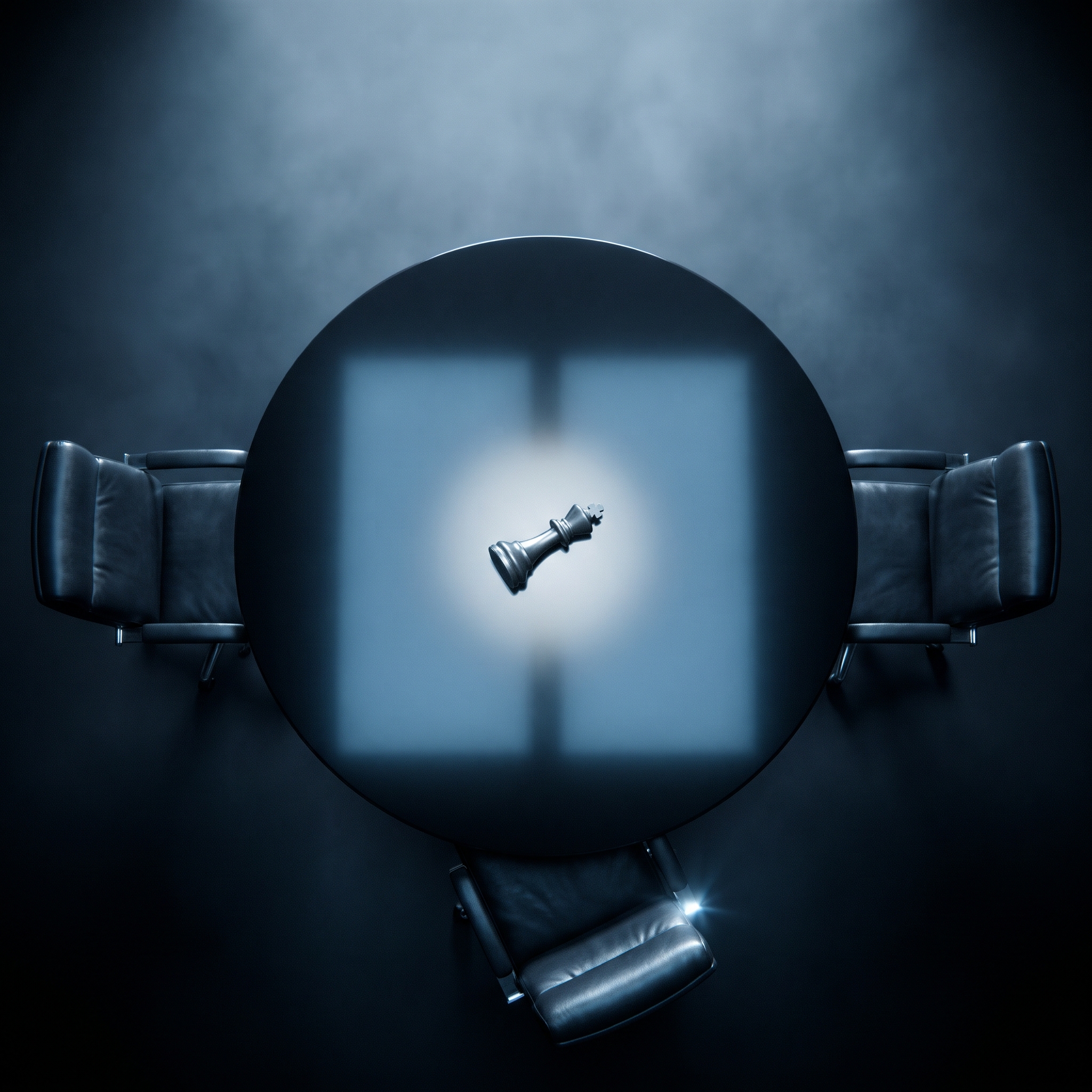
Lila Soto: Hugo, hey, ready? I wanted to start with the setting, because Shenzhen is the city China points to and says look what we built.
Hugo Vance: Yes, Deng's showcase of high-tech advancement. The stage speaks before anyone does.
Lila Soto: Mm, and on that stage, Kylin Villa, November 19th, Trump, Xi, Putin, the first time all three met. Then the verdicts split. Zelenskyy, on the 21st, says 'very unsuccessful' for Russia. A Kremlin aide says Putin left 'in an excellent mood.'
Hugo Vance: Two accounts of one meeting.
Lila Soto: Oh, and I want to leave this sitting here for a second. 111 missiles overnight, after it ended.
Hugo Vance: Well, think of two people leaving a closed-door meeting. Each tells the neighbors it went his way, and the loudest judge is the one who wasn't in the room.
Lila Soto: Huh. So if nothing is announced, who gets to decide what it was?
Hugo Vance: Well, the answer is that the people outside the room fill the silence. Zelenskyy wasn't in Shenzhen. No Ukrainian officials, no Europeans. So what can we actually verify? No announcements. No borders changed. And CNBC reported few concrete outcomes.
Lila Soto: Mm, and that part matches what he said, right? Ukraine not publicly discussed, no borders touched.
Hugo Vance: It matches the public record, yes. But "very unsuccessful for Russia" is a leap from that. And his link between the strike and Putin's reaction is an interpretation. A reasonable one, perhaps, but nobody has shown it.
Lila Soto: Oh, and the Kremlin aide is the same thing in reverse. Putin left "in an excellent mood", from a person whose job is to supply a mood. Huh.
Hugo Vance: Indeed. Though he said something checkable too: that Ukraine was the focus of the U.S.-Russia bilateral. That contradicts Zelenskyy's "not discussed." The sources don't resolve it.
Lila Soto: Wait, can both be true? Not publicly discussed, but privately the focus?
Hugo Vance: Yes, easily. And Washington muddied it. First the signal was that Ukraine was off the table. Then Donald Trump said it would feature, and per Jared Kushner he wanted a deal "with Europe by his side." That's three positions in a few days.
Lila Soto: Mm. So if the failure verdict and the good-mood verdict are both interpretation, what actually moved the needle?
Hugo Vance: Well, what moved the needle may be something that didn't happen. Putin wanted American and Chinese backing for a settlement tilted toward Moscow, a redrawn European security map with NATO rolled back from Eastern Europe. Neither gave it. And Xi was the host.
Lila Soto: Hold on. Rolled back how? Like, what's the ask in plain terms?
Hugo Vance: Spheres of influence. You see, the idea is that a great power gets a zone where its neighbors' choices are, in effect, its own to veto. Putin wanted Eastern Europe recognized as Russia's zone. NATO pulling back is how you'd make that real.
Lila Soto: Oh. So Xi would've had to bless it. And instead he stood up and said abandon "Cold War thinking."
Hugo Vance: Yes. And declined to endorse border changes or any redivision. Not a denunciation of Russia. A refusal to sign.
Lila Soto: Mm, but here's what I keep snagging on. Zelenskyy's line is that China "did not let itself be drawn in." That's a man outside the room, and Beijing hasn't confirmed any of it. So is it principle, or is it just... not wanting to pay for Putin's map?
Hugo Vance: I'd be cautious there. It's an inference, and motives are ambiguous. But Al Jazeera put it well: Xi's strategic power lies in what he chooses not to do.
Lila Soto: Huh. A silence as leverage.
Hugo Vance: Thirty years ago I'd have said China courts great-power status. Now I think it courts great-power deniability. Sit at the table, shape the room, sign nothing that binds you to Moscow's borders. Status demands you own the outcome. Deniability lets you keep the leverage and none of the blame.
Lila Soto: Wait, so a non-answer is the answer? Putin walks out with a photo and no map.
Hugo Vance: Perhaps. And yet, no redivision doesn't mean the summit achieved nothing. There's a second reading, one that Yalta itself helps with, and the thin text of that declaration. We'll come to why that's worse.
Lila Soto: But wait, if Xi signed nothing on borders, what's the worse reading? Hugo, you said Yalta helps with that.
Hugo Vance: Yes. Here's the surprise. Yalta is in Crimea. The 1945 conference sat at the Livadia Palace, territory Russia annexed in 2014. The U.S., Britain and the Soviet Union divided postwar Europe into spheres of influence there. And Putin nodded when asked about 'Yalta 2.'
Lila Soto: He nodded. Oh wow.
Hugo Vance: Now the Poland parallel. Yalta's Declaration on Liberated Europe promised free elections in Poland. Poland's government-in-exile, in London, was not in the room. The declaration reads generously, and the excluded party pays.
Lila Soto: Mm, so bring that to the 'Declaration toward Peace.' Uphold strategic stability, overhaul the United Nations, keep the International Criminal Court 'in check.' Chinese state media and the Kremlin published it. The White House hasn't, as far as the sourcing goes.
Hugo Vance: Quite. And there is no Ukraine deal, no nuclear treaty, no Iran agreement, even though the U.S.-Russia treaty expired in February.
Lila Soto: Okay, picture a Tuesday morning in Warsaw or Tallinn. A staffer opens the Xinhua text over coffee, hunting for one sentence about Ukraine. There isn't one. And she still briefs the minister by noon. What do you even say?
Hugo Vance: You say the text isn't the news. Well, I think that's the hardest fact. Three powers wrote rules for the UN and the ICC, and nobody from Europe or Ukraine helped write them. The club existing may be what Putin got.
Lila Soto: Oh. So the photo is the outcome.
Hugo Vance: Perhaps. Let me limit my claim, though. Yalta didn't cause the division of Europe. Soviet armies on the ground did. So the question is what facts on the ground Shenzhen reflects.
Lila Soto: And Europe seems to feel it. Jared Kushner and Steve Witkoff met Zelenskyy in Berlin, with more than 40 European leaders in the room.
Hugo Vance: Yes. A counter-mobilization. That's the fear of being sidelined, made visible.
Lila Soto: I keep thinking about that staffer, still at her desk, note unwritten. And the 111 missiles are sitting right next to it. Does she put them in the note? Or do they belong in a different folder, as if they weren't part of the same week?
Hugo Vance: Well, she'd have to put them in. And beside them, the gap Zelenskyy named on November 21. Full NATO membership, he said, is still Ukraine's clearest and most cost-effective guarantee. Kyiv has no formal written Article 5-style commitment from anyone. Yes, that is the fact on the ground. Nothing in Shenzhen changed it. Now, what might settle who came out ahead is plain enough. Do the three leaders meet again? Miami and the G20 is one possibility. And does anyone from Europe or Ukraine get a seat? Summits are judged by what is built afterward, not by what is said at the table.
Lila Soto: Mm. Then the photo at Kylin Villa is just a down payment, and we can't tell yet what it's buying. Putin got a club, Xi got his deniability, and Ukraine got more missiles. I'm still turning over whether the photo becomes the outcome if no one builds anything after it. I don't have an answer.